







Question: Please read here and not only look at picture. question 2 please and thank you! Project 2 Estimating Rate Constants for an Open Two-Compartment Model
Please read here and not only look at picture.
question 2 please and thank you!
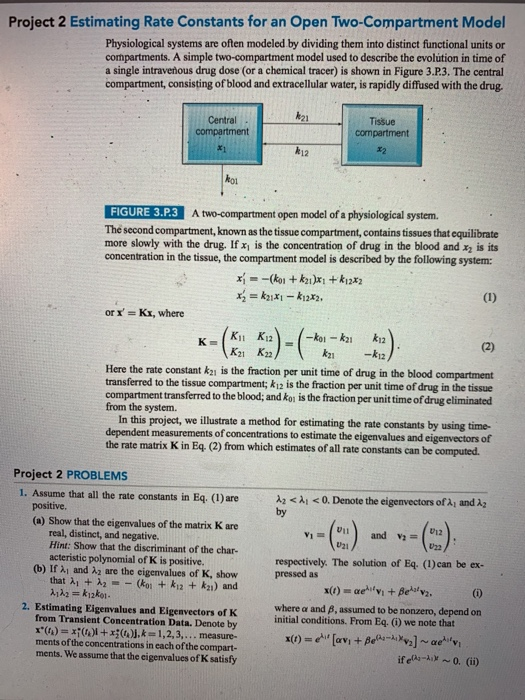
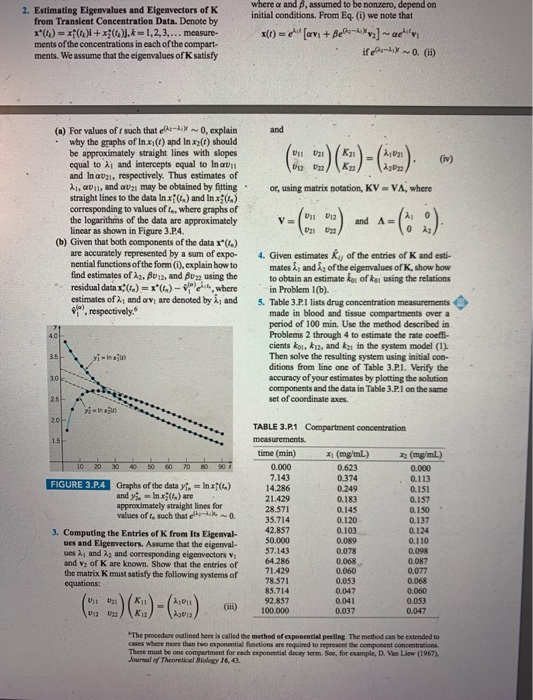
Project 2 Estimating Rate Constants for an Open Two-Compartment Model Physiological systems are often modeled by dividing them into distinct functional units or compartments. A simple two-compartment model used to describe the evolution in time of a single intravenous drug dose (or a chemical tracer) is shown in Figure 3.P.3. The central compartment, consisting of blood and extracellular water, is rapidly diffused with the drug. Central compartment Tissue compartment FIGURE 3.P.3 A two-compartment open model of a physiological system. The second compartment, known as the tissue compartment, contains tissues that equilibrate more slowly with the drug. Ifx, is the concentration of drug in the blood and X, is its concentration in the tissue, the compartment model is described by the following system: x =-koi + kai)x +k1212 = k2321 - 132. or x = kx, where K-(Ki K12 / -koi- kai k12 (2) K22/ k21 -kz Here the rate constant ki is the fraction per unit time of drug in the blood compartment transferred to the tissue compartment; kz is the fraction per unit time of drug in the tissue compartment transferred to the blood; and kor is the fraction per unit time of drug eliminated from the system. In this project, we illustrate a method for estimating the rate constants by using time dependent measurements of concentrations to estimate the eigenvalues and eigenvectors of the rate matrix K in Eq. (2) from which estimates of all rate constants can be computed. Az
Step by Step Solution
There are 3 Steps involved in it

Get step-by-step solutions from verified subject matter experts
 Study Help