Question: please read the article and briefly summarize it. 2012 Ral Publishing Quality in Primary Care 2012:20:115-23 Research paper Effective recruitment strategies in primary care research:
please read the article and briefly summarize it.
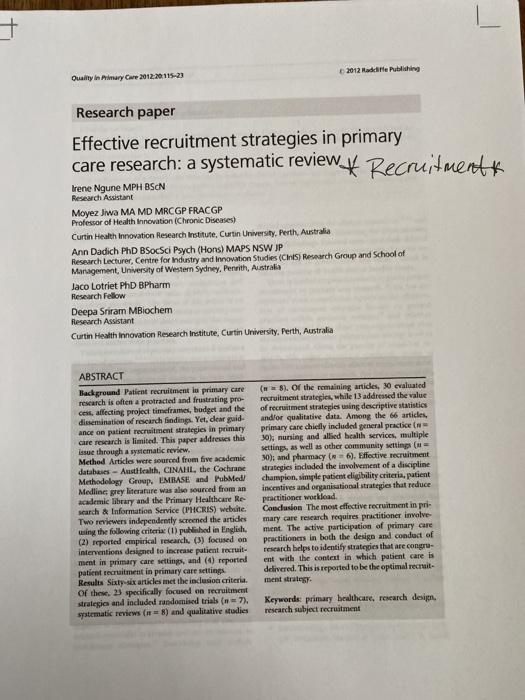
2012 Ral Publishing Quality in Primary Care 2012:20:115-23 Research paper Effective recruitment strategies in primary care research: a systematic review * Recruitment Irene Ngune MPH BSN Resench Assistant Moyez Jiwa MA MD MRCGP FRACGP Professor of Health Innovation (Chronic Diseases) Curtin Health Innovation Research Institute, Curtin University, Perth, Australia Ann Dadich PhD BSocSci Psych (Hons) MAPS NSW JP Research Lecturer, Centre for Industry and Innovation Studies (Cinis) Research Group and School of Management University of Western Sydney, Penrith, Australia Jaco Lotriet PhD BPharm Research Fellow Deepa Sriram MBiochem Research Assistant Curtin Health Innovation Research Institute, Curtin University, Perth, Australia ABSTRACT Background Patient recruitment la primary care research is often a protracted and frustrating pro- cent, affecting project timeframes, budget and the dissemination of research findings. Yet, dear guid- ance on patient recruitment strategies in primary care research is limited. This paper addresses this issue through a systematic review, Method Articles were sourced from five academic databases - Austhealth, CINAHL, the Cochrane Methodology Group, EMBASE and PubMed/ Medline: grey literature was also sourced from an academic library and the Primary Healthcare Re search & Information Service (PHCRIS) webuite. Two reviewers independently screened the articles using the following criteria (1) published in English, (2) reported empirical research (3) focused on interventions designed to increase patient recruit ment in primary care settings, and (t) reported patient recruitment in primary care settings Results Sixty-six articles met the inclusion criteria. of these. 23 specifically focused on recruitment strategies and included randomised trials (n=7). systematic reviews ( = ) and qualitative studies (8). Or the remaining artides, 0 evaluated recruitment strategies, while 13 addressed the value of recruitment strategies using descriptive statistics and/or qualitative data. Among the 66 articles primary care chiefly included general practice 30), nursing and allied health services multiple settings, as well as other community settings (n = 30): and pharmacy (6). Effective recruitment strategies incaded the involvement of a discipline champion, simple patient digibility criteria.patient incentives and organisational strategies that reduce practitioner workload. Conclusion The most effective recruitment in pri- mary care research requires practitioner involve ment. The active participation of primary care practitioners in both the design and conduct of research helps to identify strategies that are congru- ent with the context in which patient care is delivered. This is reported to be the optimal recruit ment strategy Keywords: primary healthcare, research design research subject recruitment - 116 Ngune, Mwa. A Dadich et al How this fits in with quality in primary care What do we know Recruitment delays are common in primary care reach. Delays can adversely impact the research and the cothusiasm for research in primary care. Few studies report on eccelstrategies for patient recruitment to primary care research What does this paper add The recruitment of primary care site can be added by the involvement of a discipline champion. Patient recruitment can be aided by simple patient eligibility criteria, patient rather than inician) Incentives and organisational strategies that reduce practitioner workload. Introduction missed opportunities for clinical innovation and publication delays, the hindering the dissemination of research findings. Personal costs can include delayed patient access to innovative treatments, because re- sults may not be generalisable and valid," which in Turn can prolong ill-health and/or burden carers. There is limited empirical research to guide patient recruitment to primary care research. With few ceptions.. most research that reports on the efective ness of recruitment strategies focuses on gencral practices within academic settings, and wherber lessons garnered from these non-conventional sites readily translate to other primary care settings is yet to be determined. Given the paucity of empirical e scarch, this paper presents a systematic review of ettant literature to identify effective recruitment strat egies in primary care research. For the purpose of this review, effectiveness is understood to bolster the identification of eligible patients, the representative ness of the sample, participant retention or cost efficiencies. The effective recruitment of patients for research typically involves identifying eligible populations, securing an adequate and/or representative sample, retaining participants until study completion and minimising the cost-benefit ratio, all while maintain ing ethical standards. The focus of this article is on strategies that help to recruit patients to primary care research. This includes both direct strategies that engage the patient, as well as indirect strategies that engage clinicians and/or their practices. Patient recruitment in primary care research is often a protracted process. This is largely due to barriers at three levels - the organisational, the professional and the patient. Organisational barriers include inad- equate resource allocation, governance arrangements that hamper decision making. 2. ineffective com munication channels and administrative issues. A systematic review of participation in randomised controlled trials identified a number of professional and patient barriers. The authors reported: Clinician barriers included time constraints lack of staff and training worry about the impact on the decor patient relationships concern for patients, of profes wonal autonomy, difficulty with the con procedure lack of rewards and recognition and an insufficiently interesting question. Patient barriers included additional demands of the trial patient preferences worry caused by uncertainty and concerns about information and on Ment." To this list, others have added patients' asumptions that they have little to contribute, as well as concern over rearch processes. Collectively, these barriers can impede the effective recruitment of patients to primary care research Ineffective patient recruitment can be costly. These includes economic costs, knowledge costs and per- sonal costs Economic costs include the resources required to extend projects (including staff time and research materials) to identify and execute innovative recruitment strategies. Knowledge costs include Methods The aim of this systematic review was to identify effective patient recruitment strategies in primary care research. A search strategy was developed and tested to electronically source articles published in English from six academic databases - Austhealth (an Australian Catalogue of nine repositories of health information), CINAHL, the Cochrane Methodology Group, EMBASE, the Primary Health Care Research & Information Service (PHORIS) and PubMed/Medline. These were searched in July 2010, employing the following strategy using Medical Subject Headings (MeSH): Family practice [mb] OR primary healthcare mh] AND Epidemiologic Study Characteristics as Topic (mh) OR Evaluation Studies as Topic [m] OR health Effective recruitment strategies in primary care research 117 were included in the review (see Figure 1). Divergent opinion was resolved by reviewing the full text of the article to determine whether it met the selection criteria From the identified articles, the following infor- mation was extracted (when available) and tabulated for narrative interpretation study design (randomised controlled trial, RCT, systematic review of qualitative study); research setting (general practke, community or pharmacyk recruitment method(s) (post. waiting room or telephone and duration of recruitment Only the reported effectiveness of recruitment strat- gles on patient recruitment is presented here. Results services research Im OR research design mh] OR research mh! AND Patient selection (mh OR patient participation [mh] OR patient recruitment In total, 1025 references were identified after using the search strategy, all of which were added to an EndNote library for review Using keywords (namely, primary healthcare, re- cruitment primary healthcare practitioner, patient participation and patient recruitment), this was complemented by a search of grey literature sourced from both the Curtin University library and the PHCRIS website. Eighty references were found using this strategy, which were added to the EndNote library. All duplicates were removed, yielding a total of 945 references Titles and abstracts of the 945 references were independently reviewed by two reviewers (IN and MT) using the following inclusion criteria: article represents a research article (rather than a letter or commentary) research context is primary care that is settings in which health practitioners are the first point of consultation for patients primary focus is to determine the effectiveness of a patient recruitment strategy - this includes those targeted at the patient, the practitioner, and/or the health service Following this, 879 articles were excluded for not meeting the inclusion criteria or not addressing the recruitment strategy per s. The reviewers reached consensus on the remaining 66 artides, all of which of the 66 articles that met the inclusion criteris, the largest proportion reported RCT's (-23), followed by qualitative studies (n=19) and systematic reviews ( - 15). The remaining articles reported cross-sec- tional studies (n=5), case-control studies (n=2) and retrospective studies (x=2). Approximately one-third of the articles focused solely on recruitment strategies ( 123). Their ca- pacity to recruit patients was tested via RCTS (7) systematic reviews (3) and qualitative studies ( -8). The remaining articles conveyed the effectiveness of chosen recruitment strategies as part of the method ology or results (n=43). Among the 66 articles, research settings primarily included general practice (30). pharmacies (16) Identification Number of records identified through database searching:1025 (AustHealth, 7: CINAHL, 124 Cochrane Methodology Group. 150 EMBASE, 120. PubMed/Medine, 384 Number of records identified through other sourcos: 65 Screening Number of records after duplicates removed: 945 Number of records screened: 945 > Number of records excluded: 879 Eligibility Number of l-text articles assessed for eligibility: 66 Number of full-text articles excluded, with reasons: 0 Included Number of studies included in systematic review: 66 Figure 1 PRISMA flowchart









 Study Help