Question: please read the article and sumarize it. PROCON... MINIMUM WAGE 2328 CUADES ZEN 32BJ SER HTC SEI 15 32BJ CTO TAP EH ORIES $15 DES
please read the article and sumarize it.
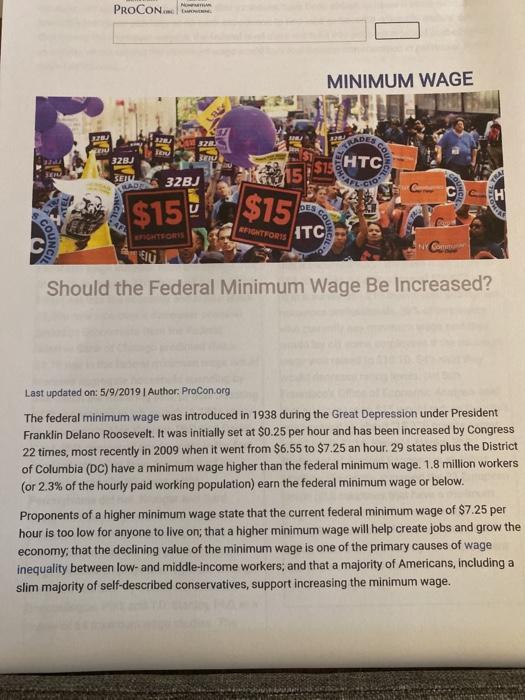
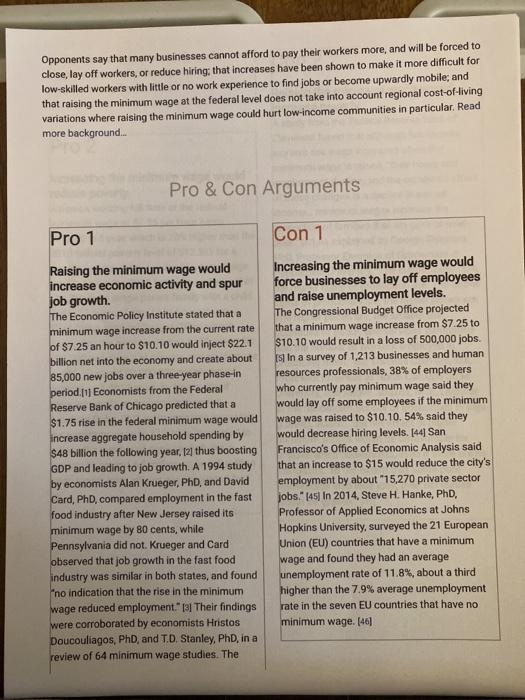
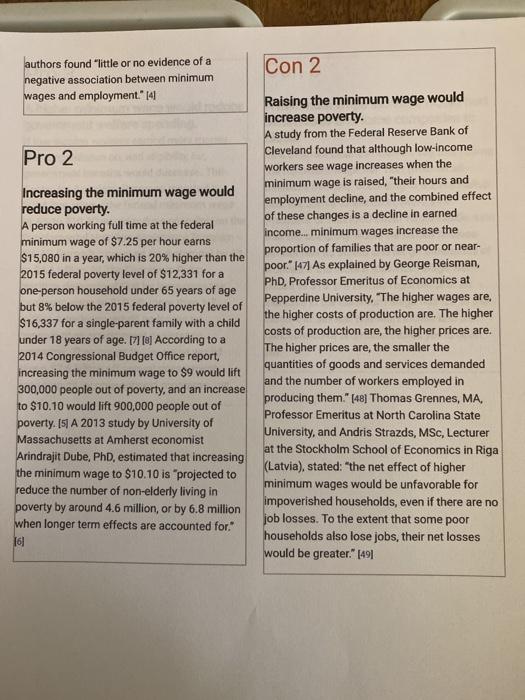
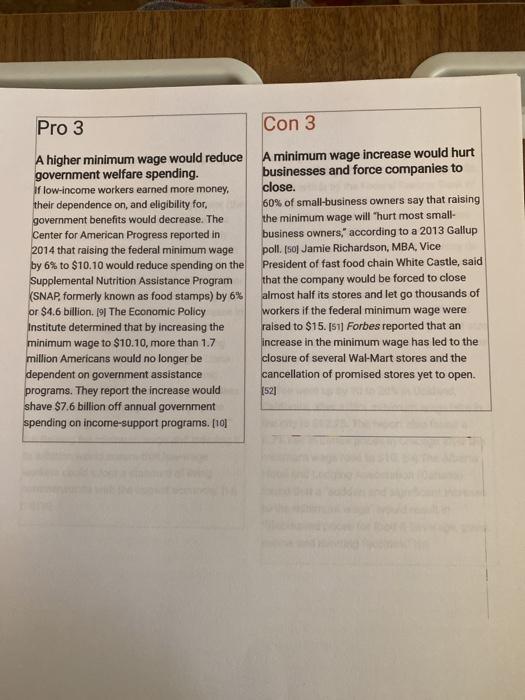
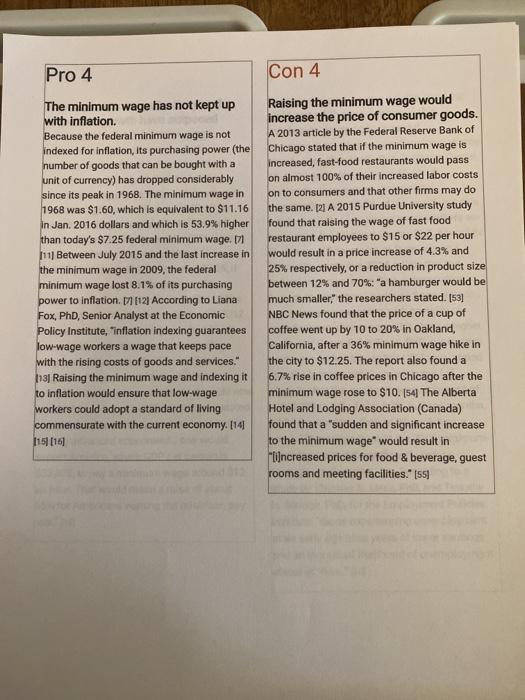
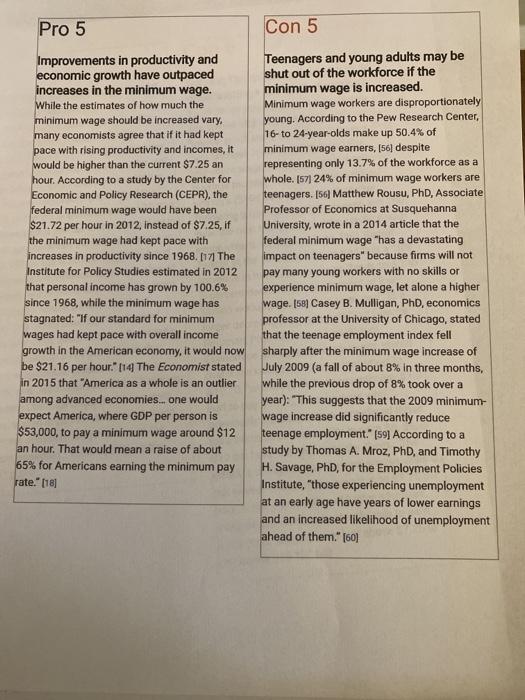
PROCON... MINIMUM WAGE 2328 CUADES ZEN 32BJ SER HTC SEI 15 32BJ CTO TAP EH ORIES $15 DES $159 CO EPIGT FOR 15 COUNC ITC EU Com Should the Federal Minimum Wage Be Increased? Last updated on: 5/9/2019 | Author: ProCon.org The federal minimum wage was introduced in 1938 during the Great Depression under President Franklin Delano Roosevelt. It was initially set at $0.25 per hour and has been increased by Congress 22 times, most recently in 2009 when it went from $6.55 to $7.25 an hour. 29 states plus the District of Columbia (DC) have a minimum wage higher than the federal minimum wage. 1.8 million workers (or 2.3% of the hourly paid working population) earn the federal minimum wage or below. Proponents of a higher minimum wage state that the current federal minimum wage of $7.25 per hour is too low for anyone to live on; that a higher minimum wage will help create jobs and grow the economy, that the declining value of the minimum wage is one of the primary causes of wage inequality between low- and middle-income workers; and that a majority of Americans, including a slim majority of self-described conservatives, support increasing the minimum wage. Opponents say that many businesses cannot afford to pay their workers more, and will be forced to close, lay off workers, or reduce hiring: that increases have been shown to make it more difficult for low-skilled workers with little or no work experience to find jobs or become upwardly mobile, and that raising the minimum wage at the federal level does not take into account regional cost-of-living variations where raising the minimum wage could hurt low-income communities in particular Read more background. Pro & Con Arguments Pro 1 Con 1 Raising the minimum wage would increase economic activity and spur Job growth. The Economic Policy Institute stated that a minimum wage increase from the current rate of $7.25 an hour to $10.10 would inject $22.1 billion net into the economy and create about 85,000 new jobs over a three-year phase-in period. (1 Economists from the Federal Reserve Bank of Chicago predicted that a $1.75 rise in the federal minimum wage would increase aggregate household spending by 548 billion the following year, 121 thus boosting GDP and leading to job growth. A 1994 study by economists Alan Krueger, PhD, and David Card, PhD, compared employment in the fast food industry after New Jersey raised its minimum wage by 80 cents, while Pennsylvania did not. Krueger and Card observed that job growth in the fast food industry was similar in both states, and found "no indication that the rise in the minimum wage reduced employment 131 Their findings were corroborated by economists Hristos Doucouliagos, PhD, and T.D. Stanley, PhD in a review of 64 minimum wage studies. The Increasing the minimum wage would force businesses to lay off employees and raise unemployment levels. The Congressional Budget Office projected that a minimum wage increase from $7.25 to $10.10 would result in a loss of 500,000 jobs Is in a survey of 1,213 businesses and human resources professionals, 38% of employers who currently pay minimum wage said they would lay off some employees if the minimum wage was raised to $10.10.54% said they would decrease hiring levels. [44] San Francisco's Office of Economic Analysis said that an increase to $15 would reduce the city's employment by about "15,270 private sector jobs." [45] In 2014, Steve H. Hanke, PhD, Professor of Applied Economics at Johns Hopkins University, surveyed the 21 European Union (EU) countries that have a minimum wage and found they had an average unemployment rate of 11.8%, about a third higher than the 7.9% average unemployment rate in the seven EU countries that have no minimum wage. (461 Con 2 authors found "little or no evidence of a negative association between minimum wages and employment." 141 Pro 2 Increasing the minimum wage would reduce poverty. A person working full time at the federal minimum wage of $7.25 per hour earns $15,080 in a year, which is 20% higher than the 2015 federal poverty level of $12,331 for a one person household under 65 years of age but 8% below the 2015 federal poverty level of $16,337 for a single-parent family with a child under 18 years of age. [7] [8] According to a 2014 Congressional Budget Office report, increasing the minimum wage to $9 would lift 300,000 people out of poverty, and an increase to $10.10 would lift 900,000 people out of poverty. (5 A 2013 study by University of Massachusetts at Amherst economist Arindrajit Dube, PhD, estimated that increasing the minimum wage to $10.10 is "projected to reduce the number of non-elderly living in poverty by around 4.6 million, or by 6.8 million when longer term effects are accounted for." 16] Raising the minimum wage would increase poverty. A study from the Federal Reserve Bank of Cleveland found that although low-income workers see wage increases when the minimum wage is raised, "their hours and employment decline, and the combined effect of these changes is a decline in earned income... minimum wages increase the proportion of families that are poor or near- poor." 147] As explained by George Reisman, PhD, Professor Emeritus of Economics at Pepperdine University. The higher wages are, the higher costs of production are. The higher costs of production are, the higher prices are. The higher prices are, the smaller the quantities of goods and services demanded and the number of workers employed in producing them." [48] Thomas Grennes, MA, Professor Emeritus at North Carolina State University, and Andris Strazds, MSc, Lecturer at the Stockholm School of Economics in Riga (Latvia), stated: "the net effect of higher minimum wages would be unfavorable for impoverished households, even if there are no job losses. To the extent that some poor households also lose jobs, their net losses would be greater." [491 Pro 3 Con 3 A higher minimum wage would reduce government welfare spending. If low-income workers earned more money, their dependence on, and eligibility for, government benefits would decrease. The Center for American Progress reported in 2014 that raising the federal minimum wage by 6% to $10.10 would reduce spending on the Supplemental Nutrition Assistance Program (SNAP, formerly known as food stamps) by 6% or $4.6 billion. [9] The Economic Policy Institute determined that by increasing the minimum wage to $10.10, more than 1.7 million Americans would no longer be dependent on government assistance programs. They report the increase would shave $7.6 billion off annual government spending on income-support programs. [10] A minimum wage increase would hurt businesses and force companies to close. 60% of small-business owners say that raising the minimum wage will "hurt most small- business owners, according to a 2013 Gallup poll. (soj Jamie Richardson, MBA, Vice President of fast food chain White Castle, said that the company would be forced to close almost half its stores and let go thousands of workers if the federal minimum wage were raised to $15. [51] Forbes reported that an increase in the minimum wage has led to the closure of several Wal-Mart stores and the cancellation of promised stores yet to open. [52] Pro 4 Con 4 The minimum wage has not kept up with inflation. Because the federal minimum wage is not Indexed for inflation, Its purchasing power (the number of goods that can be bought with a unit of currency) has dropped considerably since its peak in 1968. The minimum wage in 1968 was $1.60, which is equivalent to $11.16 In Jan. 2016 dollars and which is 53.9% higher than today's $7.25 federal minimum wage 1 111) Between July 2015 and the last increase in the minimum wage in 2009, the federal minimum wage lost 8.1% of its purchasing power to inflation. 11 1121 According to Liana Fox, PhD, Senior Analyst at the Economic Policy Institute, "inflation indexing guarantees low-wage workers a wage that keeps pace with the rising costs of goods and services." 113] Raising the minimum wage and indexing it to inflation would ensure that low-wage workers could adopt a standard of living commensurate with the current economy. [14] 115] [16] Raising the minimum wage would increase the price of consumer goods. A 2013 article by the Federal Reserve Bank of Chicago stated that if the minimum wage is increased, fast-food restaurants would pass on almost 100% of their increased labor costs on to consumers and that other firms may do the same. 21 A 2015 Purdue University study found that raising the wage of fast food restaurant employees to $15 or $22 per hour would result in a price increase of 4.3% and 25% respectively, or a reduction in product size between 12% and 70%: "a hamburger would be much smaller the researchers stated. [53] NBC News found that the price of a cup of coffee went up by 10 to 20% in Oakland, California, after a 36% minimum wage hike in the city to $12.25. The report also found a 6.7% rise in coffee prices in Chicago after the minimum wage rose to $10.154] The Alberta Hotel and Lodging Association (Canada) found that a "sudden and significant increase to the minimum wage would result in increased prices for food & beverage, guest rooms and meeting facilities." [55] Pro 5 Con 5 Improvements in productivity and economic growth have outpaced increases in the minimum wage. While the estimates of how much the minimum wage should be increased vary, many economists agree that if it had kept pace with rising productivity and incomes, would be higher than the current $7.25 an hour. According to a study by the Center for Economic and Policy Research (CEPR), the federal minimum wage would have been $21.72 per hour in 2012, Instead of $7.25, if the minimum wage had kept pace with increases in productivity since 1968. [17] The Institute for Policy Studies estimated in 2012 that personal income has grown by 100.6% since 1968, while the minimum wage has stagnated: "If our standard for minimum wages had kept pace with overall income growth in the American economy, it would now be $21.16 per hour." 114 The Economist stated in 2015 that America as a whole is an outlier among advanced economies... one would expect America, where GDP per person is $53,000, to pay a minimum wage around $12 an hour. That would mean a raise of about 65% for Americans earning the minimum pay rate." [18] Teenagers and young adults may be shut out of the workforce if the minimum wage is increased. Minimum wage workers are disproportionately young. According to the Pew Research Center, 16- to 24-year-olds make up 50.4% of minimum wage earners, (56) despite representing only 13.7% of the workforce as a whole. [57] 24% of minimum wage workers are teenagers. [56] Matthew Rousu, PhD, Associate Professor of Economics at Susquehanna University, wrote in a 2014 article that the federal minimum wage "has a devastating impact on teenagers" because firms will not pay many young workers with no skills or experience minimum wage, let alone a higher wage. [58] Casey B. Mulligan, PhD, economics professor at the University of Chicago, stated that the teenage employment index fell sharply after the minimum wage increase of July 2009 (a fall of about 8% in three months, while the previous drop of 8% took over a year): "This suggests that the 2009 minimum- wage increase did significantly reduce teenage employment." (59) According to a study by Thomas A. Mroz, PhD, and Timothy H. Savage, PhD, for the Employment Policies Institute, "those experiencing unemployment at an early age have years of lower earnings and an increased likelihood of unemployment ahead of them." [60]









 Study Help