







Question: Please read the article below and write approximately a 3-page response to the following questions: Promoting Racial Equity in the Workplace: Harvard Business Review 1.
Please read the article below and write approximately a 3-page
 response to the following questions: Promoting Racial Equity in the Workplace: Harvard Business Review
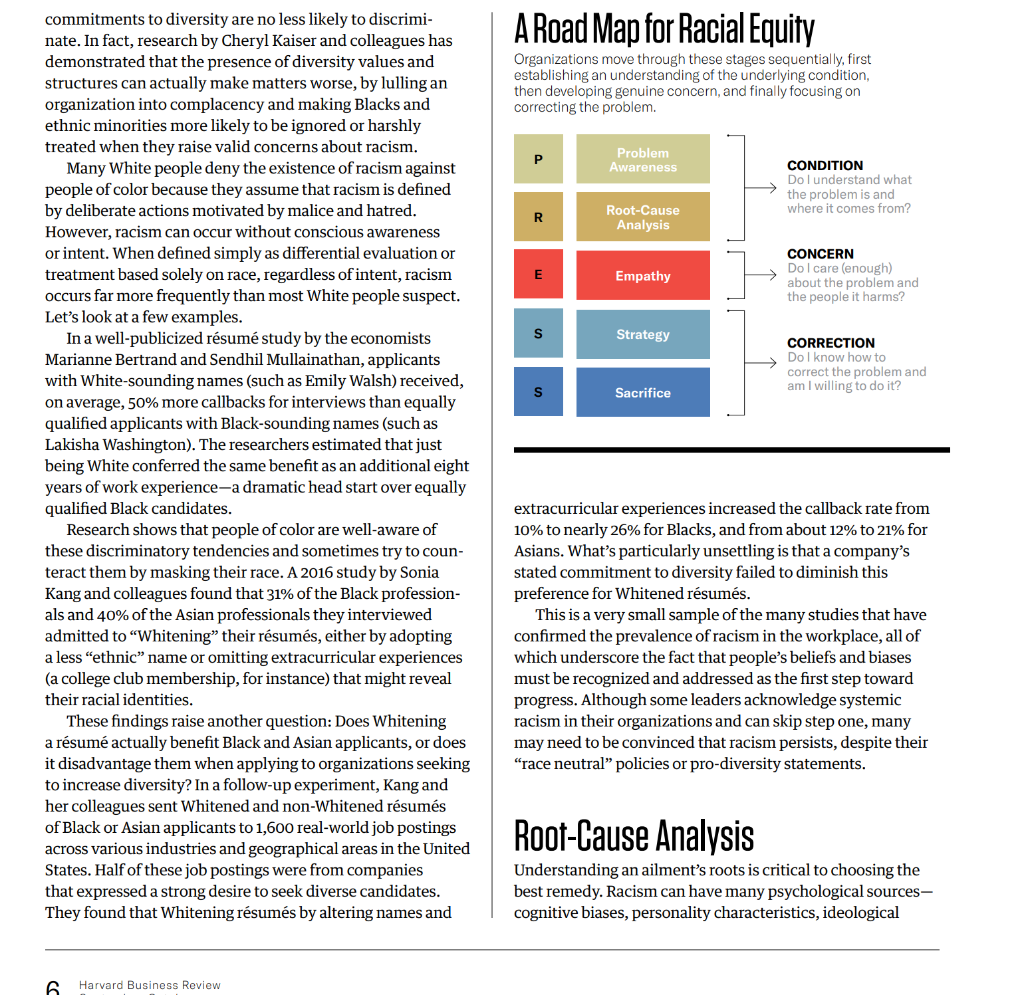
1. Discuss, in your own words, each of the 5 stages in the author's PRESS model.
2. What challenges are there to progressing through each stage?
3. Were you surprised by anything you read in this article?
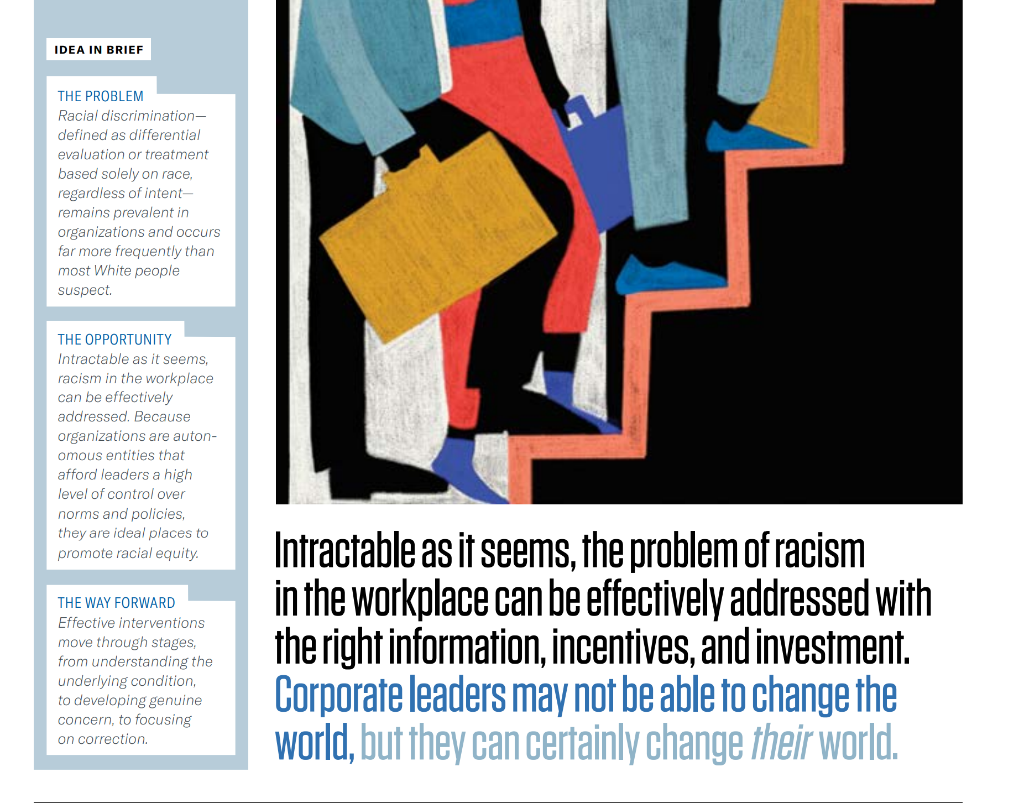
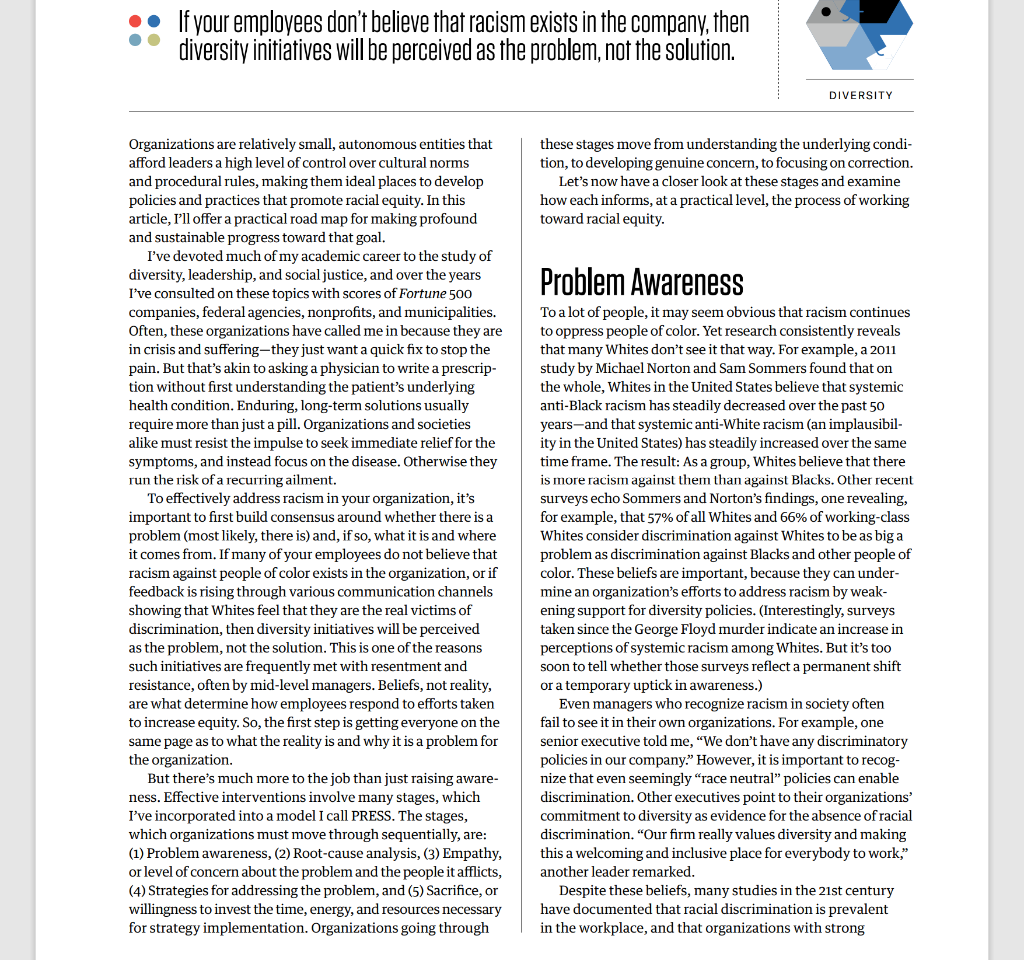
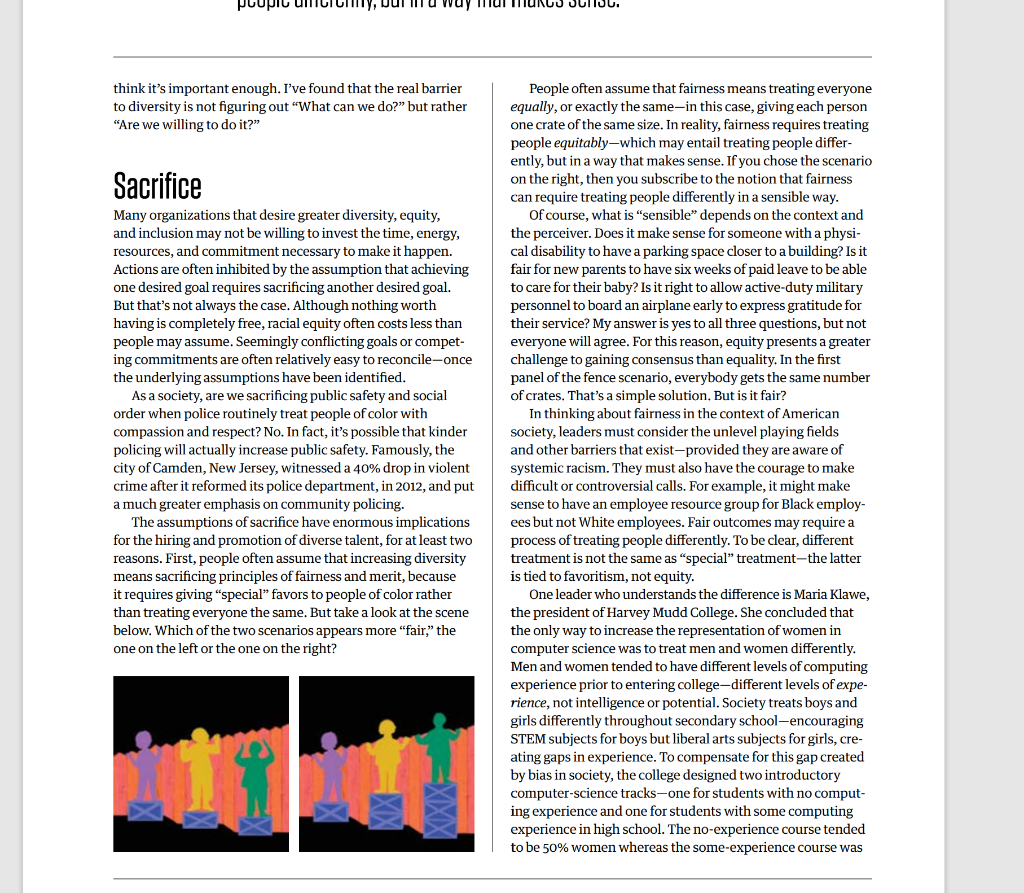
Haryard Business Review ARTICLE How to Promote Racial Equity in the Workplace Intractable as it seems, the problem of racism in the workplace can be effectively addressed with the right information, incentives, and investment. Corporate leaders may not be able to change the world, but they can certainly change their world. If your emplovees don't believe that racism exists in the company, then diversity initiatives will be perceived as the problem, not the solution. commitments to diversity are no less likely to discriminate. In fact, research by Cheryl Kaiser and colleagues has demonstrated that the presence of diversity values and structures can actually make matters worse, by lulling an organization into complacency and making Blacks and ethnic minorities more likely to be ignored or harshly treated when they raise valid concerns about racism. Many White people deny the existence of racism against people of color because they assume that racism is defined by deliberate actions motivated by malice and hatred. However, racism can occur without conscious awareness or intent. When defined simply as differential evaluation or treatment based solely on race, regardless of intent, racism occurs far more frequently than most White people suspect. Let's look at a few examples. In a well-publicized rsum study by the economists Marianne Bertrand and Sendhil Mullainathan, applicants with White-sounding names (such as Emily Walsh) received, on average, 50% more callbacks for interviews than equally qualified applicants with Black-sounding names (such as Lakisha Washington). The researchers estimated that just being White conferred the same benefit as an additional eight years of work experience-a dramatic head start over equally qualified Black candidates. A Road Map for Racial Equity Organizations move through these stages sequentially, first establishing an understanding of the underlying condition, then developing genuine concern, and finally focusing on correcting the problem. CONDITION Do l understand what the problem is and where it comes from? CORRECTION Do l know how to am I willing to do it? out "What can we do?" but rather "Are we willing to do it?" DIVERSITY their non-White coworkers share vivid, detailed accounts of the negative impact that racism has on their lives. Managers can raise awareness and empathy through psychologically safe listening sessions-for employees who want to share their experiences, without feeling obligated to do so- To most effectively combat discrimination in the worksupplemented by education and experiences that provide without any attempt to create buy-in from employees is historical and scientific evidence of the persistence of racism. likely to produce a backlash. Likewise, focusing just on For example, I spoke with Mike Kaufmann, CEO of changing attitudes without also establishing institutional Cardinal Health-the 16th largest corporation in America- policies that hold people accountable for their decisions who credited a visit to the Equal Justice Initiative's National and actions may generate little behavioral change among Memorial for Peace and Justice, in Montgomery, Alabama as those who don't agree with the policies. Establishing an a pivotal moment for the company. While diversity and inclu- anti-racist organizational culture, tied to core values and sion initiatives have been a priority for Mike and his leader- modeled by behavior from the CEO and other top leaders ship team for well over a decade, their focus and conversa- at the company, can influence both individual attitudes tions related to racial inclusion increased significantly during and institutional policies. 2019. As he expressed to me, "Some Americans think when Just as there is no shortage of effective strategies for losing slavery ended in the 1860 s that African Americans have had weight or promoting environmental sustainability, there are an equal opportunity ever since. That's just not true. Insti- ample strategies for reducing racial bias at the individual, tutional systemic racism is still very much alive today; it's cultural, and institutional levels. The hard part is getting never gone away." Kaufmann is planning a comprehensive people to actually adopt them. Even the best strategies are education program, which will include a trip for executives worthless without implementation. and other employees to visit the museum, because he is I'll discuss how to increase commitment to execution convinced that the experience will change hearts, open eyes, in the final section. But before I do, I want to give a specific and drive action and behavioral change. example of an institutional strategy that works. It comes Empathy is critical for making progress toward racial from Massport, a public organization that owns Boston equity because it affects whether individuals or organiza- Logan International Airport and commercial lots worth tions take any action and if so, what kind of action they take. billions of dollars. When its leaders decided they wanted There are at least four ways to respond to racism: join in and to increase diversity and inclusion in real estate developadd to the injury, ignore it and mind your own business, ment in Boston's booming Seaport District, they decided experience sympathy and bake cookies for the victim, or to leverage their land to do it. Massport's leaders made experience empathic outrage and take measures to promote formal changes to the selection criteria determining who equal justice. The personal values of individual employees is awarded lucrative contracts to build and operate hotels and the core values of the organization are two factors that and other large commercial buildings on their parcels. In affect which actions are undertaken. addition to evaluating three traditional criteria-the developer's experience and financial capital, Massport's revenue potential, and the project's architectural design-they Qtrategy added a fourth criterion called "comprehensive diversity After the foundation has been laid, it's finally time for the and inclusion," which accounted for 25% of the proposal overall score, the same as the other three. This forced "what do we do about it" stage. Most actionable strategies developers not only to think more deeply about how to for change address three distinct but interconnected catego- create diversity but also to go out and do it. Similarly, ries: personal attitudes, informal cultural norms, and formal organizations can integrate diversity and inclusion into institutional policies. managers' scorecards for raises and promotions-if they think it's important enough. I've found that the real barrier People often assume that fairness means treating everyone to diversity is not figuring out "What can we do?" but rather equally, or exactly the same-in this case, giving each person "Are we willing to do it?" one crate of the same size. In reality, fairness requires treating people equitably -which may entail treating people differently, but in a way that makes sense. If you chose the scenario on the right, then you subscribe to the notion that fairness can require treating people differently in a sensible way. and inclusion may not be willing to invest the time, energy, the perceiver. Does it make sense for someone with a physiresources, and commitment necessary to make it happen. cal disability to have a parking space closer to a building? Is it Actions are often inhibited by the assumption that achieving fair for new parents to have six weeks of paid leave to be able one desired goal requires sacrificing another desired goal. to care for their baby? Is it right to allow active-duty military But that's not always the case. Although nothing worth personnel to board an airplane early to express gratitude for having is completely free, racial equity often costs less than their service? My answer is yes to all three questions, but not people may assume. Seemingly conflicting goals or compet- everyone will agree. For this reason, equity presents a greater ing commitments are often relatively easy to reconcile-once challenge to gaining consensus than equality. In the first the underlying assumptions have been identified. panel of the fence scenario, everybody gets the same number As a society, are we sacrificing public safety and social of crates. That's a simple solution. But is it fair? order when police routinely treat people of color with In thinking about fairness in the context of American compassion and respect? No. In fact, it's possible that kinder society, leaders must consider the unlevel playing fields policing will actually increase public safety. Famously, the and other barriers that exist-provided they are aware of city of Camden, New Jersey, witnessed a 40% drop in violent systemic racism. They must also have the courage to make crime after it reformed its police department, in 2012, and put difficult or controversial calls. For example, it might make a much greater emphasis on community policing. sense to have an employee resource group for Black employ- The assumptions of sacrifice have enormous implications ees but not White employees. Fair outcomes may require a for the hiring and promotion of diverse talent, for at least two process of treating people differently. To be clear, different reasons. First, people often assume that increasing diversity treatment is not the same as "special" treatment-the latter means sacrificing principles of fairness and merit, because is tied to favoritism, not equity. it requires giving "special" favors to people of color rather One leader who understands the difference is Maria Klawe, than treating everyone the same. But take a look at the scene the president of Harvey Mudd College. She concluded that below. Which of the two scenarios appears more "fair," the the only way to increase the representation of women in one on the left or the one on the right? computer science was to treat men and women differently. Men and women tended to have different levels of computing experience prior to entering college-different levels of experience, not intelligence or potential. Society treats boys and girls differently throughout secondary school-encouraging STEM subjects for boys but liberal arts subjects for girls, creating gaps in experience. To compensate for this gap created by bias in society, the college designed two introductory computer-science tracks-one for students with no computing experience and one for students with some computing experience in high school. The no-experience course tended to be 50% women whereas the some-experience course was
Step by Step Solution
There are 3 Steps involved in it

Get step-by-step solutions from verified subject matter experts
 Study Help