Question: Please read the Case Study and answer following Questions 1. How do you describe that everyone of us is a salesperson? 2. Imagine you are
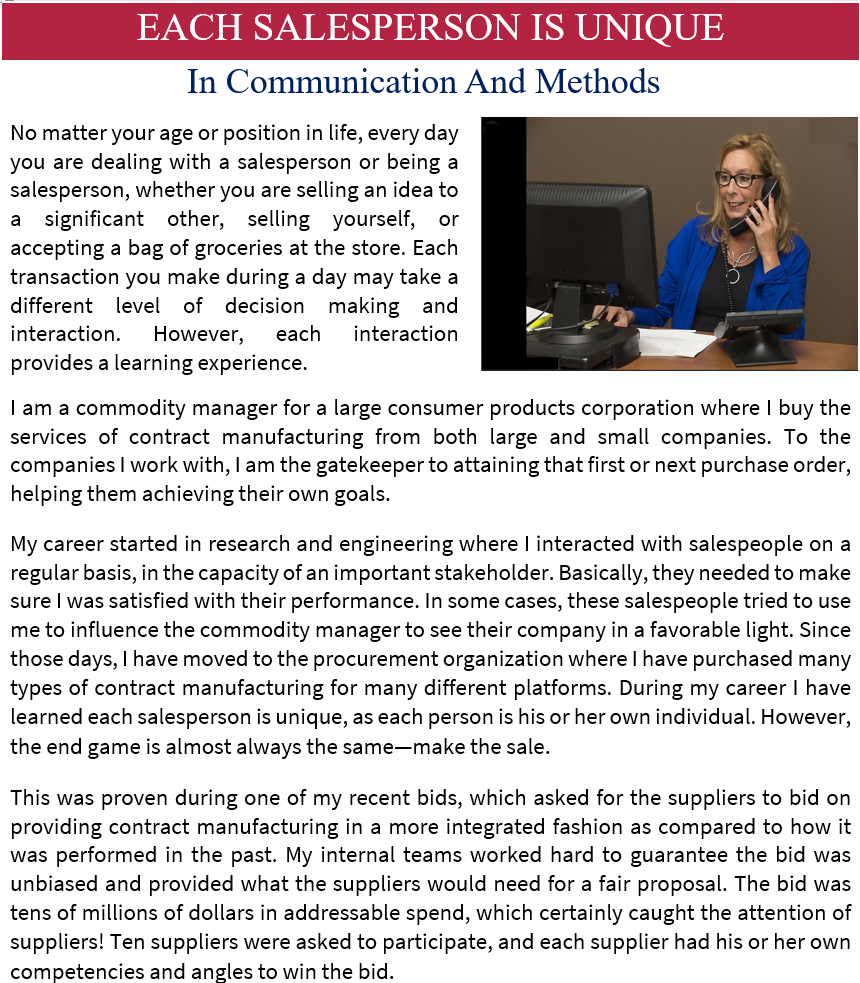
Please read the Case Study and answer following Questions 1. How do you describe that everyone of us is a salesperson? 2. Imagine you are a commodity manager for a large consumer products corporation. Explain your job duties. 3. Suppose you are promoted in your organization and before moving to another management position, you are training a newly hired colleague. How would you share your gatekeeping experience with the new colleague? 4. Describe what did you observe during one of your recent bids? 5. Describe what was your observation after the bid was initiated? 6. Describe your experience as the bid continued? 7. Describe what is the conclusion of your recent bid experience? 8. What will be one more piece of advice that you will share with the trainee? EACH SALESPERSON IS UNIQUE In Communication And Methods No matter your age or position in life, every day you are dealing with a salesperson or being a salesperson, whether you are selling an idea to a significant other, selling yourself, or accepting a bag of groceries at the store. Each transaction you make during a day may take a different level of decision making and interaction. However, each interaction provides a learning experience. I am a commodity manager for a large consumer products corporation where I buy the services of contract manufacturing from both large and small companies. To the companies I work with, I am the gatekeeper to attaining that first or next purchase order, helping them achieving their own goals. My career started in research and engineering where I interacted with salespeople on a regular basis, in the capacity of an important stakeholder. Basically, they needed to make sure I was satisfied with their performance. In some cases, these salespeople tried to use me to influence the commodity manager to see their company in a favorable light. Since those days, I have moved to the procurement organization where I have purchased many types of contract manufacturing for many different platforms. During my career I have learned each salesperson is unique, as each person is his or her own individual. However, the end game is almost always the same-make the sale. This was proven during one of my recent bids, which asked for the suppliers to bid on providing contract manufacturing in a more integrated fashion as compared to how it was performed in the past. My internal teams worked hard to guarantee the bid was unbiased and provided what the suppliers would need for a fair proposal. The bid was tens of millions of dollars in addressable spend, which certainly caught the attention of suppliers! Ten suppliers were asked to participate, and each supplier had his or her own competencies and angles to win the bid. After the bid was initiated, I worked with one salesperson per company and gave each individual an even playing field in terms of provided content and feedback given. What I learned was that some salespeople are headstrong to stick to their bullish ways, while others learned to adapt to the rules of engagement I laid down from the onset of the process. For example, the directions instructed that no in-person meetings were allowed until the second phase of the bid, which is when we cut the supplier list to three. I did this due to resource availability and the fact that we could not successfully complete nearly 10 in-person meetings. A couple of the suppliers broke these rules as a way to gain more face time with my team to try to benefit our opinion of them. These salespersons' actions only hurt their standing in the bid process. Meanwhile, the rest of the suppliers stuck to the rules of engagement to warrant an efficient bidding process and let the content of their proposals speak to their chances of a favorable outcome. As the bid continued I became more familiar with the salespeople I was dealing with. Additionally, I began to understand their competency as it pertains to understanding my needs and if they would be able to be my advocate within their own company, a true indication of a good salesperson. When I was talking to them I would always ask detailed, open-ended questions about their company's strategy and varied my questions from being comprehensive in nature to very "blue sky in nature. This method gave me an understanding of how well they knew their company's vision and inner workings of their own process. This was a great way to also understand what their communication style was and let me tailor my style to get the best of them, as I would then be able to understand what incentivized these individuals on the job. Once you understand what incentivizes people you can alter the way you act to help them benefit you. Both buyer and seller have objectives to achieve and must help each other in a mutually beneficial way to accomplish these goals









 Study Help