







Question: - Please read the case study below and answer the questions that follow. - Answer ALL the questions. CASE STUDY An African sneaker brand: Founder
Please read the case study below and answer the questions that follow.
Answer ALL the questions.
CASE STUDY
An African sneaker brand: Founder of Bathu explains how he built his business
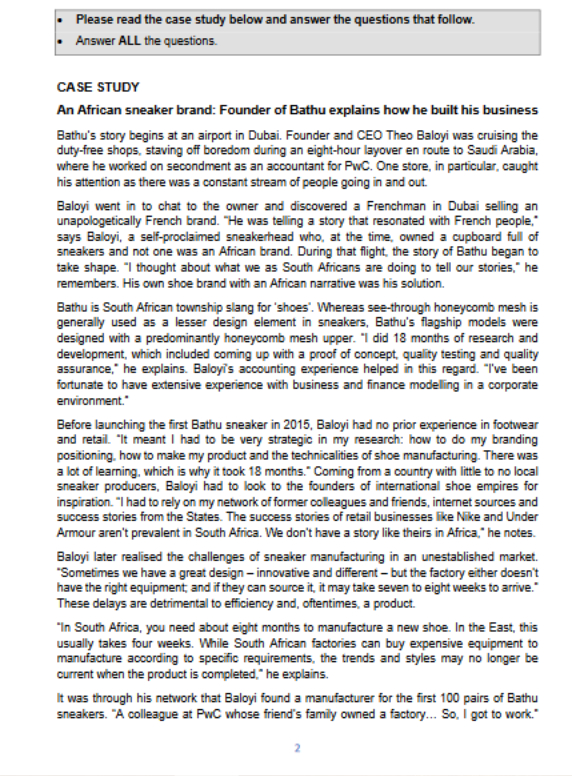
Bathu's story begins at an airport in Dubai. Founder and CEO Theo Baloyi was cruising the dutyfree shops, staving off boredom during an eighthour layover en route to Saudi Arabia, where he worked on secondment as an accountant for PwC One store, in particular, caught his attention as there was a constant stream of people going in and out.
Baloyi went in to chat to the owner and discovered a Frenchman in Dubai selling an unapologetically French brand. He was telling a story that resonated with French people," says Baloyi, a selfproclaimed sneakerhead who, at the time, owned a cupboard full of sneakers and not one was an African brand. During that flight, the story of Bathu began to take shape. "I thought about what we as South Africans are doing to tell our stories," he remembers. His own shoe brand with an African narrative was his solution.
Bathu is South African township slang for 'shoes'. Whereas seethrough honeycomb mesh is generally used as a lesser design element in sneakers, Bathu's flagship models were designed with a predominantly honeycomb mesh upper. 'I did months of research and development, which included coming up with a proof of concept, quality testing and quality assurance," he explains. Baloyi's accounting experience helped in this regard. "I've been fortunate to have extensive experience with business and finance modeling in a corporate environment.
Before launching the first Bathu sneaker in Baloyi had no prior experience in footwear and retail. It meant I had to be very strategic in my research: how to do my branding positioning, how to make my product and the technicalities of shoe manufacturing. There was a lot of learning, which is why it took months." Coming from a country with little to no local sneaker producers, Baloyi had to look to the founders of international shoe empires for inspiration. "I had to rely on my network of former colleagues and friends, internet sources and success stories from the States. The success stories of retail businesses like Nike and Under Armour aren't prevalent in South Africa. We don't have a story like theirs in Africa," he notes.
Baloyi later realised the challenges of sneaker manufacturing in an unestablished market. "Sometimes we have a great design innovative and different but the factory either doesn't have the right equipment, and if they can source it it may take seven to eight weeks to arrive." These delays are detrimental to efficiency and, oftentimes, a product.
In South Africa, you need about eight months to manufacture a new shoe. In the East, this usually takes four weeks. While South African factories can buy expensive equipment to manufacture according to specific requirements, the trends and styles may no longer be current when the product is completed," he explains.
It was through his network that Baloyi found a manufacturer for the first pairs of Bathu sneakers. "A colleague at PwC whose friend's family owned a factory... So I got to work."
Step by Step Solution
There are 3 Steps involved in it
1 Expert Approved Answer
Step: 1 Unlock

Question Has Been Solved by an Expert!
Get step-by-step solutions from verified subject matter experts
Step: 2 Unlock
Step: 3 Unlock
 Study Help