Question: Please read the case study from page 445-448 in the text titled The Westerville Physician Practice: Value Stream Mapping. Answer the questions as thoroughly
Please read the case study from page 445-448 in the text titled " The Westerville Physician Practice: Value Stream Mapping". Answer the questions as thoroughly as possible at the end on page 448.
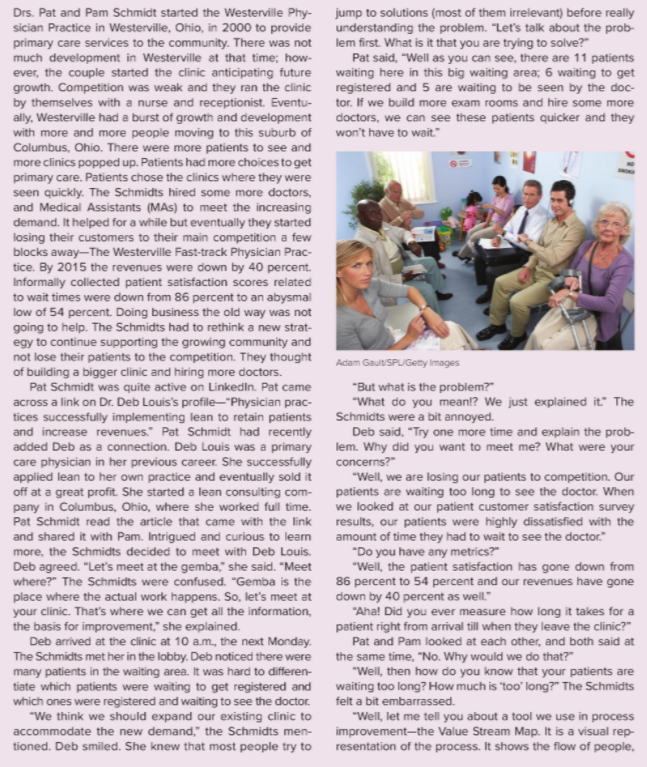
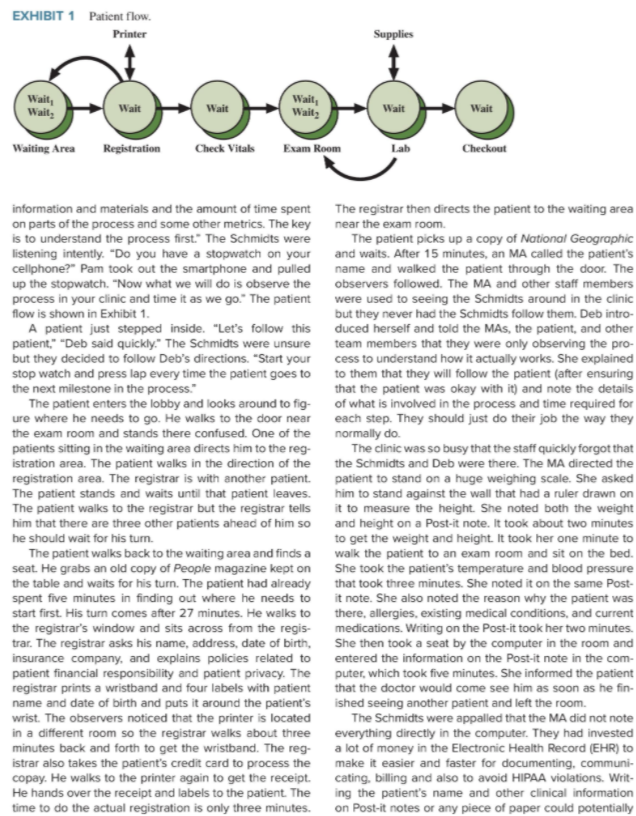
jump to solutions (most of them irrelevant) before really understanding the problem. "Let's talk about the prob- lem first. What is it that you are trying to solve?" Pat said, "Well as you can see, there are 11 patients waiting here in this big waiting area; 6 waiting to get registered and 5 are waiting to be seen by the doc- tor. If we build more exam rooms and hire some more doctors, we can see these patients quicker and they won't have to wait Drs. Pat and Pam Schmidt started the Westerville Phy- sician Practice in Westerville, Ohio, in 2000 to provide primary care services to the community. There was not much development in Westerville at that time; how- ever, the couple started the clinic anticipating future growth. Competition was weak and they ran the clinic by themselves with a nurse and receptionist. Eventu- ally, Westerville had a burst of growth and development with more and more people moving to this suburb of Columbus, Ohio. There were more patients to see and more clinics popped up. Patients had more choices to get primary care. Patients chose the clinics where they were seen quickly. The Schmidts hired some more doctors, and Medical Assistants (MAS) to meet the increasing demand. It helped for a while but eventually they started losing their customers to their main competition a few blocks away-The Westerville Fast-track Physician Prac- tice. By 2015 the revenues were down by 40 percent. Informally collected patient satisfaction scores related to wait times were down from 86 percent to an abysmal low of 54 percent. Doing business the old way was not going to help. The Schmidts had to rethink a new strat- egy to continue supporting the growing community and not lose their patients to the competition. They thought of building a bigger clinic and hiring more doctors. Pat Schmidt was quite active on Linkedin. Pat came across a link on Dr. Deb Louis's profile="Physician prac- tices successfully implementing lean to retain patients and increase revenues." Pat Schmidt had recently added Deb as a connection. Deb Louis was a primary care physician in her previous career. She successfully applied lean to her own practice and eventually sold it off at a great profit. She started a lean consulting com- pany in Columbus, Ohio, where she worked full time. Pat Schmidt read the article that came with the link and shared it with Pam. Intrigued and curious to learn more, the Schmidts decided to meet with Deb Louis. Deb agreed. "Let's meet at the gemba," she said. "Meet where?" The Schmidts were confused. "Gemba is the place where the actual work happens. So, let's meet at your clinic. That's where we can get all the information, the basis for improvement," she explained. Deb arrived at the clinic at 10 a.m., the next Monday. The Schmidts met her in the lobby. Deb noticed there were many patients in the waiting area. It was hard to differen- tiate which patients were waiting to get registered and which ones were registered and waiting to see the doctor "We think we should expand our existing clinic to accommodate the new demand," the Schmidts men- tioned. Deb smiled. She knew that most people try to Adam GaulUSPUGeny images "But what is the problem?" "What do you mean!? We just explained it" The Schmidts were a bit annoyed. Deb said, "Try one more time and explain the prob- lem. Why did you want to meet me? What were your concerns?" "Well, we are losing our patients to competition. Our patients are waiting too long to see the doctor. When we looked at our patient customer satisfaction survey results, our patients were highly dissatisfied with the amount of time they had to wait to see the doctor." "Do you have any metrics?" "Well, the patient satisfaction has gone down from 86 percent to 54 percent and our revenues have gone down by 40 percent as well." "Aha! Did you ever measure how long it takes for a patient right from arrival till when they leave the clinic?" Pat and Pam looked at each other, and both said at the same time, "No. Why would we do that? "Well, then how do you know that your patients are waiting too long? How much is too long?" The Schmidts felt a bit embarrassed. "Well, let me tell you about a tool we use in process improvement,the Value Stream Map. It is a visual rep- resentation of the process. It shows the flow of people, EXHIBIT 1 Patient flow. Printer Supplies Wait, Wait, Wait Wait Wait, Wait Wait Wait Waiting Area Registration Check Vitals Exam Room Lab Checkout information and materials and the amount of time spent the registrar then directs the patient to the waiting area on parts of the process and some other metrics. The key near the exam room. is to understand the process first." The Schmidts were The patient picks up a copy of National Geographic listening intently. "Do you have a stopwatch on your and waits. After 15 minutes, an MA called the patient's cellphone?" Pam took out the smartphone and pulled name and walked the patient through the door. The up the stopwatch. "Now what we will do is observe the observers followed. The MA and other staff members process in your clinic and time it as we go. The patient were used to seeing the Schmidts around in the clinic flow is shown in Exhibit 1. but they never had the Schmidts follow them. Deb intro- A patient just stepped inside. "Let's follow this duced herself and told the MAs, the patient, and other patient." "Deb said quickly." The Schmidts were unsure team members that they were only observing the pro- but they decided to follow Deb's directions. "Start your cess to understand how it actually works. She explained stop watch and press lap every time the patient goes to to them that they will follow the patient (after ensuring the next milestone in the process." that the patient was okay with it) and note the details The patient enters the lobby and looks around to fig- of what is involved in the process and time required for ure where he needs to go. He walks to the door near each step. They should just do their job the way they the exam room and stands there confused. One of the normally do. patients sitting in the waiting area directs him to the reg. The clinic was so busy that the staff quickly forgot that istration area. The patient walks in the direction of the the Schmidts and Deb were there. The MA directed the registration area. The registrar is with another patient. patient to stand on a huge weighing scale. She asked The patient stands and waits until that patient leaves him to stand against the wall that had a ruler drawn on The patient walks to the registrar but the registrar tells it to measure the height. She noted both the weight him that there are three other patients ahead of him so and height on a Post-it note. It took about two minutes he should wait for his turn. to get the weight and height. It took her one minute to The patient walks back to the waiting area and finds a walk the patient to an exam room and sit on the bed. seat. He grabs an old copy of People magazine kept on She took the patient's temperature and blood pressure the table and waits for his turn. The patient had already that took three minutes. She noted it on the same Post- spent five minutes in finding out where he needs to it note. She also noted the reason why the patient was start first. His turn comes after 27 minutes. He walks to there, allergies, existing medical conditions, and current the registrar's window and sits across from the regis medications. Writing on the Post-it took her two minutes. trar. The registrar asks his name, address, date of birth, She then took a seat by the computer in the room and insurance company, and explains policies related to entered the information on the Post-it note in the com- patient financial responsibility and patient privacy. The puter, which took five minutes. She informed the patient registrar prints a wristband and four labels with patient that the doctor would come see him as soon as he fin- name and date of birth and puts it around the patient's ished seeing another patient and left the room. wrist. The observers noticed that the printer is located The Schmidts were appalled that the MA did not note in a different room so the registrar walks about three everything directly in the computer. They had invested minutes back and forth to get the wristband. The reg. a lot of money in the Electronic Health Record (EHR) to istrar also takes the patient's credit card to process the make it easier and faster for documenting, communi- copay. He walks to the printer again to get the receipt. cating, billing and also to avoid HIPAA violations. Writ- He hands over the receipt and labels to the patient. The ing the patient's name and other clinical information time to do the actual registration is only three minutes. on Post-it notes or any piece of paper could potentially result in lawsuits due to patient privacy violations. This is the first time they ever saw what actually happened in the clinic. After questioning the MA they found out that the MAs were uncomfortable using the EMR. It was easier to just write on a Post-it and then enter the infor- mation in the computer taking their own time. The doctor came 20 minutes after the MA left. The doctor was surprised to see the Schmidts and Deb in the patient room. Pam quickly explained why they were there. The doctor greeted the patient and logged on to the computer and pulled up the patient's record. She read through the notes. She did not read the notes beforehand, which took her an additional two minutes. The doctor seemed in a rush. It was only 11 a.m. and she was already running late. She did a quick H&P (his- tory and physical examination-initial clinical evalua- tion and examination of patient). The doctor prescribed some labs. The patient had more questions but the doc- tor seemed impatient and uninterested in addressing them. She rushed out to see another patient. This took about 12 minutes The MA came back right after and directed the patient to the lab. There were two patients waiting ahead of him for labs to be drawn. The patient waited for 24 minutes. The technician took the labels from the patient and sat him on the phlebotomy chair. The technician needed three different tubes-green, pur- ple, and red. She found the green and red but could not find the purple tube. She went to the supply room next door but could not find it. She then interrupted her colleague who was drawing blood on another patient to see if he had any purple tubes. He directed her to a small cabinet hidden behind the door. He winked at her and said, "I keep some there just in case!" The observers overheard the technicians complain, "We never have the supplies we need to do our job effi- ciently. We are always looking and searching for them." This took up seven minutes. The technician drew the blood in the three tubes and put the labels on them. This part of the process took only four minutes. "The report will be available in 20 minutes." the technician told the patient and directed him back to the same exam room. The patient walked back to the exam room area but could not find the room. The Schmidts were about to offer directions but Deb stopped them. The patient walked back and forth in the corridor until he saw the same MA who directed him back to the room. This took five minutes. The patient waited for the doctor who came after 25 minutes. The doctor went over the reports with the patient and answered his questions. Based on the H&P, the labs and her clinical expertise, she prescribed some medications. She made sure to ask the patient's choice of pharmacy and sent the prescription there. She reassured the patient and had him set up a follow-up visit after two weeks. This took only five minutes. The observers noticed that the doctor did not write the patient notes in the computer. The Schmidts con firmed that most doctors finish their notes at the end of the day or complete them at home. It could take any- where from 10-15 minutes to complete the notes. They believed that it would take only five minutes if they doc umented right after they had seen the patient. This is because they do not have to rely on memory to write the notes and also the extra time it takes due to variable Internet speed at home. The MA came back and directed the patient to the check-out window. The doctor had not written the notes yet so the check-out person asked the patient what the doctor had advised. The patient requested to set up a follow-up appointment in two weeks. The check-out per- son set up the appointment in the EMR after confirming both the doctor and patient's availability. The process took five minutes. The patient then left. Deb asked the Schmidts. "Is this your typical patient or are there other patients that may need other interventions?" Pam Schmidt said, "We are open Monday-Friday from 8am-4p.m. Our busier days are Tuesdays and Thursdays. On an average we see between 88-90 patients per day out of which about 15% are new patients. 85 percent of all our patients need labs." Deb responded, "How many staff members do you have?" "We have 1 registrar, 1 MA, and 1 Admin person who spends 50 percent time scheduling and 50 percent check out, 1 Nurse who mostly helps with vaccina- tions, 3 full-time MDs and in addition, Pat and I spend 50 percent of our time each in the clinic, seeing patients." It was about 2 p.m. The Schmidts suggested to Deb that they grab some lunch and discuss the observations to understand what to make of them. Pam took every one's preference and brought subs from the nearby Subway. The three of them sat in a conference room Deb asked, "What did you see?" Pam said, "Well, I saw that the actual work takes very little time and most time was spent on waiting, walking and searching. I feel really sorry for the patient and my staff. We implemented the EMR system and yet it is not being used as it should be. "Great observations! I will draw a value stream map during the next week, but remember we observed only one patient. This is a single data point. It does not tell us the whole story. Over the next week, I would like you to do more observations especially on Tuesdays and Thursdays because they are the busier days. Fol- low more patients and time them, and note any varia- tions in how your team members complete their part of the process. Make a note of the walking, waiting and notes with her. They always come in quite handy when searching. Let your staff and patients know that you coming up with improvement suggestions. would be following and observing them. Send me a note on LinkedIn when you have the information and I will come to meet you again to show you how to draw a Discussion Questions Value Stream Map. 1. What are the problems in this case? The next week Pat sent Deb a note, indicating 2. Draw a current state value stream map indicating that they completed some observations. There were the customer, supplier information flow, and relevant some variations in the amount of time but on average metrics. what they captured during her first visit told the story very well. They did observe that the other MA types . What is the takt time? entered all the information directly in the EMR and the What is the total lead time (processing + waiting)? other physician completed the notes right after seeing What is the total value added and nonvalue added the patient. time? Deb came to visit the Schmidts on Wednesday. She . What is the VA/NVA percentage? started drawing the Value Stream Map on the white 3. Draw a new value stream map. Using the map, board. She had also brought with her a lot of Post-it describe how the system can be improved









 Study Help