







Question: Please read the example carefully, and complete my answer. Prove the argument I have made. Based on the definition of casual argument, how can I
Please read the example carefully, and complete my answer. Prove the argument I have made. Based on the definition of casual argument, how can I prove in accounting major?
For reference, read the example.
My answer: My designated argument type was Casual. This is an interesting fact that causal arguments about causes and effects. There are different causal arguments too. They can be arguments that state a cause and then examine its effects. Alternatively, they can be arguments that state an effect and trace the effect back to its causes. Alternatively, Arguments that move through a series of links: A causes B, which leads to C and perhaps to D. In my major, accounting, I think causal arguments are the most common because...
The example;
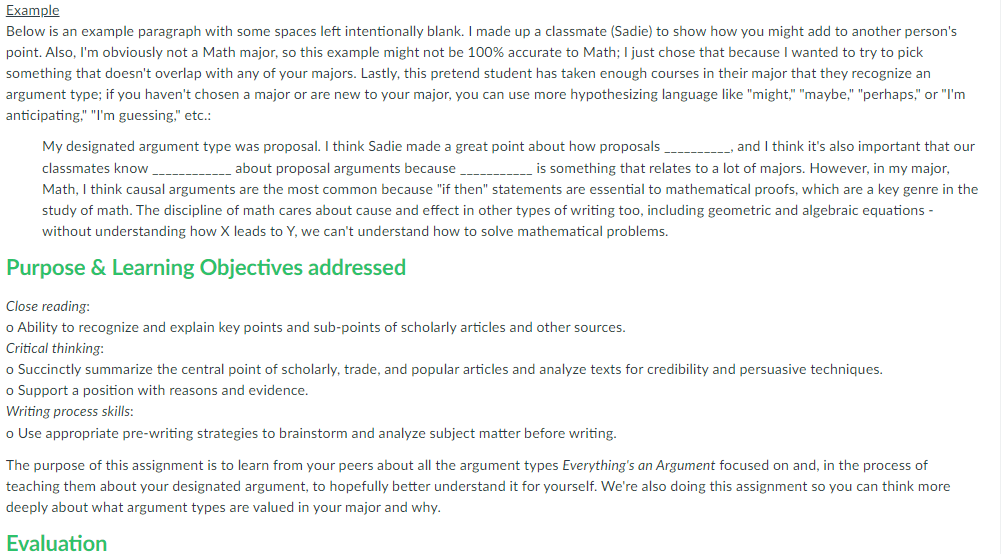
Example Below is an example paragraph with some spaces left intentionally blank. I made up a classmate (Sadie) to show how you might add to another person's point. Also, I'm obviously not a Math major, so this example might not be 100% accurate to Math; I just chose that because I wanted to try to pick something that doesn't overlap with any of your majors. Lastly, this pretend student has taken enough courses in their major that they recognize an argument type; if you haven't chosen a major or are new to your major, you can use more hypothesizing language like "might," "maybe," "perhaps," or "I'm anticipating." "I'm guessing," etc.: My designated argument type was proposal. I think Sadie made a great point about how proposals and I think it's also important that our classmates know - about proposal arguments because ------ is something that relates to a lot of majors. However, in my major, Math, I think causal arguments are the most common because "if then" statements are essential to mathematical proofs, which are a key genre in the study of math. The discipline of math cares about cause and effect in other types of writing too, including geometric and algebraic equations- without understanding how X leads to Y, we can't understand how to solve mathematical problems. Purpose & Learning Objectives addressed Close reading: o Ability to recognize and explain key points and sub-points of scholarly articles and other sources. Critical thinking: o Succinctly summarize the central point of scholarly, trade, and popular articles and analyze texts for credibility and persuasive techniques. o Support a position with reasons and evidence. Writing process skills: o Use appropriate pre-writing strategies to brainstorm and analyze subject matter before writing. The purpose of this assignment is to learn from your peers about all the argument types Everything's an Argument focused on and, in the process of teaching them about your designated argument, to hopefully better understand it for yourself. We're also doing this assignment so you can think more deeply about what argument types are valued in your major and why. Evaluation Example Below is an example paragraph with some spaces left intentionally blank. I made up a classmate (Sadie) to show how you might add to another person's point. Also, I'm obviously not a Math major, so this example might not be 100% accurate to Math; I just chose that because I wanted to try to pick something that doesn't overlap with any of your majors. Lastly, this pretend student has taken enough courses in their major that they recognize an argument type; if you haven't chosen a major or are new to your major, you can use more hypothesizing language like "might," "maybe," "perhaps," or "I'm anticipating." "I'm guessing," etc.: My designated argument type was proposal. I think Sadie made a great point about how proposals and I think it's also important that our classmates know - about proposal arguments because ------ is something that relates to a lot of majors. However, in my major, Math, I think causal arguments are the most common because "if then" statements are essential to mathematical proofs, which are a key genre in the study of math. The discipline of math cares about cause and effect in other types of writing too, including geometric and algebraic equations- without understanding how X leads to Y, we can't understand how to solve mathematical problems. Purpose & Learning Objectives addressed Close reading: o Ability to recognize and explain key points and sub-points of scholarly articles and other sources. Critical thinking: o Succinctly summarize the central point of scholarly, trade, and popular articles and analyze texts for credibility and persuasive techniques. o Support a position with reasons and evidence. Writing process skills: o Use appropriate pre-writing strategies to brainstorm and analyze subject matter before writing. The purpose of this assignment is to learn from your peers about all the argument types Everything's an Argument focused on and, in the process of teaching them about your designated argument, to hopefully better understand it for yourself. We're also doing this assignment so you can think more deeply about what argument types are valued in your major and why. Evaluation
Step by Step Solution
There are 3 Steps involved in it

Get step-by-step solutions from verified subject matter experts
 Study Help