







Question: Please read the following case study and answer the following 1. Is Milligans offer of reassignment a reasonable accommodation of Keltners disability? If Keltner accepts,
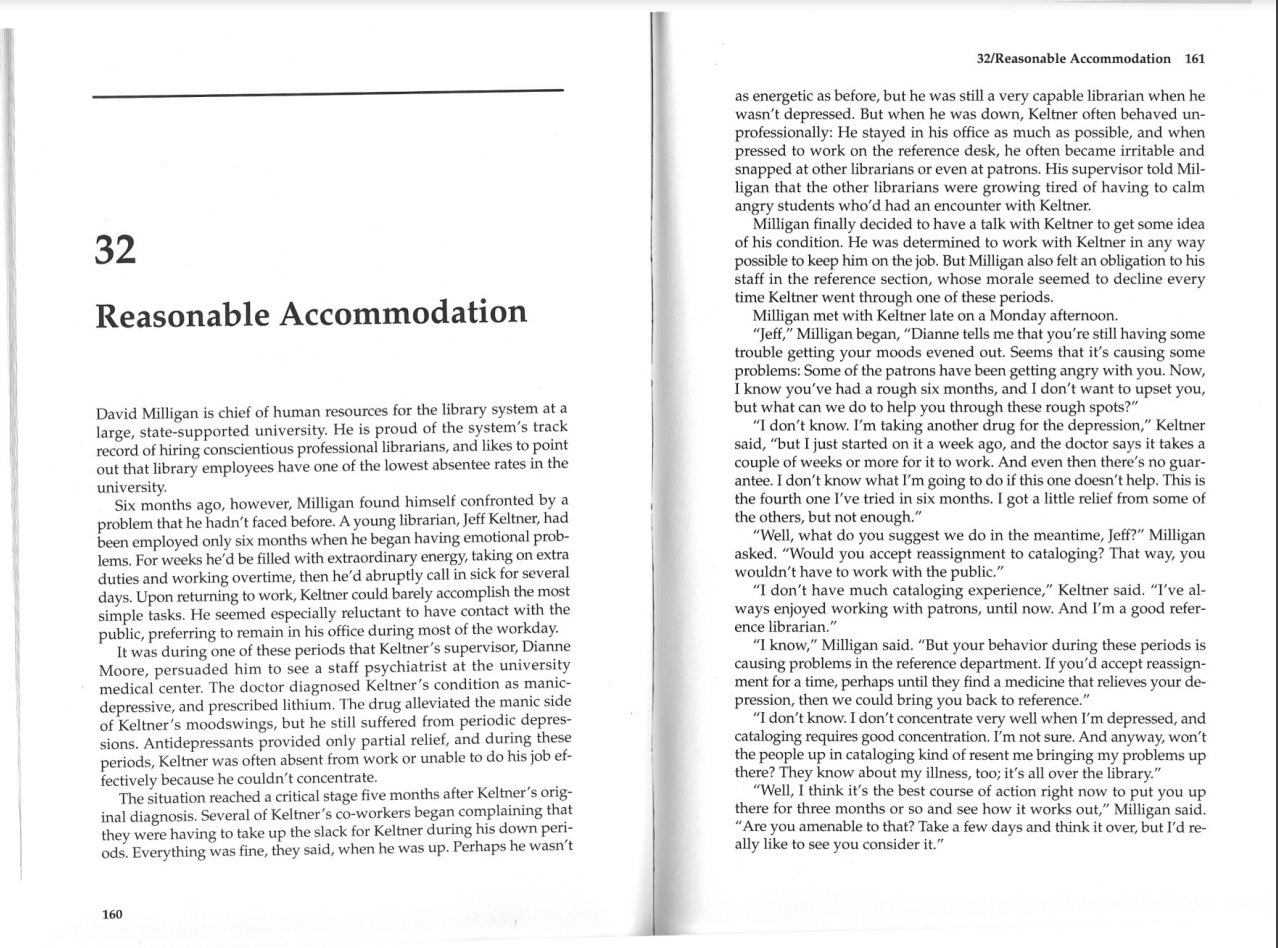
Please read the following case study and answer the following
1. Is Milligans offer of reassignment a reasonable accommodation of Keltners disability? If Keltner accepts, how will it affect his career?
2. Does Keltner have a responsibility to the university to accept reassignment, considering his occasional inability to do his job effectively?
3. Does Keltner have recourse under the Americans with Disabilities Act to prevent Milligan from reassigning him to a job that he is reluctant to perform and isnt particularly qualified for?
4. Do you consider Keltners condition a disability? Explain why?
32/Reasonable Accommodation 161 32 Reasonable Accommodation David Milligan is chief of human resources for the library system at a large, state-supported university. He is proud of the system's track record of hiring conscientious professional librarians, and likes to point out that library employees have one of the lowest absentee rates in the university Six months ago, however, Milligan found himself confronted by a problem that he hadn't faced before. A young librarian, Jeff Keltner, had been employed only six months when he began having emotional prob- lems. For weeks he'd be filled with extraordinary energy, taking on extra duties and working overtime, then he'd abruptly call in sick for several days. Upon returning to work, Keltner could barely accomplish the most simple tasks. He seemed especially reluctant to have contact with the public, preferring to remain in his office during most of the workday. It was during one of these periods that Keltner's supervisor, Dianne Moore, persuaded him to see a staff psychiatrist at the university medical center. The doctor diagnosed Keltner's condition as manic- depressive, and prescribed lithium. The drug alleviated the manic side of Keltner's moodswings, but he still suffered from periodic depres- sions. Antidepressants provided only partial relief, and during these periods, Keltner was often absent from work or unable to do his job ef- fectively because he couldn't concentrate. The situation reached a critical stage five months after Keltner's orig- inal diagnosis. Several of Keltner's co-workers began complaining that they were having to take up the slack for Keltner during his down peri- ods. Everything was fine, they said, when he was up. Perhaps he wasn't as energetic as before, but he was still a very capable librarian when he wasn't depressed. But when he was down, Keltner often behaved un- professionally: He stayed in his office as much as possible, and when pressed to work on the reference desk, he often became irritable and snapped at other librarians or even at patrons. His supervisor told Mil- ligan that the other librarians were growing tired of having to calm angry students who'd had an encounter with Keltner. Milligan finally decided to have a talk with Keltner to get some idea of his condition. He was determined to work with Keltner in any way possible to keep him on the job. But Milligan also felt an obligation to his staff in the reference section, whose morale seemed to decline every time Keltner went through one of these periods. Milligan met with Keltner late on a Monday afternoon. "Jeff," Milligan began, Dianne tells me that you're still having some trouble getting your moods evened out. Seems that it's causing some problems: Some of the patrons have been getting angry with you. Now, I know you've had a rough six months, and I don't want to upset you, but what can we do to help you through these rough spots?" "I don't know. I'm taking another drug for the depression," Keltner said, "but I just started on it a week ago, and the doctor says it takes a couple of weeks or more for it to work. And even then there's no guar- antee. I don't know what I'm going to do if this one doesn't help. This is the fourth one I've tried in six months. I got a little relief from some of the others, but not enough." "Well, what do you suggest we do in the meantime, Jeff?" Milligan asked. "Would you accept reassignment to cataloging? That way, you wouldn't have to work with the public." "I don't have much cataloging experience," Keltner said. "I've al- ways enjoyed working with patrons, until now. And I'm a good refer- ence librarian." "I know," Milligan said. But your behavior during these periods is causing problems in the reference department. If you'd accept reassign- ment for a time, perhaps until they find a medicine that relieves your de- pression, then we could bring you back to reference." "I don't know. I don't concentrate very well when I'm depressed, and cataloging requires good concentration. I'm not sure. And anyway, won't the people up in cataloging kind of resent me bringing my problems up there? They know about my illness, too; it's all over the library." "Well, I think it's the best course of action right now to put you up there for three months or so and see how it works out," Milligan said. "Are you amenable to that? Take a few days and think it over, but I'd re- ally like to see you consider it." 160Step by Step Solution
There are 3 Steps involved in it
1 Expert Approved Answer
Step: 1 Unlock

Question Has Been Solved by an Expert!
Get step-by-step solutions from verified subject matter experts
Step: 2 Unlock
Step: 3 Unlock
 Study Help