Question: Please read the Kenya Health Professionals Case Study. This case study details the work of Kenyan health professionals that developed a website using an easy
Please read the Kenya Health Professionals Case Study. This case study details the work of Kenyan health professionals that developed a website using an easy to use toolkit to help provide reproductive health knowledge to citizens.
Task: The website was developed and launched in 2012. Much time has passed and technologies and management systems have evolved since that time. DRH is interested in redesigning their knowledge management. You are tasked with revamping the the DRH website using a new knowledge management system.
Assignment: Write up a report with your recommendations on the following:
KMS System: What system do you recommend is used? Why? Provide details about the system itself and the technology.
How will the system be an improvement?
Transition: How do you propose existing knowledge is transferred from the current system?
Training: How will staff be trained?
Support: What ongoing support resources are needed for the KMS system?
When you select a KMS technology conduct research on it to provide additional information and context.
Format: Your response should be a minimum of four pages. APA format. Please include all references and citations to outside sources.
Kenya Health Professionals Case Study here.
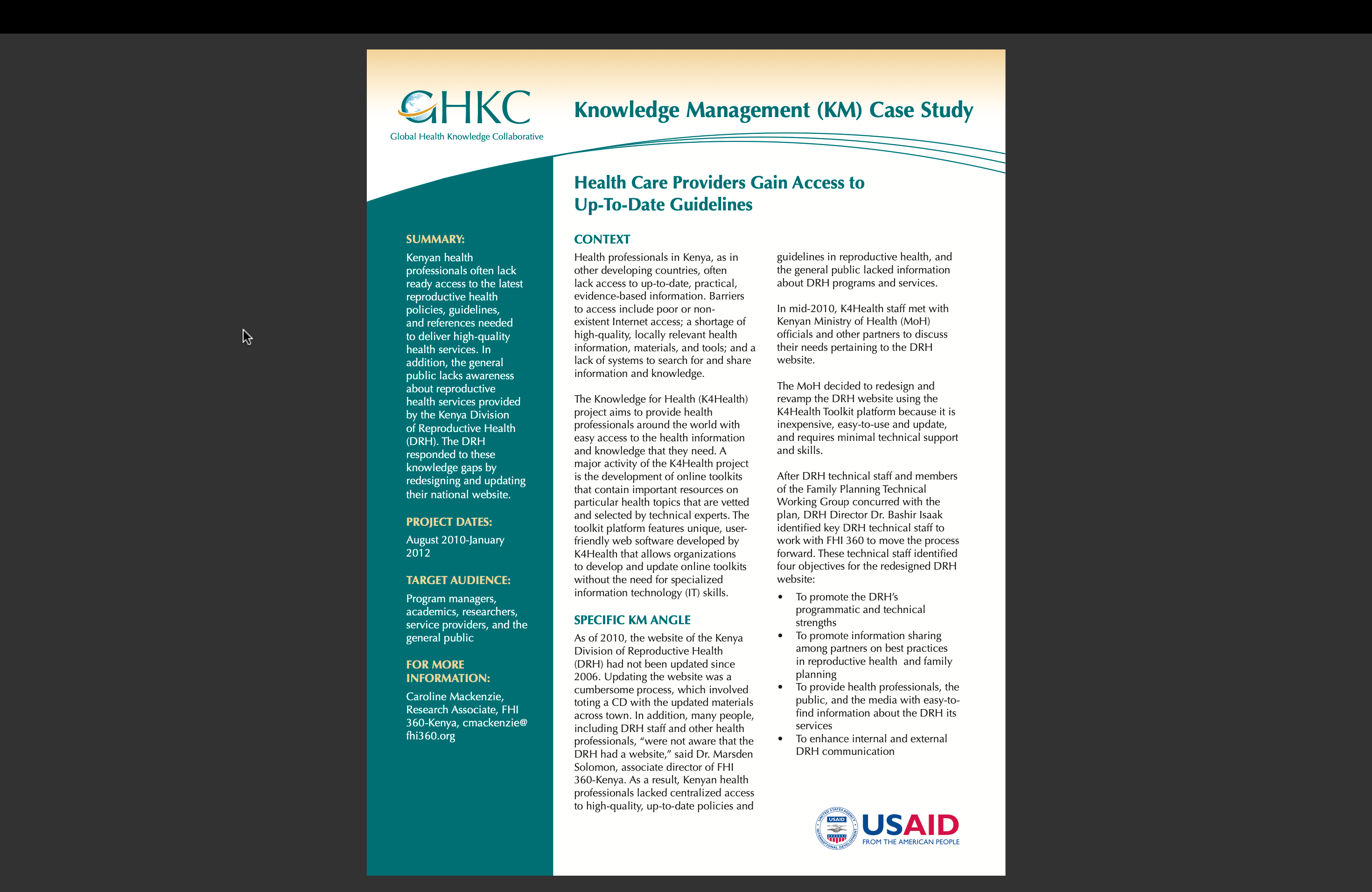
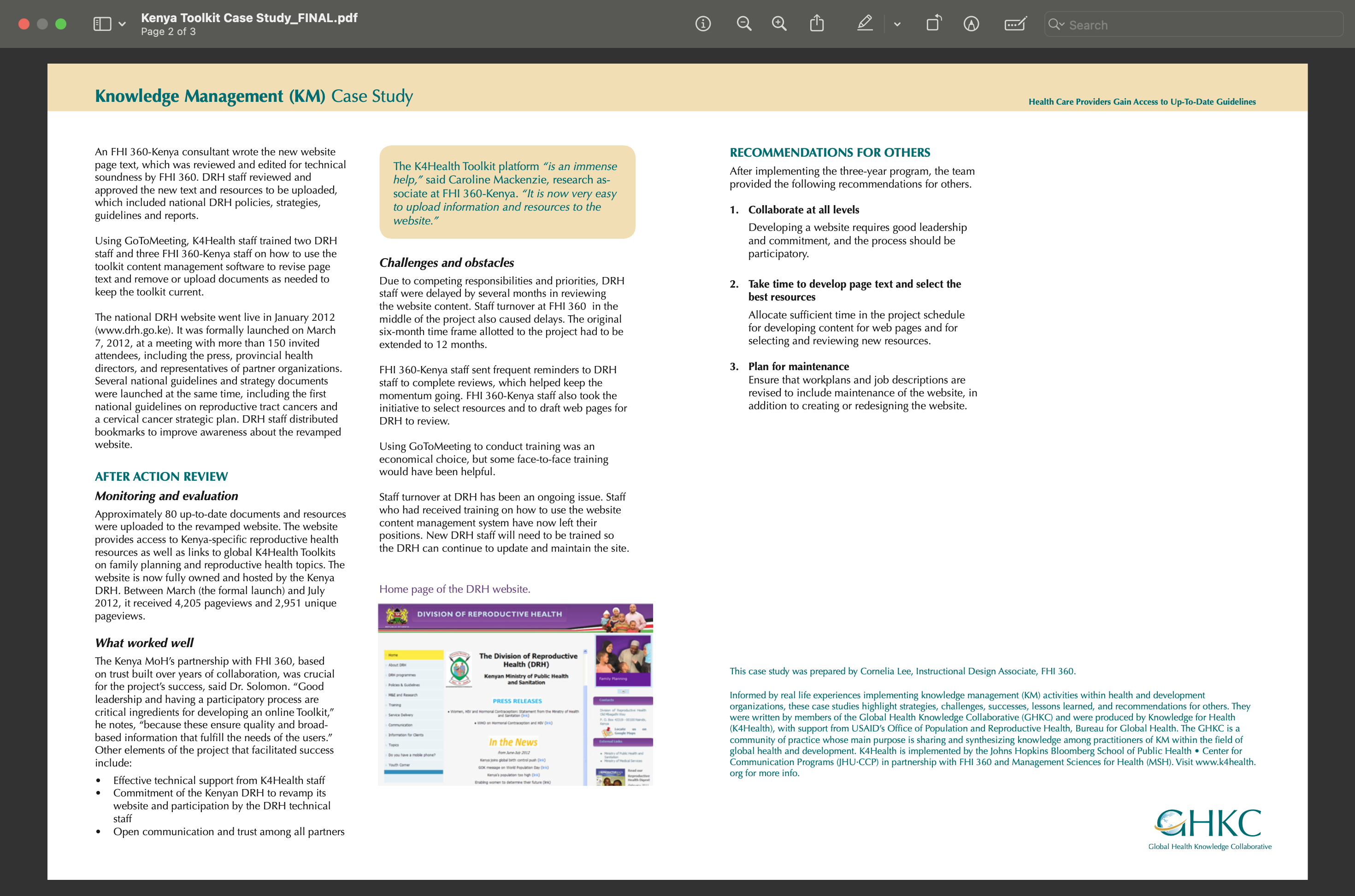
GHKC Knowledge Management (KM) Case Study Global Health Knowledge Collaborative Health Care Providers Gain Access to Up-To-Date Guidelines SUMMARY: CONTEXT Kenyan health Health professionals in Kenya, as in guidelines in reproductive health, and professionals often lack other developing countries, ofter the general public lacked information ready access to the latest lack access to up-to-date, practical, about DRH programs and services. reproductive health evidence-based information. Barriers policies, guidelines, to access include poor or non- In mid-2010, K4Health staff met with and references needed existent Internet access; a shortage of Kenyan Ministry of Health (MoH) to deliver high-quality high-quality, locally relevant health officials and other partners to discuss health services. In information, materials, and tools; and a their needs pertaining to the DRH addition, the general lack of systems to search for and share website. public lacks awareness information and knowledge. about reproductive The MoH decided to redesign and health services provided or Health (K4Health) revamp the DRH website using the by the Kenya Division project aims to provide health K4Health Toolkit platform because it is of Reproductive Health professionals around the world with inexpensive, easy-to-use and update, (DRH). The DRH easy access to the health information and requires minimal technical support responded to these and knowledge that they need. A and skills. knowledge gaps by major activity of the K4Health project redesigning and updating is the development of online toolkits After DRH technical staff and members their national website. that contain important resources on of the Family Planning Technical particular health topics that are vetted Working Group concurred with the PROJECT DATES: and selected by technical experts. The plan, DRH Director Dr. Bashir Isaak toolkit platform features unique, user- identified key DRH technical staff to August 2010-January friendly web software developed by work with FHI 360 to move the process 2012 K4Health that allows organizations orward. These technical staff identified to develop and update online toolkits four objectives for the redesigned DRH TARGET AUDIENCE: without the need for specialized website: information technology (IT) skills Program managers, . To promote the DRH's academics, researchers, programmatic and technical service providers, and the SPECIFIC KM ANGLE strengths general public As of 2010, the website of the Kenya To promote information sharing Division of Reproductive Health among partners on best practices FOR MORE DRH) had not been updated since in reproductive health and family INFORMATION: 2006. Updating the website was a planning cumbersome process, which involved To provide health professionals, the Caroline Mackenzie, toting a CD with the updated materials public, and the media with easy-to- Research Associate, FHI find information about the DRH its 360-Kenya, cmackenzie@ across town. In addition, many people, including DRH staff and other health services fhi360.org professionals, "were not aware that the To enhance internal and external DRH had a website," said Dr. Marsden DRH communication Solomon, associate director of FHI 360-Kenya. As a result, Kenyan health professionals lacked centralized access to high-quality, up-to-date policies and USAID FROM THE AMERICAN PEOPLEM~ Kenya Toolkit Case Study_FINAL.pdf Page 2 of 3 Knowledge Management (KM) Case Study An FHI 360-Kenya consultant wrote the new website page text, which was reviewed and edited for technical soundness by FHI 360. DRH staff reviewed and approved the new text and resources to be uploaded, which included national DRH policies, strategies, guidelines and reports. Using GoToMeeting, K4Health staff trained two DRH staff and three FHI 360-Kenya staff on how to use the toolkit content management software to revise page text and remove or upload documents as needed to keep the toolkit current. The national DRH website went live in January 2012 (www.drh.go.ke). It was formally launched on March 7, 2012, at a meeting with more than 150 invited attendees, including the press, provincial health directors, and representatives of partner organizations. Several national guidelines and strategy documents. were launched at the same time, including the first national guidelines on reproductive tract cancers and a cervical cancer strategic plan. DRH staff distributed bookmarks to improve awareness about the revamped website. AFTER ACTION REVIEW Monitoring and evaluation Approximately 80 up-to-date documents and resources were uploaded to the revamped website. The website provides access to Kenya-specific reproductive health resources as well as links to global K4Health Toolkits on family planning and reproductive health topics. The website is now fully owned and hosted by the Kenya DRH. Between March (the formal launch) and July 2012, it received 4,205 pageviews and 2,951 unique pageviews. What worked well The Kenya MoH's partnership with FHI 360, based on trust built over years of collaboration, was crucial for the project's success, said Dr. Solomon. \"Good leadership and having a participatory process are critical ingredients for developing an online Toolkit,\" he notes, \"because these ensure quality and broad- based information that fulfill the needs of the users.\" Other elements of the project that facilitated success include: Effective technical support from K4Health staff Commitment of the Kenyan DRH to revamp its website and participation by the DRH technical staff Open communication and trust among all partners The K4Health Toolkit platform \"is an immense help,\" said Caroline Mackenzie, research as- sociate at FHI 360-Kenya. \"It is now very easy to upload information and resources to the website.\" Challenges and obstacles Due to competing responsibilities and priorities, DRH staff were delayed by several months in reviewing the website content. Staff turnover at FHI 360 in the middle of the project also caused delays. The original six-month time frame allotted to the project had to be extended to 12 months. FHI 360-Kenya staff sent frequent reminders to DRH staff to complete reviews, which helped keep the momentum going. FHI 360-Kenya staff also took the initiative to select resources and to draft web pages for DRH to review. Using GoToMeeting to conduct training was an economical choice, but some face-to-face training would have been helpful. Staff turnover at DRH has been an ongoing issue. Staff who had received training on how to use the website content management system have now left their positions. New DRH staff will need to be trained so the DRH can continue to update and maintain the site. Home page of the DRH website. Health Care Providers Gain Access to Up-To-Date Guidelines RECOMMENDATIONS FOR OTHERS After implementing the three-year program, the team provided the following recommendations for others. 1. Collaborate at all levels Developing a website requires good leadership and commitment, and the process should be participatory. Take time to develop page text and select the best resources Allocate sufficient time in the project schedule for developing content for web pages and for selecting and reviewing new resources. Plan for maintenance Ensure that workplans and job descriptions are revised to include maintenance of the website, in addition to creating or redesigning the website. This case study was prepared by Comelia Lee, Instructional Design Associate, FHI 360. Informed by real life experiences implementing knowledge management (KM) activities within health and development organizations, these case studies highlight strategies, challenges, successes, lessons learned, and recommendations for others. They were witten by members of the Global Health Knowledge Collaborative (GHKC) and were produced by Knowledge for Health (K4Health), with support from USAID's Office of Population and Reproductive Health, Bureau for Global Health. The GHKC is a community of practice whose main purpose is sharing and synthesizing knowledge among practitioners of KM within the field of global health and development. K4Health is implemented by the Johns Hopkins Bloomberg School of Public Health Center for Communication Programs (JHU-CCP) in partnership with FHI 360 and Management Sciences for Health (MSH). Visit www.k4health. org for more info. GHKC Global Health Knowledge Collaborative
Step by Step Solution
There are 3 Steps involved in it
1 Expert Approved Answer
Step: 1 Unlock
Question Has Been Solved by an Expert!
Get step-by-step solutions from verified subject matter experts
Step: 2 Unlock
Step: 3 Unlock
Students Have Also Explored These Related General Management Questions!









 Study Help