







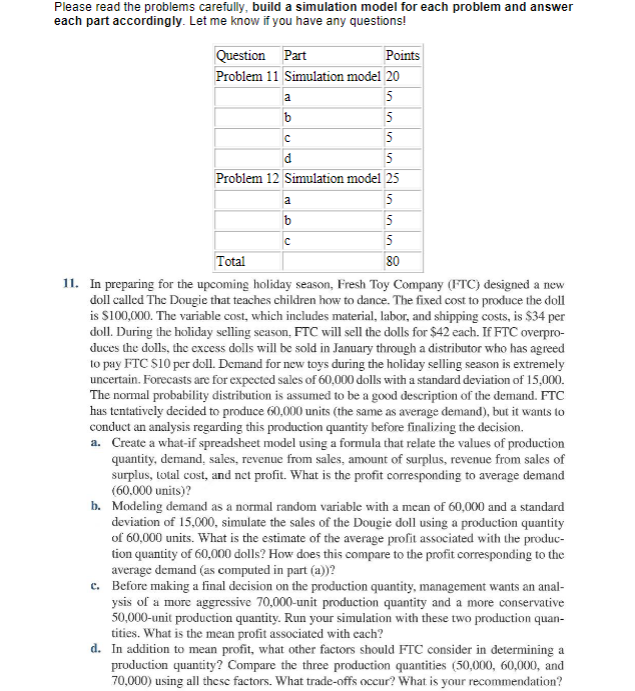
Question: Please read the problems carefully, build a simulation model for each problem and answer each part accordingly. Let me know if you have any questions!
Please read the problems carefully, build a simulation model for each problem and answer
each part accordingly. Let me know if you have any questions!
In preparing for the upcoming holiday season, Fresh Toy Company ITC designed a new
doll called The Dougie that teaches children how to dance. The fixed cost to produce the doll
is $ The variable cost, which includes material, labor, and shipping costs, is $ per
doll. During the holiday selling season, FTC will sell the dolls for $ each. If FTC overpro
Juces the dolls, the excess dolls will be sold in January through a distributor who has agreed
to pay FTC $ per doll. Demand for new toys during the holiday selling season is extremely
uncertain. Forecasts are for expected sales of dolls with a standard deviation of
The normal probability distribution is assumed to be a good description of the demand. FTC
has tentatively decided to produce units the same as average demand but it wants to
conduct an analysis regarding this production quantity before finalizing the decision.
a Create a whatif spreadsheet model using a formula that relate the values of production
quantity, demand, sales, revenue from sales, amount of surplus, revenue from sales of
surplus, total cost, and net profit. What is the profit corresponding to average demand
units
b Modeling demand as a normal random variable with a mean of and a standard
deviation of simulate the sales of the Dougie doll using a production quantity
of units. What is the estimate of the average profit associated with the produc
tion quantity of dolls? How does this compare to the profit corresponding to the
average demand as computed in part a
c Before making a final decision on the production quantity, management wants an anal
ysis of a more aggressive unit production quantity and a more conservative
unit production quantity. Run your simulation with these two production quan
tities. What is the mean profit associated with each?
d In addition to mean profit, what other factors should FTC consider in determining a
production quantity? Compare the three production quantities and
using all these factors. What tradeoffs occur? What is your recommendation?
Step by Step Solution
There are 3 Steps involved in it
1 Expert Approved Answer
Step: 1 Unlock

Question Has Been Solved by an Expert!
Get step-by-step solutions from verified subject matter experts
Step: 2 Unlock
Step: 3 Unlock
 Study Help