Question: Please read the question Question : Based on the pages, what is the role of play in early childhood education ? Through the stories of
Please read the question
Question: Based on the pages, what is the role of play in early childhood education?
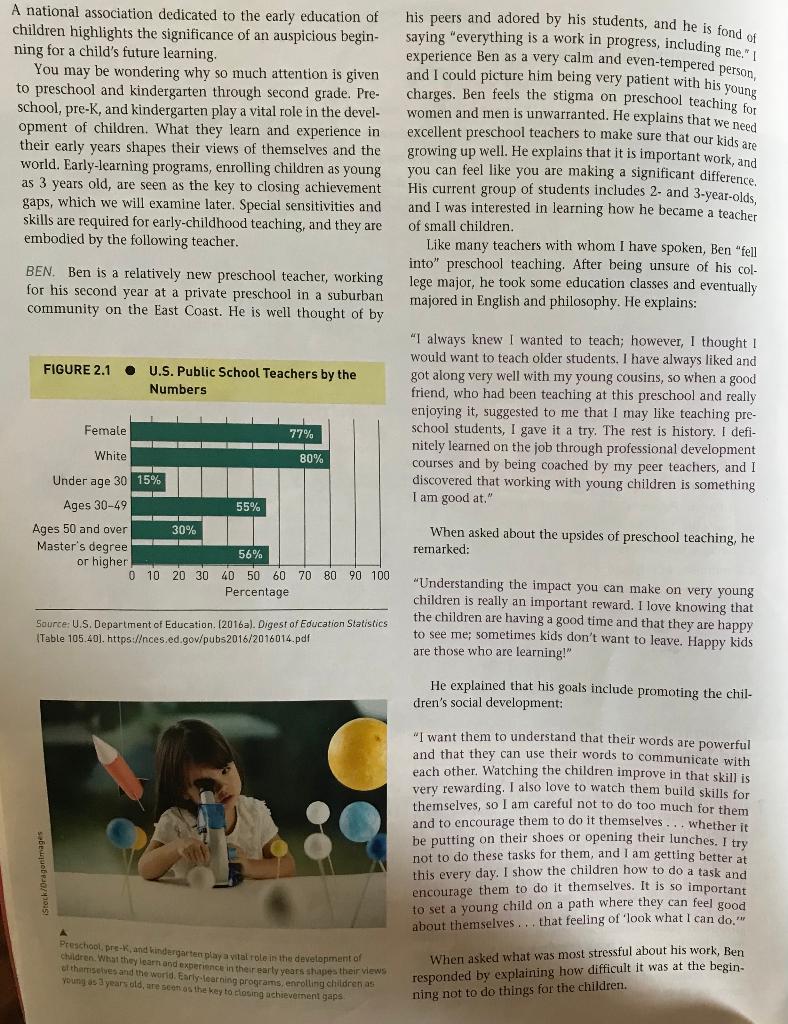
Through the stories of new and experienced teachers, this chapter provides a glimpse into the ways teachers from grades pre-K-12 make their decisions to enter the field and what they consider the most exciting and challenging aspects of their work. Their stories are designed to help you explore what Parker Palmer (2017) calls the "inner landscape of a teacher's life." Being a teacher requires an emotional and intellectual commitment. In a typical school day, teachers can experi- ence excitement and frustration, pleasure and angst, great leaps of joy as well as sadness. How ready you are to navigate these emotions-while at the same time staying focused on your goals for the day-is something only you can know. The stories in this chapter may remind you of yourself or of a teacher you have had. of 42. About 80% are White, which is a decline from 90% in 2001; 77% are female (U.S. Department of Education, 2017b). Given the increasing diversity of students in the United States, many educators believe that U.S. schools have an urgent need for young teachers from varied ethnic back- grounds. Efforts to diversify the nation's teaching workforce have not kept up with the changing landscape of our stu- dents. For example, it is important that more men enter the profession, since researchers have asserted that male role models are significant figures in the classroom. Black men are the most underrepresented demographic in the teach- ing workforce (Mitchell, 2016). Studies are exploring what it takes to recruit and keep minority male teachers in the class- room (Bristol, 2015). Many non-White males see teaching as a woman's profession, especially at the pre-K and elemen- tary levels where the absence of males, especially non-White males, is most pronounced. We know that more than half of all teachers, public and private, are between 30 and 49 years of age, while only 15% are under age 30 (Figure 2.1). This speaks to the large number of younger teachers that leave the profession. It also speaks to the importance of emphasiz- ing how rewarding a teaching career is and how most teach- ers realize satisfaction over a lifetime of teaching. It is also important to dispel teacher stereotypes. In addition, notice that over 55% of teachers have attained a master's degree or higher, signaling the importance of lifelong learning as they continue in their careers. Taking the Roll Call for Students and Teachers About 56 million students are enrolled in American public and private elementary and secondary schools with over 50 million students in public schools. An estimated 5.3 million students attend private schools. Serving these students are 3.6 million teachers, which includes over 400,000 private school teachers. In public schools, between 1985 and 2015, there was a 30% increase in elementary enrollment (pre-K through Grade 8), compared with a 17% increase in sec- ondary enrollment (Grades 9-12). Part of the relatively fast growth in public elementary school enrollment resulted from the expansion of pre-K enrollment (U.S. Department of Education, 2017a). The majority of public school teachers in the U.S. work- force are more than 30 years of age, with an average age Early-Childhood Education There are many more early-childhood teachers today than there were just a few years ago, paralleling the rise of pre-K classes in public and private schools. In Chapter 1, we described the National Association for the Education of Young People (NAEYC), a group that works tirelessly on improving the education of our youngest students. A national association dedicated to the early education of children highlights the significance of an auspicious begin- ning for a child's future learning. You may be wondering why so much attention is given to preschool and kindergarten through second grade. Pre- school, pre-K, and kindergarten play a vital role in the devel- opment of children. What they learn and experience in their early years shapes their views of themselves and the world. Early-learning programs, enrolling children as young as 3 years old, are seen as the key to closing achievement gaps, which we will examine later. Special sensitivities and skills are required for early childhood teaching, and they are embodied by the following teacher. his peers and adored by his students, and he is fond of saying "everything is a work in progress, including me." experience Ben as a very calm and even-tempered person, and I could picture him being very patient with his young charges. Ben feels the stigma on preschool teaching for women and men is unwarranted. He explains that we need excellent preschool teachers to make sure that our kids are growing up well. He explains that it is important work, and you can feel like you are making a significant difference. His current group of students includes 2 and 3-year-olds, and I was interested in learning how he became a teacher of small children Like many teachers with whom I have spoken, Ben "fell into" preschool teaching. After being unsure of his col- lege major, he took some education classes and eventually majored in English and philosophy. He explains: BEN. Ben is a relatively new preschool teacher, working for his second year at a private preschool in a suburban community on the East Coast. He is well thought of by FIGURE 2.1 U.S. Public School Teachers by the Numbers "I always knew I wanted to teach; however, I thought I would want to teach older students. I have always liked and got along very well with my young cousins, so when a good friend, who had been teaching at this preschool and really enjoying it, suggested to me that I may like teaching pre- school students, I gave it a try. The rest is history. I defi- nitely learned on the job through professional development courses and by being coached by my peer teachers, and I discovered that working with young children is something I am good at." Female 77% White 80% Under age 30 15% Ages 30-49 55% Ages 50 and over 30% Master's degree - 56% or higher 0 10 20 30 40 50 60 70 80 90 100 Percentage - When asked about the upsides of preschool teaching, he remarked: Source: U.S. Department of Education. (2016a). Digest of Education Statistics Table 105.40). https:/ces.ed.gov/pubs 2016/2016014.pdf "Understanding the impact you can make on very young children is really an important reward. I love knowing that the children are having a good time and that they are happy to see me; sometimes kids don't want to leave. Happy kids are those who are learning!" He explained that his goals include promoting the chil- dren's social development: "I want them to understand that their words are powerful and that they can use their words to communicate with each other. Watching the children improve in that skill is very rewarding. I also love to watch them build skills for themselves, so I am careful not to do too much for them and to encourage them to do it themselves . . . whether it be putting on their shoes or opening their lunches. I not to do these tasks for them, and I am getting better at this every day. I show the children how to do a task and encourage them to do it themselves. It is so important to set a young child on a path where they can feel good about themselves... that feeling of 'look what I can do When asked what was most stressful about his work, Ben responded by explaining how difficult it was at the begin. Preschool pre-K and kindergarten play a vital role in the development of children. What they learn and experience in their early years shapes their views ettharsetes and the world. Early learning programs, enrolling children as young as 3 years old, are seen as the key to closing achievement gaps. ning not to do things for the children. "I found myself learning from my students the way they develop, and the challenges they are facing. It was really dif- ficult at first not to do things for the children, but that does not help them learn for themselves." Instead, Ben spends time patiently holding out the expec- tations that they can perform the task on their own with a bit of guidance. "You have to be so consistent with young children and know how important your language is. They are teaching me a lot every single day. I tell them that their words are the most important thing they have. I feel like I plant little seeds." Often, early childhood educators are dismissed by society as glorified babysitters. This is incorrect and dam- aging to the profession and to an understanding of the crucial role that early learning plays in the development of healthy children and productive students. There is con- sistent controversy over the role of play in early-learning environments. Watching young children at play reminds us of the social skills the students develop through play, such as empathy, impulse control, capacity for sharing, communicating, and problem solving. Play-based activities also enhance children's capacity to think creatively, make choices, explore their environment, and develop prewrit- ing and sequencing skills. Learning is an interactive, social experience that requires communication between the learners and their peers as well as their teachers. Perhaps the most dominant misconception about early-childhood teaching is that it is not as work-intensive as teaching in the higher grades. In fact, preparing a curriculum and activities for young children requires many hours of research and careful planning. Preschool teachers often work in teams, collaborating on a wide range of early childhood issues. Ben shares that: "Watching more experienced teachers work and having con- versations with them has been so helpful. Everything that my peers do is in the interests of their kids. Even if you do not understand it at first, when you learn their reasoning, you know their goals are to help the children grow." Like the teachers you will read about in the following section, Ben receives support from his colleagues and from taking professional development courses. Deciding to Become a Teacher In my entire life as a student, I remember only twice being given the opportunity to come up with my own ideas, a fact I consider typical and terrible. --Eleanor Duckworth, educational researcher (1991) The Bureau of Labor Statistics' description of "Teach- ing for a Living" begins with the following: "If you dream of inspiring the minds of the future, consider teaching" (Vilorio, 2016). Over the years, I have often asked elemen- tary, middle, and high school teachers from all backgrounds to talk about themselves and their attitudes toward the profession. We begin with what some of them said about their reasons for becoming teachers. Notice how, for some teachers, both new and experienced, teaching was a calling. For others, they had twists and turns in their careers before winding up in the classroom. Think about their stories as you begin your own journey









 Study Help