Please read the Schering Case. Imagine Schering considered an acquisition of a local company in Russia to produce contraceptive pills there, back in 1996. Would you take the risk of such move? Justify.
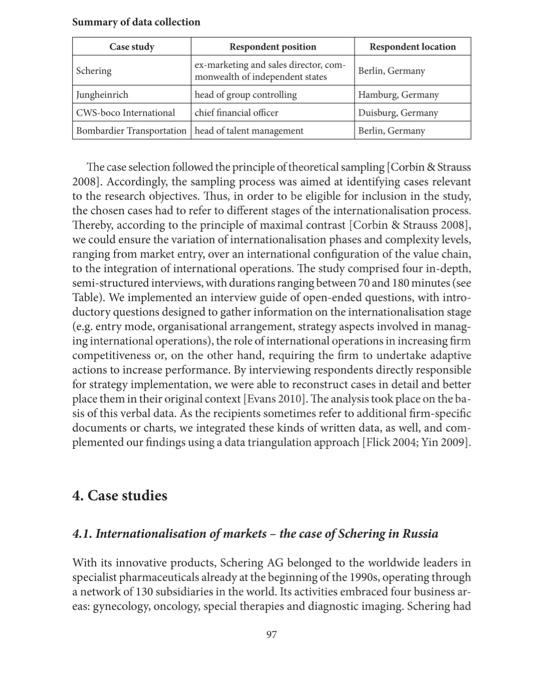
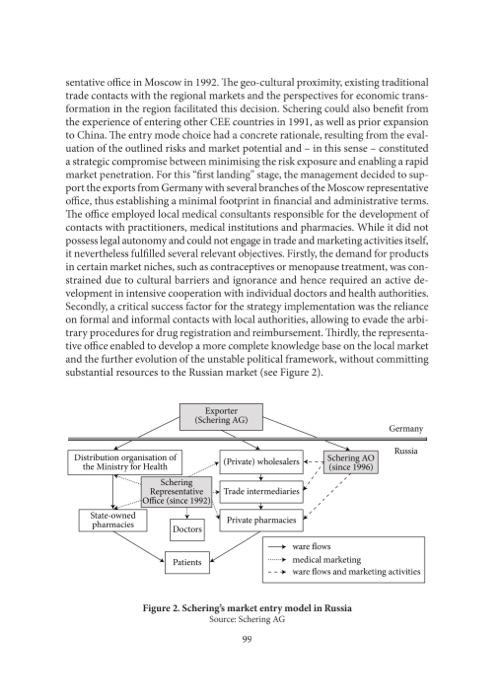
Respondent location Berlin, Germany Summary of data collection Case study Respondent position Schering ex-marketing and sales director, com- monwealth of independent states Jungheinrich head of group controlling CWS-boco International chief financial officer Bombardier Transportation head of talent management Hamburg, Germany Duisburg, Germany Berlin, Germany The case selection followed the principle of theoretical sampling (Corbin & Strauss 2008). Accordingly, the sampling process was aimed at identifying cases relevant to the research objectives. Thus, in order to be eligible for inclusion in the study, the chosen cases had to refer to different stages of the internationalisation process. Thereby, according to the principle of maximal contrast (Corbin & Strauss 2008), we could ensure the variation of internationalisation phases and complexity levels, ranging from market entry, over an international configuration of the value chain, to the integration of international operations. The study comprised four in-depth, semi-structured interviews with durations ranging between 70 and 180 minutes (see Table). We implemented an interview guide of open-ended questions, with intro- ductory questions designed to gather information on the internationalisation stage (e.g.entry mode, organisational arrangement, strategy aspects involved in manag- ing international operations), the role of international operations in increasing firm competitiveness or, on the other hand, requiring the firm to undertake adaptive actions to increase performance. By interviewing respondents directly responsible for strategy implementation, we were able to reconstruct cases in detail and better place them in their original context (Evans 2010). The analysis took place on the ba- sis of this verbal data. As the recipients sometimes refer to additional firm-specific documents or charts, we integrated these kinds of written data, as well, and com- plemented our findings using a data triangulation approach (Flick 2004; Yin 2009). 4. Case studies 4.1. Internationalisation of markets - the case of Schering in Russia With its innovative products, Schering AG belonged to the worldwide leaders in specialist pharmaceuticals already at the beginning of the 1990s, operating through a network of 130 subsidiaries in the world. Its activities embraced four business ar- eas: gynecology, oncology, special therapies and diagnostic imaging. Schering had 97 revolutionised the contraceptives market with the introduction of the pill" back in 1961, which gained a global market share of 50% already in 1971. The acquisition of Schering by Bayer AG in 2006 was primarily motivated by the integration of the pharmaceutical businesses of the two firms and the realisation of synergies in terms of product offering, Bayer Health Care Pharmaceuticals (formerly Bayer Schering Pharma), headquartered in Berlin, now belongs to the ten top pharmaceutical spe- cialists in the world. The company generated revenues of almost 10 billion in 2011. whereby Schering brands accounted for 2/3 of the sold drugs. Despite a growing demand for medicines related to the increased life expectancy and a simultaneous surge of chronic diseases, allowing for a stable growth even in times of global recession, the dramatic rise of research & development costs in the h industry leads to a pressure on cost reduction. Moreover, a successful development and a possibly wide market introduction of blockbuster' drugs can be regarded as a condition for survival. In this context, a rapid expansion into foreign markets oc- cupied a particular position in the growth strategy of Schering. A natural course of expansion at the beginning of the 1990s was Central and Eastern Europe (CEE), whose political transformation opened significant markets for Western firms. The Russian market alone, with its population of ca. 140 mil- lion and positive GDP growth forecasts, showed an enormous potential despite its still limited income per capita. From the perspective of Schering, the primary is- sue related to the uncertainty of entering an unknown market, on which no reli- able market reports existed, as it was usual in the case of developed markets. This lack of knowledge significantly hindered identification of the market structure, par- ticularly in terms of the state-owned distribution channels and credibility of local business partners. Moreover, drug manufacturers were subject to bureaucratised and highly arbitrary registration procedures, necessary to introduce drugs to the Russian market, which immensely prolonged the time-to-market. However, these delays differed between firms, depending on their informal relationships with au- thorities and hence the ability to influence the formal procedures. On the demand side, the high inflation rate afflicted the purchasing power of Russian patients, while the drug reimbursement by the state was limited due to budgetary constraints and subjected to highly arbitrary procedures. The low political stability and legal secu- rity posed a direct threat to the operations of foreign entrants, as the bureaucrat- ic rules for business activity and the complex fiscal laws deteriorated the business planning process due to their constant and unforeseeable changes. While the pat- ent law was in place, its violations and the diffusion of copy or fake products were commonplace, eroding the profits of original drug manufacturers. In spite of these risk factors, Schering seized the opportunity to enter the Russian market immediately after the political change in CEE and opened the first repre- HA A drug which generates annual sales of at least $1 billion 98 sentative office in Moscow in 1992. The geo-cultural proximity, existing traditional trade contacts with the regional markets and the perspectives for economic trans- formation in the region facilitated this decision. Schering could also benefit from the experience of entering other CEE countries in 1991, as well as prior expansion to China. The entry mode choice had a concrete rationale, resulting from the eval- uation of the outlined risks and market potential and - in this sense - constituted a strategic compromise between minimising the risk exposure and enabling a rapid market penetration. For this "first landing stage, the management decided to sup port the exports from Germany with several branches of the Moscow representative Office, thus establishing a minimal footprint in financial and administrative terms. The office employed local medical consultants responsible for the development of contacts with practitioners, medical institutions and pharmacies. While it did not possess legal autonomy and could not engage in trade and marketing activities itself. it nevertheless fulfilled several relevant objectives. Firstly, the demand for products in certain market niches, such as contraceptives or menopause treatment was con- strained due to cultural barriers and ignorance and hence required an active de- velopment in intensive cooperation with individual doctors and health authorities, Secondly, a critical success factor for the strategy implementation was the reliance on formal and informal contacts with local authorities, allowing to evade the arbi trary procedures for drug registration and reimbursement. Thirdly, the representa- tive office enabled to develop a more complete knowledge base on the local market and the further evolution of the unstable political framework, without committing substantial resources to the Russian market (see Figure 2). Exporter (Schering AG) Germany Russia (Private) wholesalers Schering AO Esince 1996) Distribution organisation of the Ministry for Health Schering Representative Office (since 1992) State-owned pharmacies Doctors Trade intermediaries Private pharmacies ware flows medical marketing ware flows and marketing activities Patients Figure 2. Schering's market entry model in Russia Source Schering AG 99 Since Schering's management perceived the Russian market as important for the firm's long-term competitive position, it gradually decided to increase the investment and extend market penetration. For this purpose, a subsidiary of local law (Schering AO) was founded in 1996, reinforcing the market presence. The new operating mode enabled Schering to shape its marketing strategy in Russia independently of local intermediaries, particularly in terms of pricing. For the contraceptives seg- ment, the local marketing department introduced a three-pill" competitive strategy differentiating between low priced pills for public tenders, middle priced pills for wholesalers and the most innovative premium-priced pills for private pharmacies. Product differentiation and Schering's strong brand image provided an additional protection against me too and copy-products. Moreover, the product offering al- lowed Schering to capitalise on the significant demand for innovative drugs, which were lacking in an emerging economy. Last but not least, the development of own distribution network had an opera- tional advantage of internalising the logistic chain and making it independent of local distribution agents. On the other hand, the creation of Schering AO exposed the firm to local regulations to a larger extent than before. However, the risk of unexpected and unfavourable legal changes was deliberately accepted in the light of the long- term orientation towards increasing market sales in Central and Eastern Europe. 4.2. Internationalisation of value chain modules - the case of Jungheinrich Jungheinrich is one of the world's three leading companies in the material han dling equipment, warehousing and material flow engineering sectors, as well as the European leader in warehousing technology. Established in Hamburg, the compa- ny offers a broad range of products and services for the intralogistics. The business model of Jungheinrich is based on direct sales of products and services via wholly- owned subsidiaries in international markets. A primary reason for this internalisa- tion extent is the critical role of customer service for business growth. Therefore, a focal question prior to each market entry pertains to the existence of a sufficient sales volume of new products and, consequently, a potential for service activities, This relevance of market potential for both new products and service activities re- mains in a close relationship with the firm's competitive strategy. The market for indoor electro-technical trucks is of top priority to Jungheinrich, although its level of development varies across countries, especially emerging markets. In the seg ment of outdoor combustion engine trucks, which grows dynamically in emerging markets, premium, middle and low-cost product segments can be distinguished. Jungheinrich basically follows a differentiation strategy and therefore puts empha- sis on the premium segment. Thus, markets with a dominance of the low-cost seg ment are to a large extent inaccessible for the company. 100