





Question: Please read the text below and answer all 3 questions.. Below is a picture of an example how it should be answer. Medical Coverage The

Please read the text below and answer all 3 questions.. Below is a picture of an example how it should be answer.
Medical Coverage
The medical plan is a combination of two types of plans-a preferred provider
network and a traditional indemnity plan that does not require a network.
Employees are automatically covered under both and will receive the better preferred
provider organization (PPO) network benefits whenever they use a PPO provider.
Our PPO network offers high-quality care at a discounted price. Benefits provided
under this plan are only for services done by a PPO member. These are referred to as
network providers.
A prescription drug plan is included with the medical plan. All full-time employees
and their eligible dependents qualify for participation in the group dental insurance
program. Coverage for eligible employees is effective after 30 days of employment.
1. are these the best options for the company financially and for the employees to have different options?
2. What do you see that you might do differently to control rising costs in this category?
3. Do you see this as required for all employees, or might there be an option where some employees might just want catastrophic or emergency coverage, or may not need any provided by the company at all?
Please read the text below and answer all 3
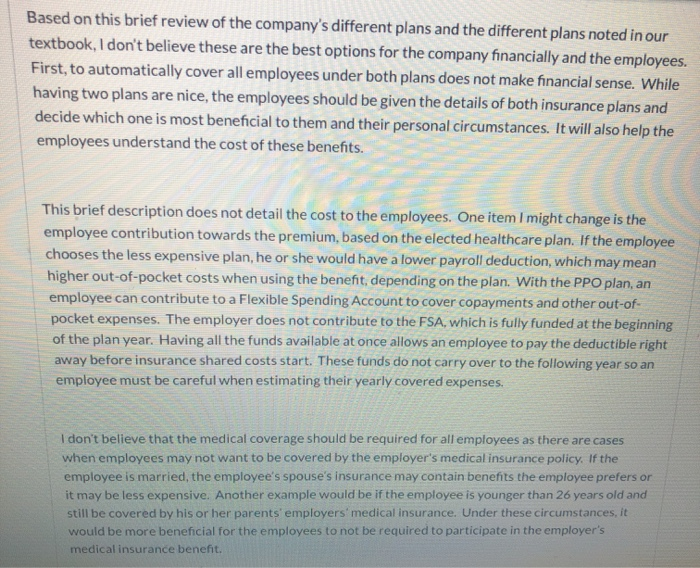
Based on this brief review of the company's different plans and the different plans noted in our textbook, I don't believe these are the best options for the company financially and the employees. First, to automatically cover all employees under both plans does not make financial sense. While having two plans are nice, the employees should be given the details of both insurance plans and decide which one is most beneficial to them and their personal circumstances. It will also help the employees understand the cost of these benefits. This brief description does not detail the cost to the employees. One item I might change is the employee contribution towards the premium, based on the elected healthcare plan. If the employee chooses the less expensive plan, he or she would have a lower payroll deduction, which may mean higher out-of-pocket costs when using the benefit, depending on the plan. With the PPO plan, an employee can contribute to a Flexible Spending Account to cover copayments and other out-of- pocket expenses. The employer does not contribute to the FSA, which is fully funded at the beginning of the plan year. Having all the funds available at once allows an employee to pay the deductible right away before insurance shared costs start. These funds do not carry over to the following year so an employee must be careful when estimating their yearly covered expenses. I don't believe that the medical coverage should be required for all employees as there are cases when employees may not want to be covered by the employer's medical insurance policy. If the employee is married, the employee's spouse's insurance may contain benefits the employee prefers or it may be less expensive. Another example would be if the employee is younger than 26 years old and still be covered by his or her parents' employers' medical insurance. Under these circumstances, it would be more beneficial for the employees to not be required to participate in the employer's medical insurance benefit

Step by Step Solution

There are 3 Steps involved in it

1 Expert Approved Answer
Step: 1 Unlock blur-text-image

Question Has Been Solved by an Expert!

Get step-by-step solutions from verified subject matter experts

Step: 2 Unlock
Step: 3 Unlock

Students Have Also Explored These Related General Management Questions!