







Question: Please read this case and do it according to 4 questions in first picture, please don't ignore any question. (Operations Research) Requirements to the Contents
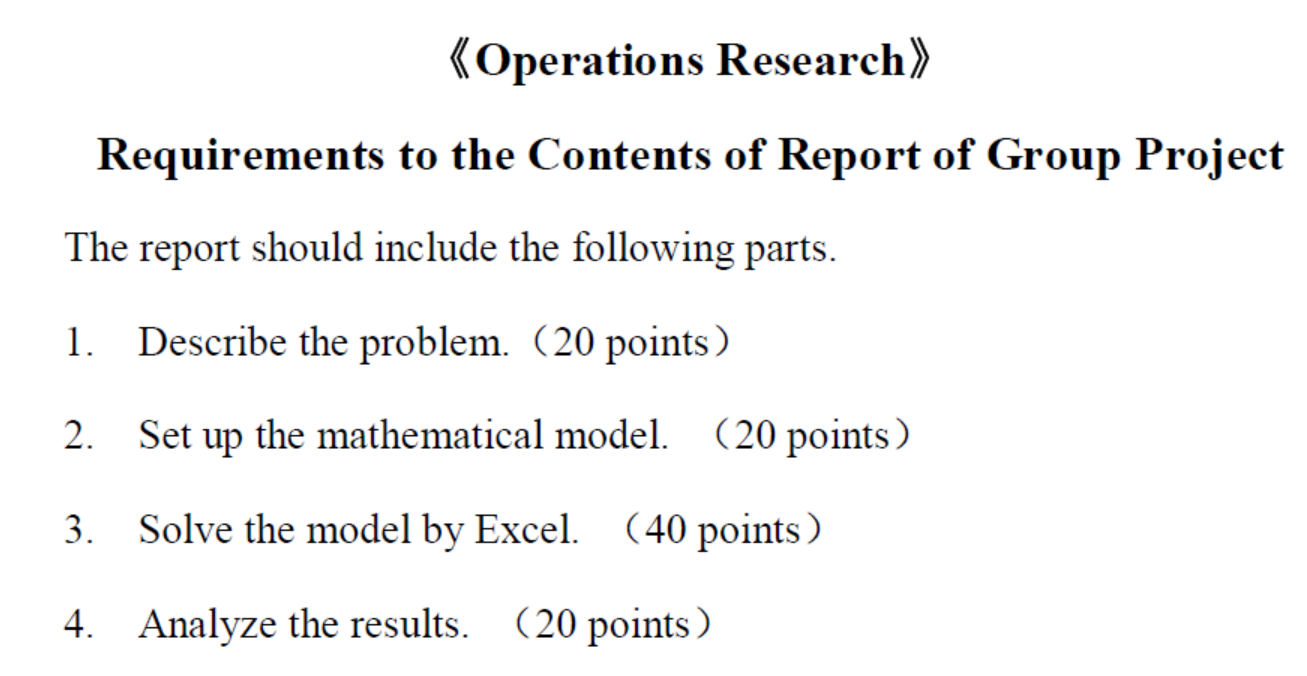
Please read this case and do it according to 4 questions in first picture, please don't ignore any question.
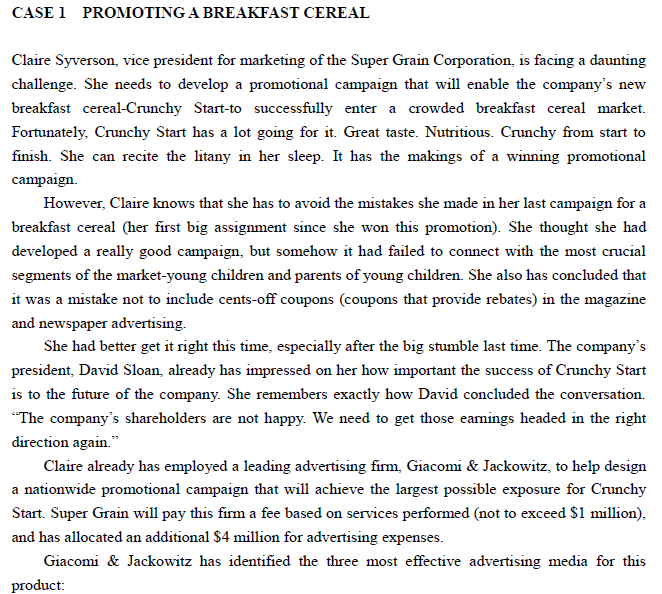
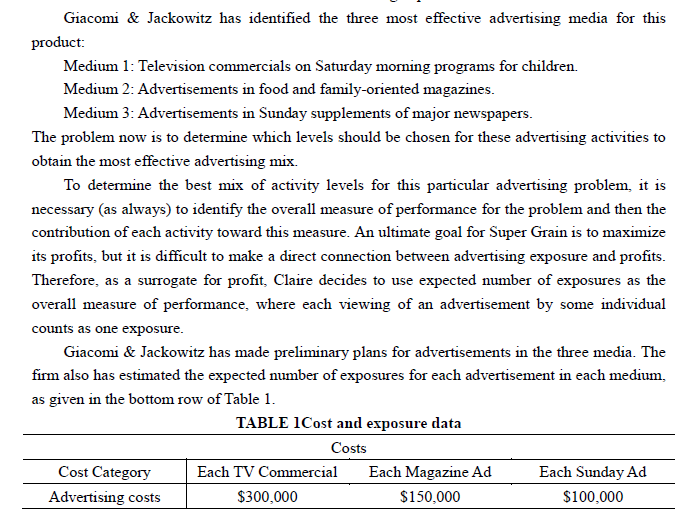
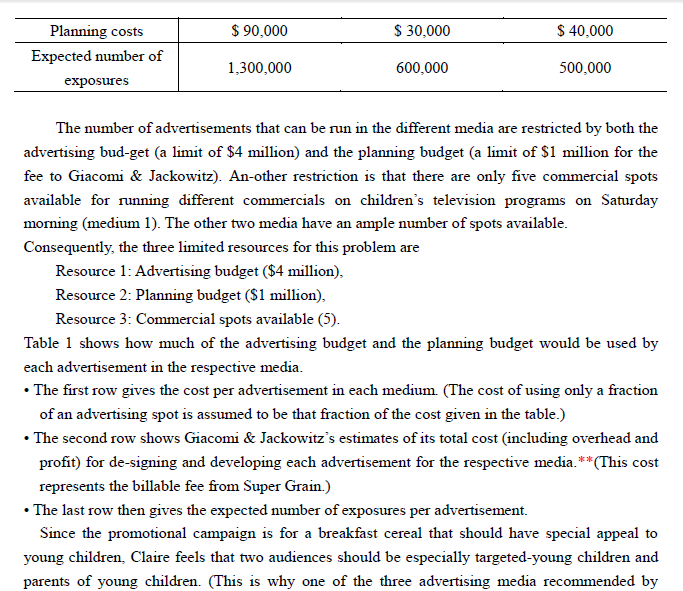
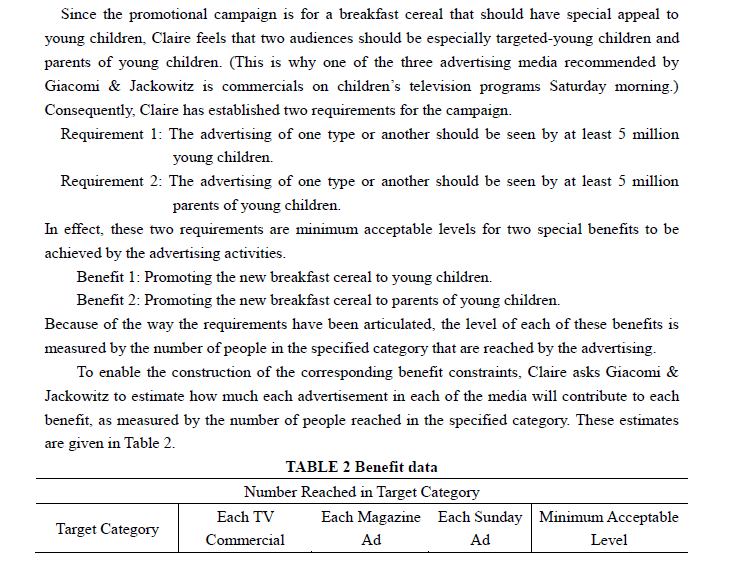
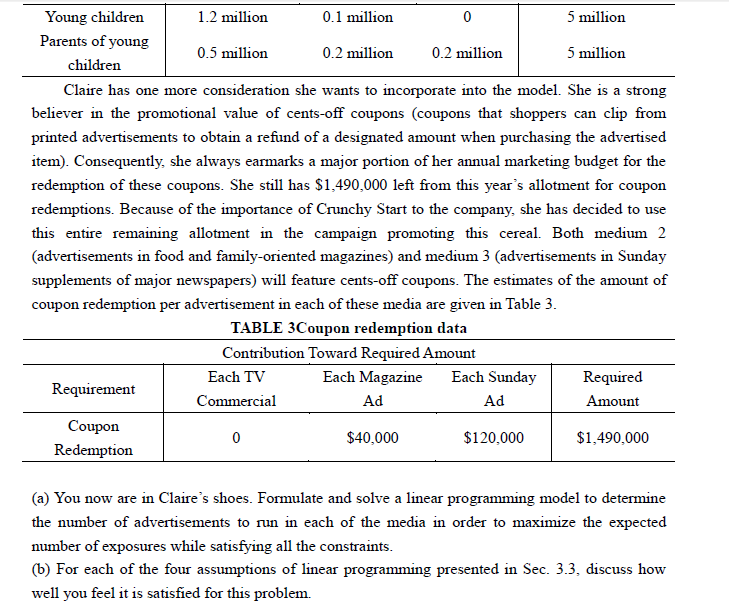
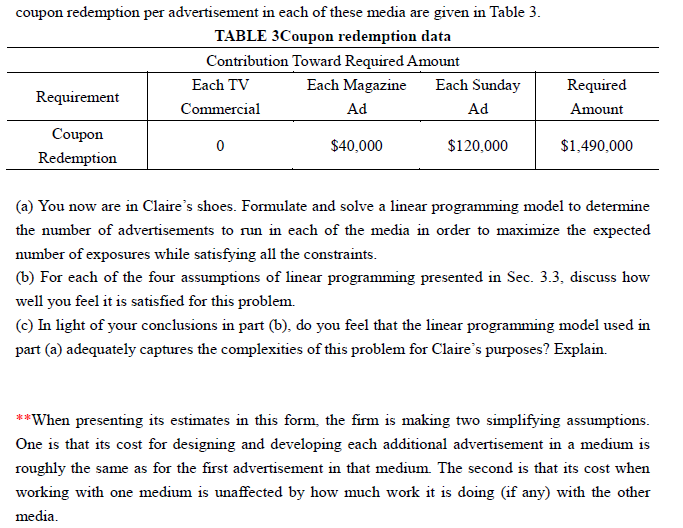
(Operations Research) Requirements to the Contents of Report of Group Project The report should include the following parts. 1. Describe the problem. (20 points) 2. Set up the mathematical model. (20 points) 3. Solve the model by Excel. (40 points) 4. Analyze the results. (20 points) CASE 1 PROMOTING A BREAKFAST CEREAL Claire Syverson, vice president for marketing of the Super Grain Corporation, is facing a daunting challenge. She needs to develop a promotional campaign that will enable the company's new breakfast cereal-Crunchy Start-to successfully enter a crowded breakfast cereal market. Fortunately, Crunchy Start has a lot going for it. Great taste. Nutritious. Crunchy from start to finish. She can recite the litany in her sleep. It has the makings of a winning promotional campaign. However, Claire knows that she has to avoid the mistakes she made in her last campaign for a breakfast cereal (her first big assignment since she won this promotion). She thought she had developed a really good campaign, but somehow it had failed to connect with the most crucial segments of the market-young children and parents of young children. She also has concluded that it was a mistake not to include cents-off coupons (coupons that provide rebates) in the magazine and newspaper advertising She had better get it right this time, especially after the big stumble last time. The company's president, David Sloan, already has impressed on her how important the success of Crunchy Start is to the future of the company. She remembers exactly how David concluded the conversation. "The company's shareholders are not happy. We need to get those earnings headed in the right direction again." Claire already has employed a leading advertising firm, Giacomi & Jackowitz, to help design a nationwide promotional campaign that will achieve the largest possible exposure for Crunchy Start. Super Grain will pay this firm a fee based on services performed (not to exceed $1 million). and has allocated an additional $4 million for advertising expenses. Giacomi & Jackowitz has identified the three most effective advertising media for this product: Giacomi & Jackowitz has identified the three most effective advertising media for this product: Medium 1: Television commercials on Saturday morning programs for children. Medium 2: Advertisements in food and family-oriented magazines. Medium 3: Advertisements in Sunday supplements of major newspapers. The problem now is to determine which levels should be chosen for these advertising activities to obtain the most effective advertising mix. To determine the best mix of activity levels for this particular advertising problem, it is necessary (as always) to identify the overall measure of performance for the problem and then the contribution of each activity toward this measure. An ultimate goal for Super Grain is to maximize its profits, but it is difficult to make a direct connection between advertising exposure and profits. Therefore, as a surrogate for profit. Claire decides to use expected number of exposures as the overall measure of performance, where each viewing of an advertisement by some individual counts as one exposure. Giacomi & Jackowitz has made preliminary plans for advertisements in the three media. The firm also has estimated the expected number of exposures for each advertisement in each medium, as given in the bottom row of Table 1. TABLE 1Cost and exposure data Costs Cost Category Each TV Commercial Each Magazine Ad Each Sunday Ad Advertising costs $300,000 $150,000 $100,000 $ 90,000 $ 30,000 $ 40,000 Planning costs Expected number of exposures 1,300,000 600,000 500,000 The number of advertisements that can be run in the different media are restricted by both the advertising bud-get (a limit of $4 million) and the planning budget (a limit of $1 million for the fee to Giacomi & Jackowitz). An-other restriction is that there are only five commercial spots available for running different commercials on children's television programs on Saturday morning (medium 1). The other two media have an ample number of spots available. Consequently, the three limited resources for this problem are Resource 1: Advertising budget ($4 million) Resource 2: Planning budget ($1 million), Resource 3: Commercial spots available (5). Table 1 shows how much of the advertising budget and the planning budget would be used by each advertisement in the respective media. The first row gives the cost per advertisement in each medium (The cost of using only a fraction of an advertising spot is assumed to be that fraction of the cost given in the table.) The second row shows Giacomi & Jackowitz's estimates of its total cost (including overhead and profit) for de-signing and developing each advertisement for the respective media. **(This cost represents the billable fee from Super Grain.) The last row then gives the expected number of exposures per advertisement. Since the promotional campaign is for a breakfast cereal that should have special appeal to young children, Claire feels that two audiences should be especially targeted-young children and parents of young children. (This is why one of the three advertising media recommended by Since the promotional campaign is for a breakfast cereal that should have special appeal to young children, Claire feels that two audiences should be especially targeted-young children and parents of young children. (This is why one of the three advertising media recommended by Giacomi & Jackowitz is commercials on children's television programs Saturday morning.) Consequently, Claire has established two requirements for the campaign. Requirement 1: The advertising of one type or another should be seen by at least 5 million young children. Requirement 2: The advertising of one type or another should be seen by at least 5 million parents of young children. In effect, these two requirements are minimum acceptable levels for two special benefits to be achieved by the advertising activities. Benefit 1: Promoting the new breakfast cereal to young children. Benefit 2: Promoting the new breakfast cereal to parents of young children. Because of the way the requirements have been articulated, the level of each of these benefits is measured by the number of people in the specified category that are reached by the advertising. To enable the construction of the corresponding benefit constraints, Claire asks Giacomi & Jackowitz to estimate how much each advertisement in each of the media will contribute to each benefit, as measured by the number of people reached in the specified category. These estimates are given in Table 2. TABLE 2 Benefit data Number Reached in Target Category Each TV Each Magazine Each Sunday Minimum Acceptable Target Category Commercial Ad Ad Level Young children 1.2 million 0.1 million 0 5 million Parents of young 0.5 million 0.2 million 0.2 million 5 million children Claire has one more consideration she wants to incorporate into the model. She is a strong believer in the promotional value of cents-off coupons (coupons that shoppers can clip from printed advertisements to obtain a refund of a designated amount when purchasing the advertised item). Consequently, she always earmarks a major portion of her annual marketing budget for the redemption of these coupons. She still has $1,490,000 left from this year's allotment for coupon redemptions. Because of the importance of Crunchy Start to the company, she has decided to use this entire remaining allotment in the campaign promoting this cereal. Both medium 2 (advertisements in food and family-oriented magazines) and medium 3 (advertisements in Sunday supplements of major newspapers) will feature cents-off coupons. The estimates of the amount of coupon redemption per advertisement in each of these media are given in Table 3. TABLE 3Coupon redemption data Contribution Toward Required Amount Each TV Each Magazine Each Sunday Required Requirement Commercial Ad Ad Amount Coupon 0 $40,000 $120,000 $1,490,000 Redemption (a) You now are in Claire's shoes. Formulate and solve a linear programming model to determine the number of advertisements to run in each of the media in order to maximize the expected number of exposures while satisfying all the constraints. (b) For each of the four assumptions of linear programming presented in Sec. 3.3, discuss how well you feel it is satisfied for this problem. coupon redemption per advertisement in each of these media are given in Table 3. TABLE 3Coupon redemption data Contribution Toward Required Amount Each TV Each Magazine Each Sunday Requirement Commercial Ad Ad Coupon 0 $40,000 $120,000 Redemption Required Amount $1,490,000 (a) You now are in Claire's shoes. Formulate and solve a linear programming model to determine the number of advertisements to run in each of the media in order to maximize the expected number of exposures while satisfying all the constraints. (b) For each of the four assumptions of linear programming presented in Sec. 3.3, discuss how well you feel it is satisfied for this problem. (c) In light of your conclusions in part (b), do you feel that the linear programming model used in part (a) adequately captures the complexities of this problem for Claire's purposes? Explain. *When presenting its estimates in this form, the firm is making two simplifying assumptions. One is that its cost for designing and developing each additional advertisement in a medium is roughly the same as for the first advertisement in that medium The second is that its cost when working with one medium is unaffected by how much work it is doing (if any) with the other media. (Operations Research) Requirements to the Contents of Report of Group Project The report should include the following parts. 1. Describe the problem. (20 points) 2. Set up the mathematical model. (20 points) 3. Solve the model by Excel. (40 points) 4. Analyze the results. (20 points) CASE 1 PROMOTING A BREAKFAST CEREAL Claire Syverson, vice president for marketing of the Super Grain Corporation, is facing a daunting challenge. She needs to develop a promotional campaign that will enable the company's new breakfast cereal-Crunchy Start-to successfully enter a crowded breakfast cereal market. Fortunately, Crunchy Start has a lot going for it. Great taste. Nutritious. Crunchy from start to finish. She can recite the litany in her sleep. It has the makings of a winning promotional campaign. However, Claire knows that she has to avoid the mistakes she made in her last campaign for a breakfast cereal (her first big assignment since she won this promotion). She thought she had developed a really good campaign, but somehow it had failed to connect with the most crucial segments of the market-young children and parents of young children. She also has concluded that it was a mistake not to include cents-off coupons (coupons that provide rebates) in the magazine and newspaper advertising She had better get it right this time, especially after the big stumble last time. The company's president, David Sloan, already has impressed on her how important the success of Crunchy Start is to the future of the company. She remembers exactly how David concluded the conversation. "The company's shareholders are not happy. We need to get those earnings headed in the right direction again." Claire already has employed a leading advertising firm, Giacomi & Jackowitz, to help design a nationwide promotional campaign that will achieve the largest possible exposure for Crunchy Start. Super Grain will pay this firm a fee based on services performed (not to exceed $1 million). and has allocated an additional $4 million for advertising expenses. Giacomi & Jackowitz has identified the three most effective advertising media for this product: Giacomi & Jackowitz has identified the three most effective advertising media for this product: Medium 1: Television commercials on Saturday morning programs for children. Medium 2: Advertisements in food and family-oriented magazines. Medium 3: Advertisements in Sunday supplements of major newspapers. The problem now is to determine which levels should be chosen for these advertising activities to obtain the most effective advertising mix. To determine the best mix of activity levels for this particular advertising problem, it is necessary (as always) to identify the overall measure of performance for the problem and then the contribution of each activity toward this measure. An ultimate goal for Super Grain is to maximize its profits, but it is difficult to make a direct connection between advertising exposure and profits. Therefore, as a surrogate for profit. Claire decides to use expected number of exposures as the overall measure of performance, where each viewing of an advertisement by some individual counts as one exposure. Giacomi & Jackowitz has made preliminary plans for advertisements in the three media. The firm also has estimated the expected number of exposures for each advertisement in each medium, as given in the bottom row of Table 1. TABLE 1Cost and exposure data Costs Cost Category Each TV Commercial Each Magazine Ad Each Sunday Ad Advertising costs $300,000 $150,000 $100,000 $ 90,000 $ 30,000 $ 40,000 Planning costs Expected number of exposures 1,300,000 600,000 500,000 The number of advertisements that can be run in the different media are restricted by both the advertising bud-get (a limit of $4 million) and the planning budget (a limit of $1 million for the fee to Giacomi & Jackowitz). An-other restriction is that there are only five commercial spots available for running different commercials on children's television programs on Saturday morning (medium 1). The other two media have an ample number of spots available. Consequently, the three limited resources for this problem are Resource 1: Advertising budget ($4 million) Resource 2: Planning budget ($1 million), Resource 3: Commercial spots available (5). Table 1 shows how much of the advertising budget and the planning budget would be used by each advertisement in the respective media. The first row gives the cost per advertisement in each medium (The cost of using only a fraction of an advertising spot is assumed to be that fraction of the cost given in the table.) The second row shows Giacomi & Jackowitz's estimates of its total cost (including overhead and profit) for de-signing and developing each advertisement for the respective media. **(This cost represents the billable fee from Super Grain.) The last row then gives the expected number of exposures per advertisement. Since the promotional campaign is for a breakfast cereal that should have special appeal to young children, Claire feels that two audiences should be especially targeted-young children and parents of young children. (This is why one of the three advertising media recommended by Since the promotional campaign is for a breakfast cereal that should have special appeal to young children, Claire feels that two audiences should be especially targeted-young children and parents of young children. (This is why one of the three advertising media recommended by Giacomi & Jackowitz is commercials on children's television programs Saturday morning.) Consequently, Claire has established two requirements for the campaign. Requirement 1: The advertising of one type or another should be seen by at least 5 million young children. Requirement 2: The advertising of one type or another should be seen by at least 5 million parents of young children. In effect, these two requirements are minimum acceptable levels for two special benefits to be achieved by the advertising activities. Benefit 1: Promoting the new breakfast cereal to young children. Benefit 2: Promoting the new breakfast cereal to parents of young children. Because of the way the requirements have been articulated, the level of each of these benefits is measured by the number of people in the specified category that are reached by the advertising. To enable the construction of the corresponding benefit constraints, Claire asks Giacomi & Jackowitz to estimate how much each advertisement in each of the media will contribute to each benefit, as measured by the number of people reached in the specified category. These estimates are given in Table 2. TABLE 2 Benefit data Number Reached in Target Category Each TV Each Magazine Each Sunday Minimum Acceptable Target Category Commercial Ad Ad Level Young children 1.2 million 0.1 million 0 5 million Parents of young 0.5 million 0.2 million 0.2 million 5 million children Claire has one more consideration she wants to incorporate into the model. She is a strong believer in the promotional value of cents-off coupons (coupons that shoppers can clip from printed advertisements to obtain a refund of a designated amount when purchasing the advertised item). Consequently, she always earmarks a major portion of her annual marketing budget for the redemption of these coupons. She still has $1,490,000 left from this year's allotment for coupon redemptions. Because of the importance of Crunchy Start to the company, she has decided to use this entire remaining allotment in the campaign promoting this cereal. Both medium 2 (advertisements in food and family-oriented magazines) and medium 3 (advertisements in Sunday supplements of major newspapers) will feature cents-off coupons. The estimates of the amount of coupon redemption per advertisement in each of these media are given in Table 3. TABLE 3Coupon redemption data Contribution Toward Required Amount Each TV Each Magazine Each Sunday Required Requirement Commercial Ad Ad Amount Coupon 0 $40,000 $120,000 $1,490,000 Redemption (a) You now are in Claire's shoes. Formulate and solve a linear programming model to determine the number of advertisements to run in each of the media in order to maximize the expected number of exposures while satisfying all the constraints. (b) For each of the four assumptions of linear programming presented in Sec. 3.3, discuss how well you feel it is satisfied for this problem. coupon redemption per advertisement in each of these media are given in Table 3. TABLE 3Coupon redemption data Contribution Toward Required Amount Each TV Each Magazine Each Sunday Requirement Commercial Ad Ad Coupon 0 $40,000 $120,000 Redemption Required Amount $1,490,000 (a) You now are in Claire's shoes. Formulate and solve a linear programming model to determine the number of advertisements to run in each of the media in order to maximize the expected number of exposures while satisfying all the constraints. (b) For each of the four assumptions of linear programming presented in Sec. 3.3, discuss how well you feel it is satisfied for this problem. (c) In light of your conclusions in part (b), do you feel that the linear programming model used in part (a) adequately captures the complexities of this problem for Claire's purposes? Explain. *When presenting its estimates in this form, the firm is making two simplifying assumptions. One is that its cost for designing and developing each additional advertisement in a medium is roughly the same as for the first advertisement in that medium The second is that its cost when working with one medium is unaffected by how much work it is doing (if any) with the other mediaStep by Step Solution
There are 3 Steps involved in it
1 Expert Approved Answer
Step: 1 Unlock

Question Has Been Solved by an Expert!
Get step-by-step solutions from verified subject matter experts
Step: 2 Unlock
Step: 3 Unlock
 Study Help