







Question: Please refer attached case study and answer following questions 1. Consider Dr. Ofri's comments about the trade off of using EMRs in the context of
Please refer attached case study and answer following questions
1. Consider Dr. Ofri's comments about the trade off of using EMRs in the context of your most recent visit to a health care professional. Did he or she use a computer? If so, did you feel that it interfered with your discussion? Compare answers with your classmates.
2. Suppose your family lives in Vermont, you attend school in Texas, and you break your leg while skiing in Colorado. Describe how EMRs coukl help in that situation.
Critical Thinking Questions
1a. (For U.S. students) The United States has been criscized for having excellent health care but no health care system. Do you feel that criticism is justified? What, if anything, can EMRs do to address this concem?
1b. (For students outside the United States) Compare what your country is doing with EMRs with the situation in any other country at approx-mately the same economic level. Is your country ahead of the other in its adoption or behind Why is this so? In your opinion, is that a problem?
2 Find the definition of "meaningful use" of EMRs on the Web. Do you feel that the meaningful use standards for physicians force them to move too fast Let them move too slowly?
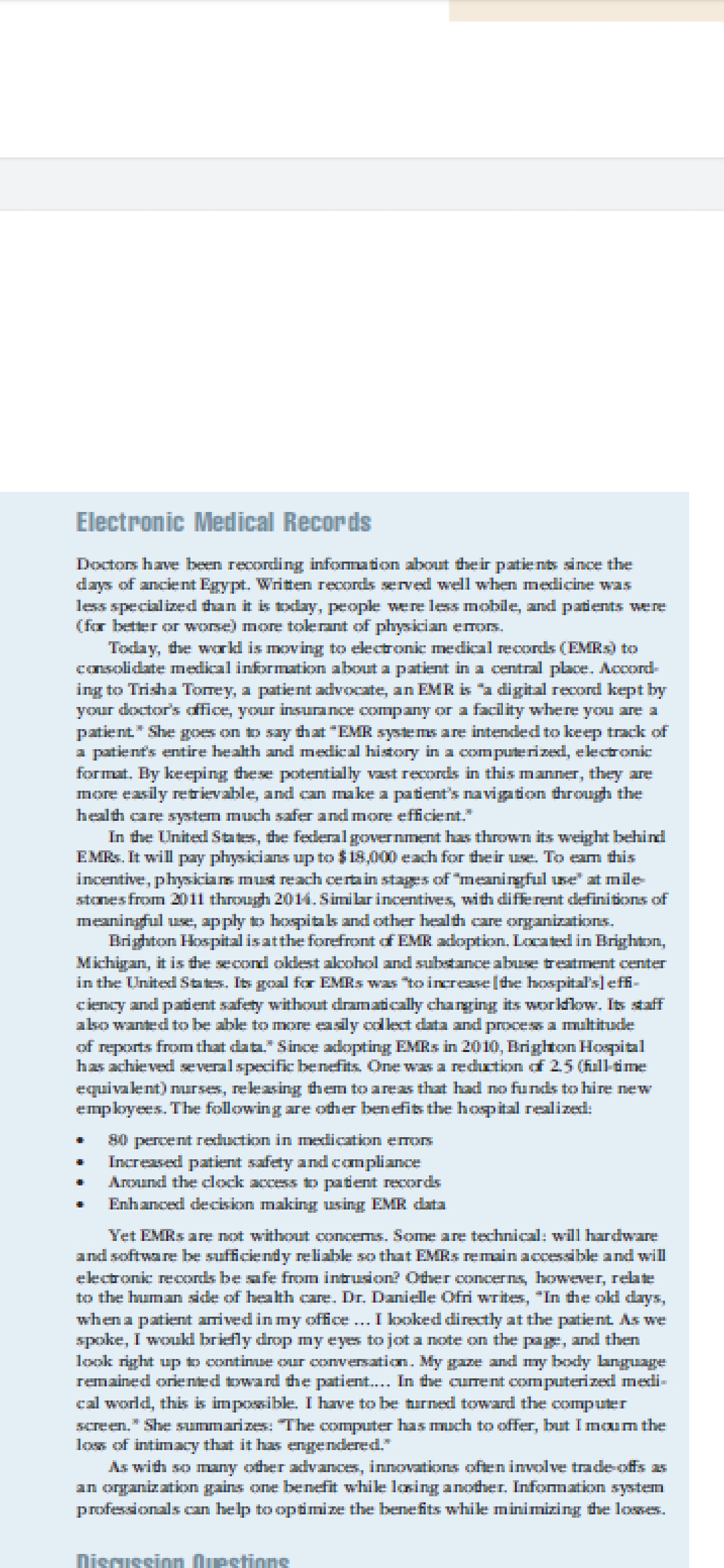
Electronic Medical Records Doctors have been recording information about their patients since the days of ancient Egypt. Written records served well when medicine was less specialized than it is today, people were less mobile, and patients were ( fox better or worse) more tolerant of physician enor. Today, the world is moving to electronic medical records (EMRs) to consolidate medical information about a patient in a central place. Accord- ing to Trisha Toney, a patient advocate, an EMR is "a digital record kept by your doctor's office, your insurance company or a facility where you are a patient " She goes on to say that "EMR systems are intended to keep track of a patient's entire health and medical history in a computerized, electronic format. By keeping these potentially vast records in this manner, they are more easily retrievable, and can make a patient's navigation through the health care system much safer and more efficient." In the United States, the federal government has thrown its weight behind EMRs. It will pay physicians up to $18,000 each for their us To earn this incentive, physicians must reach certain stages of "meaningful use" at mile stones from 2011 through 2014. Similar incentives, with different definitions of meaningful wx, apply to hospitals and other health care organizations. Brighton Hospital is at the forefront of EMR adoption, Located in Brighton, Michigan, it is the second oldest alcohol and substance abuse treatment center in the United States. Its goal for EMRs was "to increase [ the hospital's] effi- ciency and patient safety without dramatically changing its workflow. Its staff also wanted to be able to more easily collect data and process a multitude of reports from that data." Since adopting EMRs in 2010, Brighton Hospital has achieved several specific benefits One was a reduction of 25 (full-time equivalent) nurses, releasing them to areas that had no funds to hire new employees. The following are other benefits the hospital realized: # 80 percent reduction in medication errors Increased patient safety and compliance Around the clock access to patient records Enhanced decision making using EMR data Yet EMRs are not without concerns. Some are technical: will hardware and software be sufficiently reliable so that EMRs remain accessible and will electronic records be safe from intrusion? Other concerns, however, rebate to the human side of health care. Dr. Danielle Ofri writes, "In the old days, when a patient anived in my office ... I looked directly at the patient As we spoke, I would briefly drop my eyes to jot a note on the page, and then look right up to continue our conversation. My gaze and my body language remained oriented toward the patient.... In the current computerized medi- cal world, this is impossible. I have to be turned toward the computer screen. " She summarizes: The computer has much to offer, but I moum the loss of intimacy that it has engendered." As with so many other advances, innovations often involve trade offs as an organization gains one benefit while losing another. Information system professionals can help to optimize the benefits while minimizing the losses
Step by Step Solution
There are 3 Steps involved in it

Get step-by-step solutions from verified subject matter experts
 Study Help