







Question: PLEASE refer to data table and requirements for your answer as necessary. PLEASE Right click on image and open image in new tab if text
PLEASE refer to data table and requirements for your answer as necessary.
PLEASE Right click on image and open image in new tab if text is too blurry.
PLEASE type out your answer or use Excel as it is easier to read than handwriting.
PLEASE round all answers as necessary.
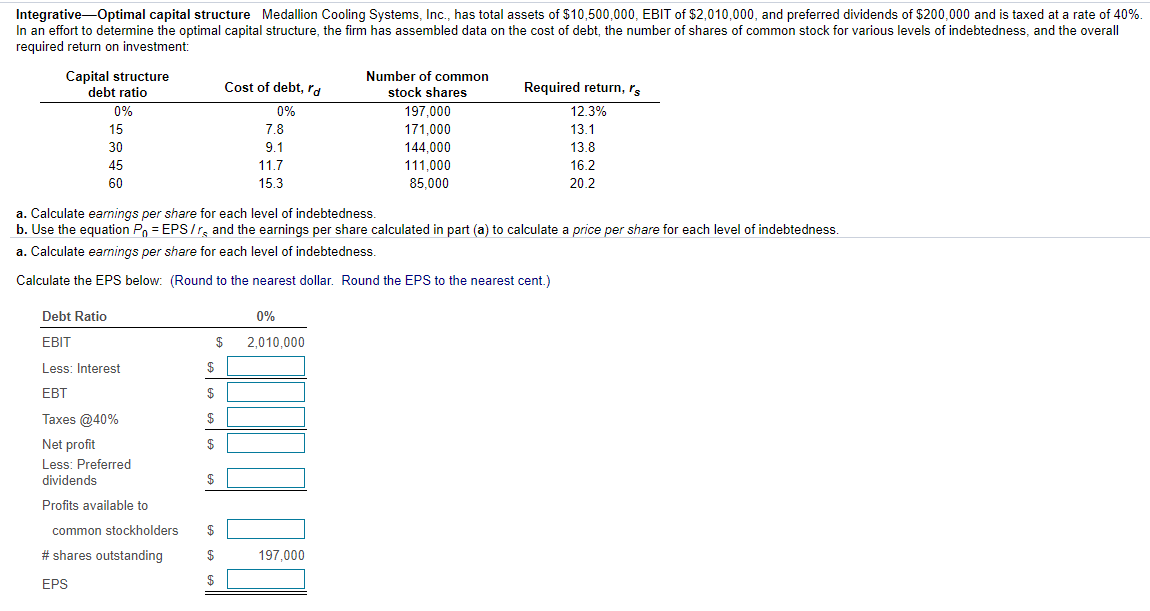
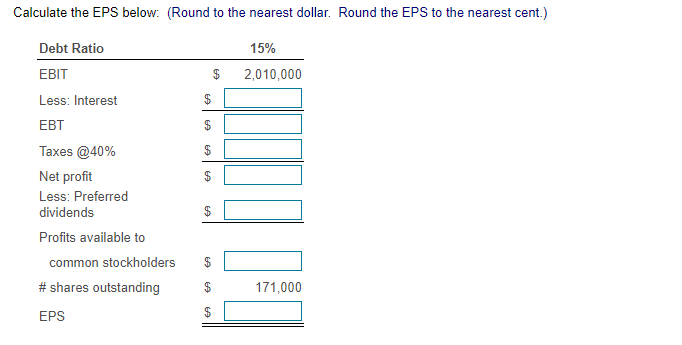
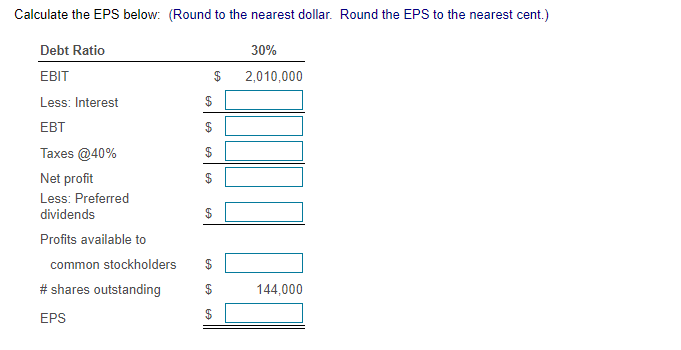
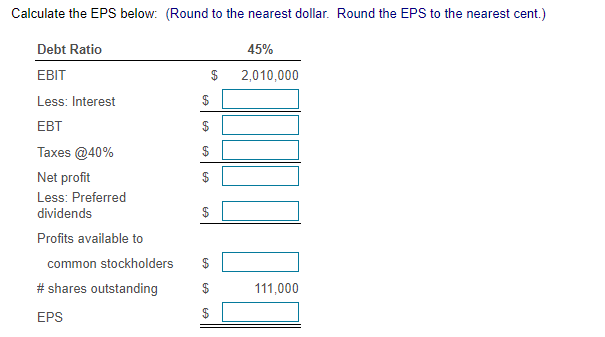
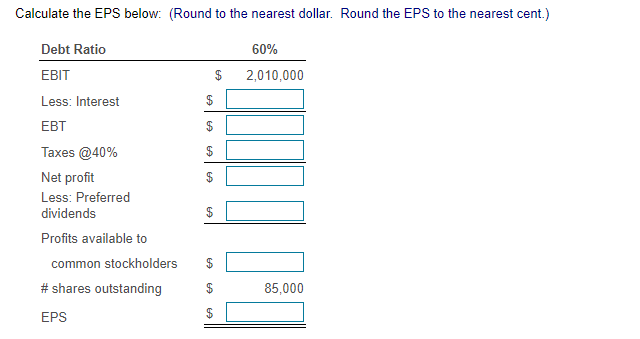
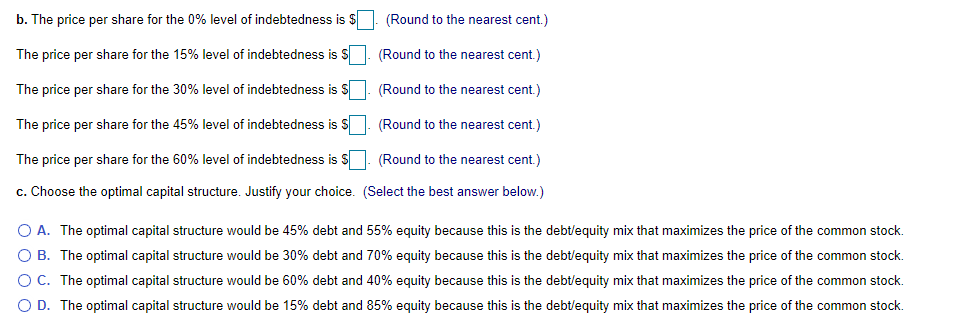
Integrative-Optimal capital structure Medallion Cooling Systems, Inc., has total assets of $10,500,000, EBIT of $2,010,000, and preferred dividends of $200,000 and is taxed at a rate of 40%. In an effort to determine the optimal capital structure, the firm has assembled data on the cost of debt, the number of shares of common stock for various levels of indebtedness, and the overall required return on investment: Capital structure debt ratio 0% 15 30 45 60 Cost of debt, rd 0% 7.8 9.1 11.7 15.3 Number of common stock shares 197,000 171,000 144,000 111,000 85,000 Required return, 's 12.3% 13.1 13.8 16.2 20.2 a. Calculate earnings per share for each level of indebtedness. b. Use the equation Po = EPS/rs and the earnings per share calculated in part (a) to calculate a price per share for each level of indebtedness. a. Calculate earnings per share for each level of indebtedness. Calculate the EPS below: (Round to the nearest dollar. Round the EPS to the nearest cent.) Debt Ratio 0% EBIT $ 2,010,000 $ Less: Interest EBT $ Taxes @40% Net profit Less: Preferred dividends $ $ Profits available to $ common stockholders # shares outstanding $ 197.000 EPS $ Calculate the EPS below: (Round to the nearest dollar. Round the EPS to the nearest cent.) 15% 2,010,000 $ $ $ Debt Ratio EBIT Less: Interest EBT Taxes @40% Net profit Less: Preferred dividends Profits available to common stockholders # shares outstanding EA $ $ 171,000 EPS $ Calculate the EPS below: (Round to the nearest dollar. Round the EPS to the nearest cent.) 30% $ 2,010,000 Debt Ratio EBIT Less: Interest EBT CA $ $ $ Taxes @40% Net profit Less: Preferred dividends Profits available to common stockholders # shares outstanding $ 144,000 EPS $ Calculate the EPS below: (Round to the nearest dollar. Round the EPS to the nearest cent.) 45% $ CA 2,010,000 A $ $ Debt Ratio EBIT Less: Interest EBT Taxes @40% Net profit Less: Preferred dividends Profits available to common stockholders # shares outstanding $ $ $ 111,000 EPS $ Calculate the EPS below: (Round to the nearest dollar. Round the EPS to the nearest cent.) 60% $ 2,010,000 $ Debt Ratio EBIT Less: Interest EBT Taxes @40% Net profit Less: Preferred dividends Profits available to common stockholders # shares outstanding EPS $ $ $ 85,000 $ b. The price per share for the 0% level of indebtedness is $. (Round to the nearest cent.) The price per share for the 15% level of indebtedness is $. (Round to the nearest cent.) The price per share for the 30% level of indebtedness is $. (Round to the nearest cent.) The price per share for the 45% level of indebtedness is $. (Round to the nearest cent.) The price per share for the 60% level of indebtedness is $. (Round to the nearest cent.) c. Choose the optimal capital structure. Justify your choice. (Select the best answer below.) A. The optimal capital structure would be 45% debt and 55% equity because this is the debt/equity mix that maximizes the price of the common stock. OB. The optimal capital structure would be 30% debt and 70% equity because this is the debt/equity mix that maximizes the price of the common stock. OC. The optimal capital structure would be 60% debt and 40% equity because this is the debt/equity mix that maximizes the price of the common stock. OD. The optimal capital structure would be 15% debt and 85% equity because this is the debt/equity mix that maximizes the price of the common stock
Step by Step Solution
There are 3 Steps involved in it

Get step-by-step solutions from verified subject matter experts
 Study Help