







Question: Please refer to the above case: Question: 2. Using the table below discuss how the risks were addressed or how they could have been addressed.
Please refer to the above case:
Question:
2. Using the table below discuss how the risks were addressed or how they could have been addressed. Include any additional risks you can think of.
Please discuss why you came to your conclusion.
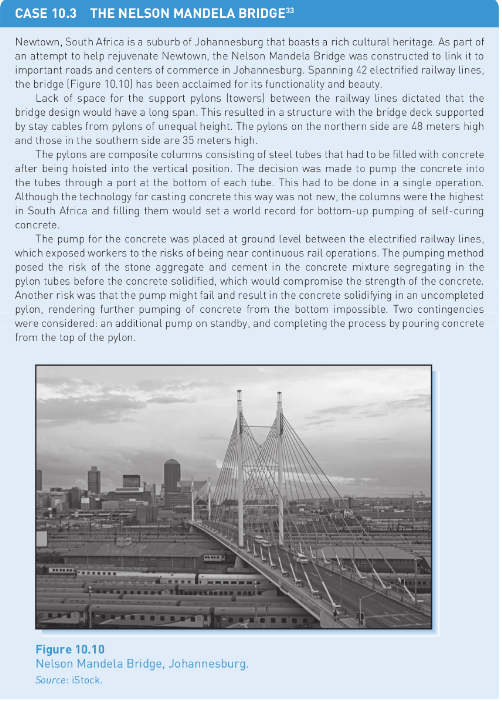
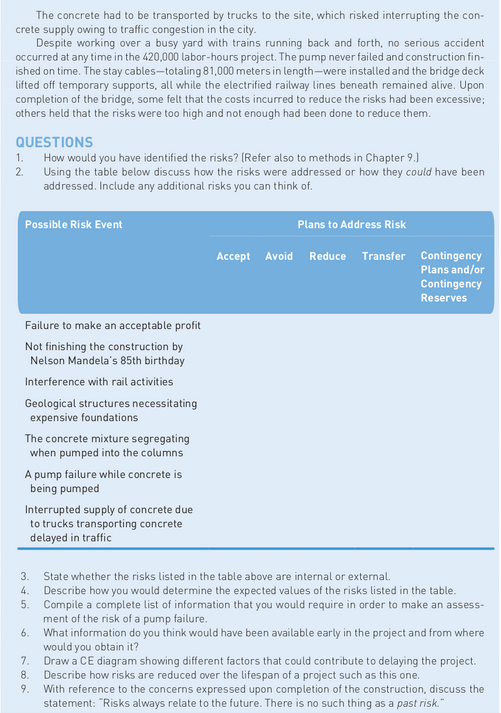
CASE 10.3 THE NELSON MANDELA BRIDGE Newtown, South Africa is a suburb of Johannesburg that boasts a rich cultural heritage. As part of an attempt to help rejuvenate Newtown, the Nelson Mandela Bridge was constructed to link it to important roads and centers of commerce in Johannesburg. Spanning 42 electrified railway lines. the bridge (Figure 10.10) has been acclaimed for its functionality and beauty Lack of space for the support pylons (towers) between the railway lines dictated that the bridge design would have a long span. This resulted in a structure with the bridge deck supported by stay cables from pylons of unequal height. The pylons on the northern side are 48 meters high and those in the southern side are 35 meters high. The pylons are compusile columns consisting of steel tubes that had to be filled with concrete after being hoisted into the vertical position. The decision was made to pump the concrete into the tubes through a port at the bottom of each tube. This had to be done in a single operation. Although the technology for casting concrete this way was not new, the columns were the highest in South Africa and filling them would set a world record for bottom-up pumping of self-curing The pump for the concrete was placed at ground level between the electrified railway lines. which exposed workers to the risks of being near continuous rail operations. The pumping method posed the risk of the stone aggregate and cement in the concrete mixture segregating in the pylon tubes before the concrete solidified, which would compromise the strength of the concrete. Another risk was that the pump might fail and result in the concrete solidifying in an uncompleted pylon, rendering further pumping of concrete from the bottom impossible. Two contingencies were considered an additional pump on standby, and completing the process by pouring concrete from the top of the pylon concrete Figure 10.10 Nelson Mandela Bridge, Johannesburg. Source: iStock The concrete had to be transported by trucks to the site, which risked interrupting the con- crete supply owing to traffic congestion in the city. Despite working over a busy yard with trains running back and forth, no serious accident occurred at any time in the 420,000 labor-hours project. The pump never failed and construction fin- ished on time. The stay cables-totaling 81.000 meters in length -- were installed and the bridge deck lifted off temporary supports, all while the electrified railway lines beneath remained alive. Upon completion of the bridge, some felt that the costs incurred to reduce the risks had been excessive; others held that the risks were too high and not enough had been done to reduce them. QUESTIONS 1. How would you have identified the risks? (Refer also to methods in Chapter 9.) Using the table below discuss how the risks were addressed or how they could have been addressed. Include any additional risks you can think of. 2. Possible Risk Event Plans to Address Risk Accept Avoid Reduce Transfer Contingency Plans and/or Contingency Reserves Failure to make an acceptable profit Not finishing the construction by Nelson Mandela's 85th birthday Interference with rail activities Geological structures necessitating expensive foundations The concrete mixture segregating when pumped into the columns A pump failure while concrete is being pumped Interrupted supply of concrete due to trucks transporting concrete delayed in traffic 3. State whether the risks listed in the table above are internal or external. 4. Describe how you would determine the expected values of the risks listed in the table. 5. Compile a complete list of information that you would require in order to make an assess- ment of the risk of a pump failure. 6. What information do you think would have been available early in the project and from where would you obtain it? 7. Draw a CE diagram showing different factors that could contribute to delaying the project. Describe how risks are reduced over the lifespan of a project such as this one. 9. With reference to the concerns expressed upon completion of the construction, discuss the statement: "Risks always relate to the future. There is no such thing as a past risk." 8Step by Step Solution
There are 3 Steps involved in it
1 Expert Approved Answer
Step: 1 Unlock

Question Has Been Solved by an Expert!
Get step-by-step solutions from verified subject matter experts
Step: 2 Unlock
Step: 3 Unlock
 Study Help