







Question: Please reply to the inquiry by the reference with an understanding *Please reply to the inquiry with an interpretation of the reference Issue: What overarching
Please reply to the inquiry by the reference with an understanding
*Please reply to the inquiry with an interpretation of the reference
Issue: What overarching issue was the court addressing or resolving (one questions not a paragraph just one sentence encapsulating)
Facts: What are the facts that the court described and cared about?
facts section should only include the actual facts of the case.
Rule of Law:What rule please mention the statue, case, legal principle mention did the court apply
*rule of law segment should only include the actual statutes, constitutional amendments or cases the Court applies the facts USE PRECEDENT FROM THE OTHER ITALIZES CASES
Application- how did the court apply the rule to the facts?
*application section should be how the Court applied the facts to the law
Conclusion: what result did the court reach and WHY?
Kuhlmann v. Wilson
The state court found that Officer Cullen had instructed Lee only to listen to respondent for the purpose of determining the identities of the other participants in the robbery and murder. The police already had solid evidence of respondent's participation. The court further found that Lee followed those instructions, that he "at no time asked any questions" of respondent concerning the pending charges, and that he "only listened" to respondent's "spontaneous" and "unsolicited" statements. The only remark made by Lee that has any support in this record was his comment that respondent's initial version of his participation in the crimes "didn't sound too good."
the Court of Appeals focused on that one remark and gave a description of Lee's interaction with respondent that is completely at odds with the facts found by the trial court.
The judgment of the Court of Appeals is reversed, and the case is remanded for further proceedings consistent with this opinion.
It is so ordered.
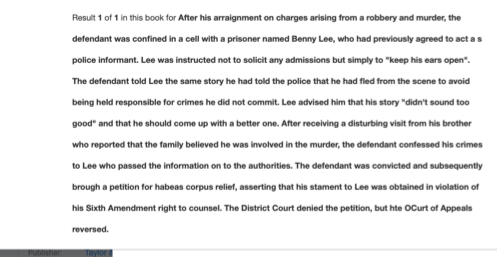
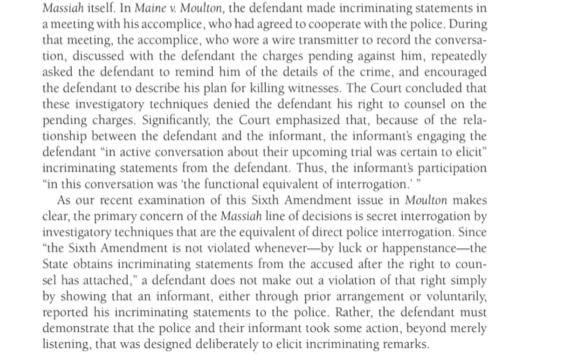
Result 1 of 1 in this book for After his arraignment on charges arising from a robbery and murder, the defendant was confined in a cell with a prisoner named Benny Lee, who had previously agreed to act a s police informant. Lee was instructed not to solicit any admissions but simply to "keep his ears open". The defendant told Lee the same story he had told the police that he had fled from the scene to avoid being held responsible for crimes he did not commit. Lee advised him that his story "didn't sound too good" and that he should come up with a better one. After receiving a disturbing visit from his brother who reported that the family believed he was involved in the murder, the defendant confessed his crimes to Lee who passed the information on to the authorities. The defendant was convicted and subsequently brough a petition for habeas corpus relief, asserting that his stament to Lee was obtained in violation of his Sixth Amendment right to counsel. The District Court denied the petition, but hte OCurt of Appeals reversed. BylorMessiah itself. In Maine it Moullart. the defendant made incriminating statements In a meeting with his accomplice. who had agreed to cooperate with the police. During that meeting. the accomplice. who wore a wire transmitter to record the conversa- lion. dimmed with the defendant the charges pending against him. repeatedly asked the defendant to remind him of the details of the crime. and encouraged the defendant to describe his plan for killing Vintnesses. The Court concluded that these investigator'y techniques denied the defendant his right to counsel on the pending charges. Signicantly. the Court emphasized that. because of the rela- tionship between the defendant and the informant. the informants engaging the defendant \"in active conversation about their upcoming trial was certain to elicit" incriminating statements from the defendant. Thus. the informants participation \"in this conversation was 'the functional equivalent of intenoytion.' " As our recent. examination. of this Sixth amendment issue in Moullan makes clear. the primary concern of the Messiah line of decisions is secret intenogation by investigator}! techniques that are the equivalent oldirect police interrogation. Since \"the Sixth amendment is not violated wheneverby Incl: or happenstancethe State obtains incriminating statements from the accused alter the right to court- sel has attached." a defendant does not make out a violation of that right sirt'lriltir by showing that art irtfonnartl. either throuyt prior arrangement or voluntarily. reported his incriminating statemnts to the police. Rather. the defendant must demonstrate that the police and their inlonnant tool: some action. beyond merely listening. that was designed deliberately to elicit incriminating remarks
Step by Step Solution
There are 3 Steps involved in it

Get step-by-step solutions from verified subject matter experts
 Study Help