







Question: Please respond in four-steps, Thank you When Jack Welch was appointed the CEO of General Electric (GE) in 1981, he made a number of changes.
Please respond in four-steps, Thank you
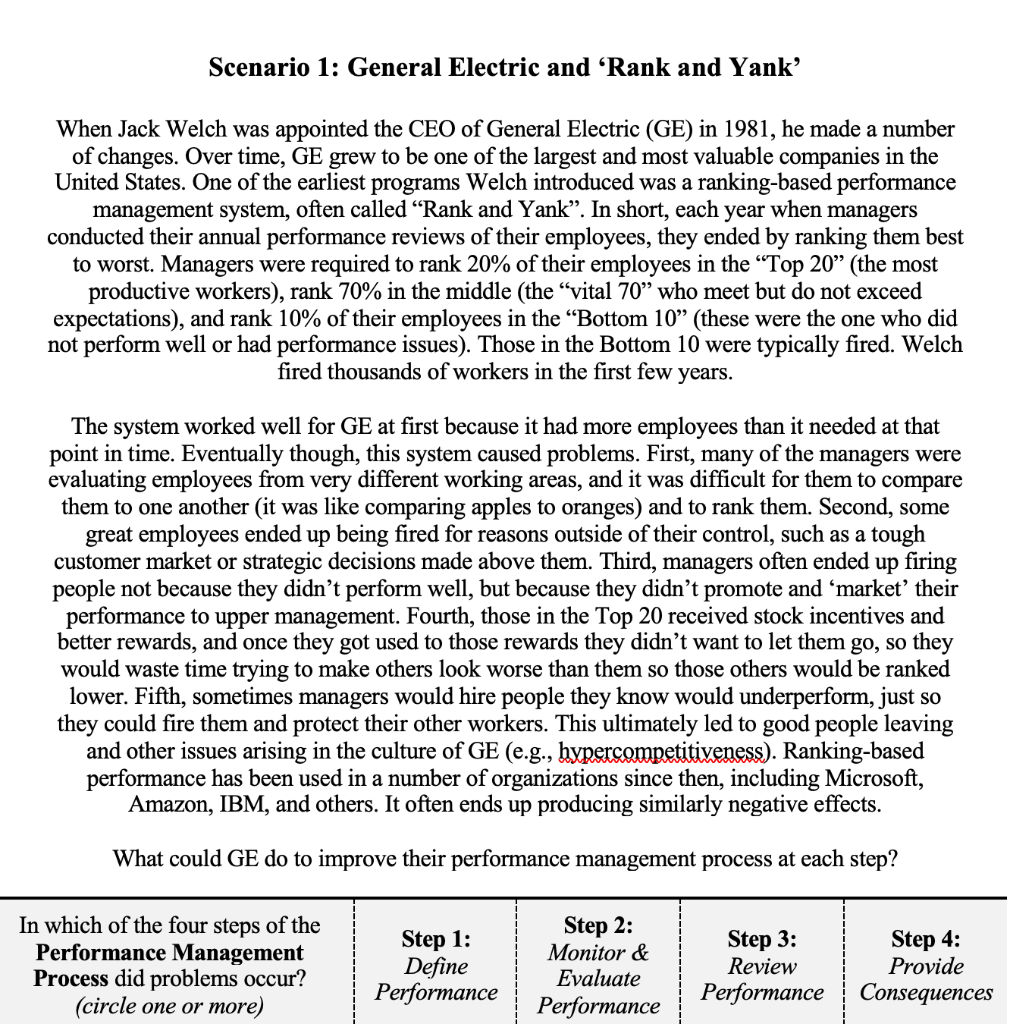
When Jack Welch was appointed the CEO of General Electric (GE) in 1981, he made a number of changes. Over time, GE grew to be one of the largest and most valuable companies in the United States. One of the earliest programs Welch introduced was a ranking-based performance management system, often called "Rank and Yank". In short, each year when managers conducted their annual performance reviews of their employees, they ended by ranking them best to worst. Managers were required to rank 20% of their employees in the "Top 20 " (the most productive workers), rank 70% in the middle (the "vital 70" who meet but do not exceed expectations), and rank 10% of their employees in the "Bottom 10" (these were the one who did not perform well or had performance issues). Those in the Bottom 10 were typically fired. Welch fired thousands of workers in the first few years. The system worked well for GE at first because it had more employees than it needed at that point in time. Eventually though, this system caused problems. First, many of the managers were evaluating employees from very different working areas, and it was difficult for them to compare them to one another (it was like comparing apples to oranges) and to rank them. Second, some great employees ended up being fired for reasons outside of their control, such as a tough customer market or strategic decisions made above them. Third, managers often ended up firing people not because they didn't perform well, but because they didn't promote and 'market' their performance to upper management. Fourth, those in the Top 20 received stock incentives and better rewards, and once they got used to those rewards they didn't want to let them go, so they would waste time trying to make others look worse than them so those others would be ranked lower. Fifth, sometimes managers would hire people they know would underperform, just so they could fire them and protect their other workers. This ultimately led to good people leaving and other issues arising in the culture of GE (e.g., hypercompetitiveness). Ranking-based performance has been used in a number of organizations since then, including Microsoft, Amazon, IBM, and others. It often ends up producing similarly negative effects. What could GE do to improve their performance management process at each stepStep by Step Solution
There are 3 Steps involved in it
1 Expert Approved Answer
Step: 1 Unlock

Question Has Been Solved by an Expert!
Get step-by-step solutions from verified subject matter experts
Step: 2 Unlock
Step: 3 Unlock
 Study Help