







Question: Please review the below two case study's with required specific questions for each. I'd like to know if my provided answers are accurate, If you
Please review the below two case study's with required specific questions for each. I'd like to know if my provided answers are accurate, If you have suggestions for each, please provide explanation and reference for each new idea. Thank you.
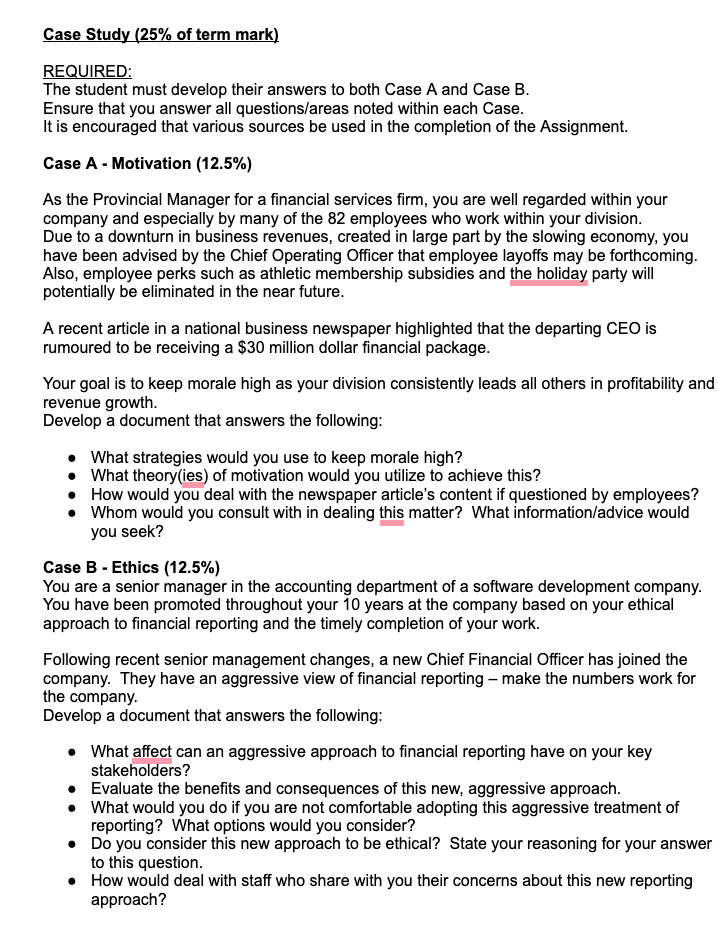
Case A Motivation (12.5%)
As the Provincial Manager for a financial services firm, you are well regarded within your company and especially by many of the 82 employees who work within your division.
Due to a downturn in business revenues, created in large part by the slowing economy, you have been advised by the Chief Operating Officer that employee layoffs may be forthcoming. Also, employee perks such as athletic membership subsidies and holiday parties will potentially be eliminated in the near future.
A recent article in a national business newspaper highlighted that the departing CEO is rumoured to be receiving a $30 million dollar financial package.
Your goal is to keep morale high as your division consistently leads all others in profitability and revenue growth.
What strategies would you use to keep morale high?
It's not simple to keep people motivated during difficult economic times when their jobs are in jeopardy. It is vital to communicate the truth to employees through an official meeting in which the facts are communicated effectively to the employees in order to keep employee morale strong during a difficult revenue position in the organization. This will allow them time to reflect, and while they are doing so, it is also vital to reassure them that things will change as a result of their hard work and devotion and that the company is doing everything possible to keep everyone employed. This will motivate people to work hard and feel appreciated, even if some will lose their employment in the end.
What theory of motivation would you utilize to achieve this?
Maslow's hierarchy of needs, particularly the notion of safety and security, is the best motivating theory to use in this case. Giving employees the assurance that the company would try to keep everyone's employment and providing a suitable send-off package will motivate them to work hard even if the future is uncertain because their basic needs for job security and financial stability will be met.
How would you deal with the newspaper article's content if questioned by employees?
When employees inquire about the newspaper article's comments about the CEO receiving a whopping $30 million, giving them the truth, since it is a tradition and business policy, will calm them down. It's also a good idea to mention that the subject is currently being discussed by the board.
Whom would you consult in dealing with this matter? What information/advice would you seek?
HR personnel and the Company's chief financial officer are the appropriate people to consult in this situation. The HR department will address the topic of layoffs, while the CFO will discuss the financial elements of the situation and its anticipated consequence.
References.
McLeod, S. (2007). Maslow's hierarchy of needs.Simply psychology,1(1-18).
Maslow, A., & Lewis, K. J. (1987). Maslow's hierarchy of needs.Salenger Incorporated,14(17), 987-990.
Ittner, C. D., Lambert, R. A., & Larcker, D. F. (2003). The structure and performance consequences of equity grants to employees of new economy firms.Journal of Accounting and Economics,34(1-3), 89-127.
Leovaridis, C., & Popescu, G. (2015). Organizational innovation-A means to enhance quality of life for employees in knowledge economy.Management Dynamics in the Knowledge Economy,3(1), 25.
Case B - Ethics (12.5%)
You are a senior manager in the accounting department of a software development company. You have been promoted throughout your 10 years at the company based on your ethical approach to financial reporting and timely completion of your work.
Following recent senior management changes, a new Chief Financial Officer has joined the company. They have an aggressive view of financial reporting - make the numbers work for the company.
Develop a document that answers the following:
- ?What affect can an aggressive approach to financial reporting have on your key stakeholders?
- ?Evaluate the benefits and consequences of this new, aggressive approach.
- ?What would you do if you are not comfortable adopting this aggressive treatment of reporting?
- What options would you consider?
- ?Do you consider this new approach to be ethical? State your reasoning for your answer to this
- question.
- ?How would deal with staff who share with you their concerns about this new reporting approach?
- Everyone aspires to be the greatest in today's world, which has grown more competitive. Therefore, companies will utilize all methods at their disposal to acquire and maintain their competitive edge. As companies seek to identify where they succeed and where they fail, aggressive financial reporting is frequent. Everything seems to be in order at first sight; nevertheless, overzealous reporting may have serious ethical consequences.
? To comprehend how aggressive financial reporting may affect business stakeholders, one must first comprehend what it entails. Investopedia (2020) definesAggressive accountingas methods utilized to exaggerate financial performance. That is, businesses that opt to disclose their results more aggressively will attempt to uncover hidden sources of financial or accounting advantages while postponing or concealing losses. For example, the business may use gross sales rather than net revenues to Illustrate positive growth.
What affect can an aggressive approach to financial reporting have on your key stakeholders?
What does this imply for the many stakeholders?There is no one-size-fits-all solution. On the one hand, aggressive financial reporting elicits a positive response. On the other side, it paints an inaccurate, deceptive, and false image of the company's financial situation and health. Revenues are exaggerated, while losses are postponed or hidden in every way imaginable. As a result, aggressive financial reporting has little to do with accuracy, thoroughness, or meticulousness. It is, on the contrary, a method of manipulating stakeholder awareness, and it is unlikely to help them.
? For example, suppose stakeholders think the business is performing better than a year ago. In that case, they may wish to invest in the company's ambitious initiative, purchase its stock, and so on. They may file a financial fraud lawsuit against the business because it failed to provide accurate and impartial financial facts to support their investment choices.
Evaluate the benefits and consequences of this new, aggressive approach.
Regardless of how unethical and controversial aggressive financial accounting seems, it nevertheless offers certain benefits. Inflated assets and delayed losses may help a business's public image, especially if it is publicly listed. Consequently, its stock price will rise, its capitalization will rise, and it is better positioned to weather transitory instabilities or limited resource and revenue gaps. When it comes to proactive accounting and reporting, however, the business is the only beneficiary. Everyone else suffers as a result of aggressive financial reporting, which has many disadvantages.
? Aggressive financial reporting entails misreading a company's financial figures. It is an unethical financial approach and done on purpose. When faced with adversity, businesses turn to aggressive financial reporting. Successful companies will not need to inflate their sales or conceal their losses. The truth always comes out when robust financial reporting is used. "You know that if a business is losing money, it will eventually go bankrupt" (McFarland, 2002). When investors and stakeholders discover that the business manipulated its financial numbers to make them seem reasonable, its reputation will be tarnished to the point that it will be challenging to repair.
What would you do if you are not comfortable adopting this aggressive treatment of reporting? What options would you consider?Do you consider this new approach to be ethical? State your reasoning for your answer to this question.
Consider WorldCom, where aggressive financial reporting ultimately resulted in massive financial fraud. Even if it is just a temporary fix, it may be very harmful, if not deadly. Since a result, if the Chief Financial Officer opts for the aggressive approach, it is critical to understand why, as this will influence how the department handles a similar situation in the future.
? I am not comfortable with this aggressive approach to reporting, so my first course of action is to talk to the newly appointed CFO about it. It is essential to determine if this is a CFO effort or a new accounting philosophy adopted at the executive level. My concerns would be expressed to the CFO. I would talk about the dangers and ethical consequences of adopting this strategy in our company. I would also try to persuade the CFO that the company's financial statements have always been ethical and honest. Any effort to alter financial data would have disastrous consequences for our stakeholders. If the CFO ignores my message, I will have no choice except to request a meeting with the board.
How would deal with staff who share with you their concerns about this new reporting approach?
As a senior manager, I would have to deal with the employees, who are likely to be concerned about the new reporting system. I would praise them for their participation and assure them that we would find a logical solution to the issue before it got out of hand. Aggressive financial reporting will not help a renowned business for its accounting and finance ethics, and the CFO should be aware of this.
References: https://www.investopedia.com/terms/a/aggressiveaccounting.asp https://www.theglobeandmail.com/report-on-business/a-critical-eye-on- aggressive-accounting/article18286771/
Step by Step Solution
There are 3 Steps involved in it

Get step-by-step solutions from verified subject matter experts
 Study Help