



Question: Please see attachment for question Today's worksheet is about simple harmonic motion. An object is said to move according to simple harmonic motion if its
Please see attachment for question
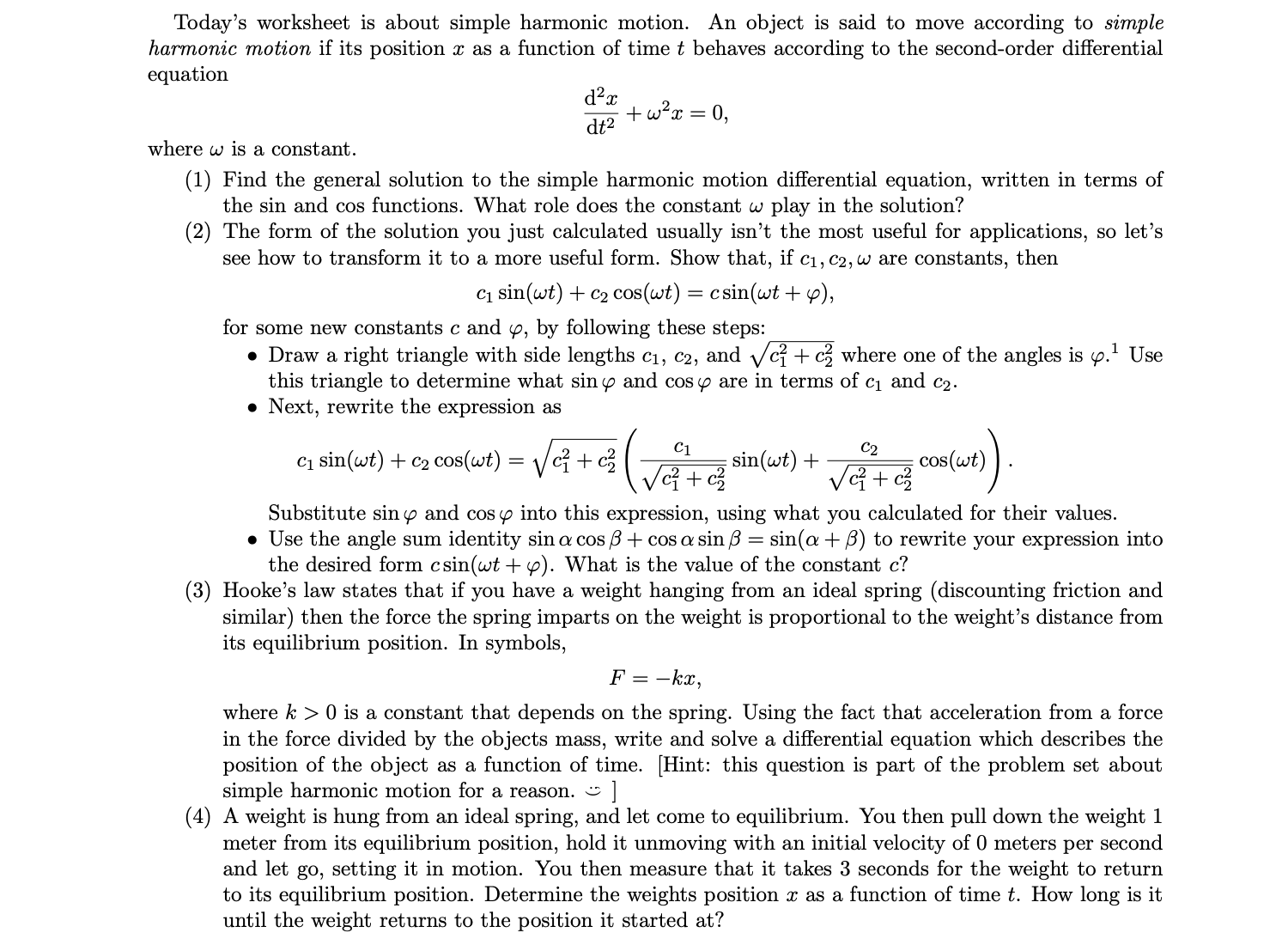
Today's worksheet is about simple harmonic motion. An object is said to move according to simple harmonic motion if its position ac as a function of time t behaves according to the second-order di'erential equation 2 g + w22: = 0, where w is a constant. (1) Find the general solution to the simple harmonic motion differential equation, written in terms of the sin and cos functions. What role does the constant a; play in the solution? (2) The form of the solution you just calculated usually isn't the most useful for applications, so let's see how to transform it to a more useful form. Show that, if (1], ca, w are constants, then cl sin(wt) + (32 cos(wt) = csin(wt + cp), for some new constants c and cp, by 0110wing these steps: 0 Draw a right triangle with side lengths c1, (32, and 'lcf + cg where one of the angles is cp.1 Use this triangle to determine what sings and cos cp are in terms of cl and (32. 0 Next, rewrite the expression as c1 sin(wt) + Cg cos(wt) = 4,! cf + cg ( sin(wt) + % cos(wt)) . 1 1 2 Substitute Slnlp and cos (p into this expression, using what you calculated for their values. 0 Use the angle sum identity sin a cos ,8 + cosasin = sin(cr + ,6) to rewrite your expression into the desired form csin(wt + 90). What is the value of the constant c? (3) Hooke's law states that if' you have a weight hanging from an ideal spring (discounting friction and similar) then the force the spring imparts on the weight is proportional to the weight's distance from its equilibrium position. In symbols, F = lc:c, where k > 0 is a constant that depends on the spring. Using the fact that acceleration from a force in the force divided by the objects mass, write and solve a differential equation which describes the position of the object as a function of time. (Hint: this question is part of the problem set about simple harmonic motion for a reason. 3 ] (4) A weight is hung from an ideal spring, and let come to equilibrium. You then pull down the weight 1 meter from its equilibrium position, hold it unmoving with an initial velocity of 0 meters per second and let go, setting it in motion. You then measure that it takes 3 seconds for the weight to return to its equilibrium position. Determine the weights position :1: as a function of time t. How long is it until the weight returns to the position it started at
Step by Step Solution
There are 3 Steps involved in it

Get step-by-step solutions from verified subject matter experts