







Question: please see below: In this problem we will simulate expected loss using Monte Carlo integration. (a) Consider the squared error loss function: L(a, y) =
please see below:
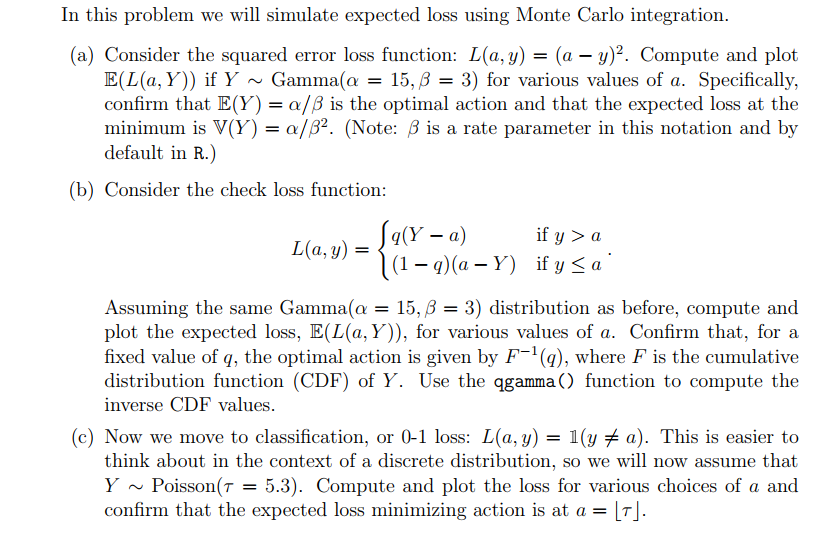
In this problem we will simulate expected loss using Monte Carlo integration. (a) Consider the squared error loss function: L(a, y) = (a - y)2. Compute and plot E(L(a, Y)) if Y ~ Gamma(o = 15, 3 = 3) for various values of a. Specifically, confirm that E(Y) = a/ B is the optimal action and that the expected loss at the minimum is V(Y) = o/32. (Note: 8 is a rate parameter in this notation and by default in R.) (b) Consider the check loss function: L(a, y) Jq( Y - a) if y > a (1 -9)(a- Y) ify sa Assuming the same Gamma(o = 15, 3 = 3) distribution as before, compute and plot the expected loss, E(L(a, Y)), for various values of a. Confirm that, for a fixed value of q, the optimal action is given by F-(q), where F is the cumulative distribution function (CDF) of Y. Use the qgamma () function to compute the inverse CDF values. (c) Now we move to classification, or 0-1 loss: L(a, y) = 1(y # a). This is easier to think about in the context of a discrete distribution, so we will now assume that Y ~ Poisson(7 = 5.3). Compute and plot the loss for various choices of a and confirm that the expected loss minimizing action is at a = [~]
Step by Step Solution
There are 3 Steps involved in it

Get step-by-step solutions from verified subject matter experts
 Study Help