







Question: Please share complete step by step solution. 2. CRA has observed that randomly selecting returns for investigation is expensive and not productive. As noted in
Please share complete step by step solution.
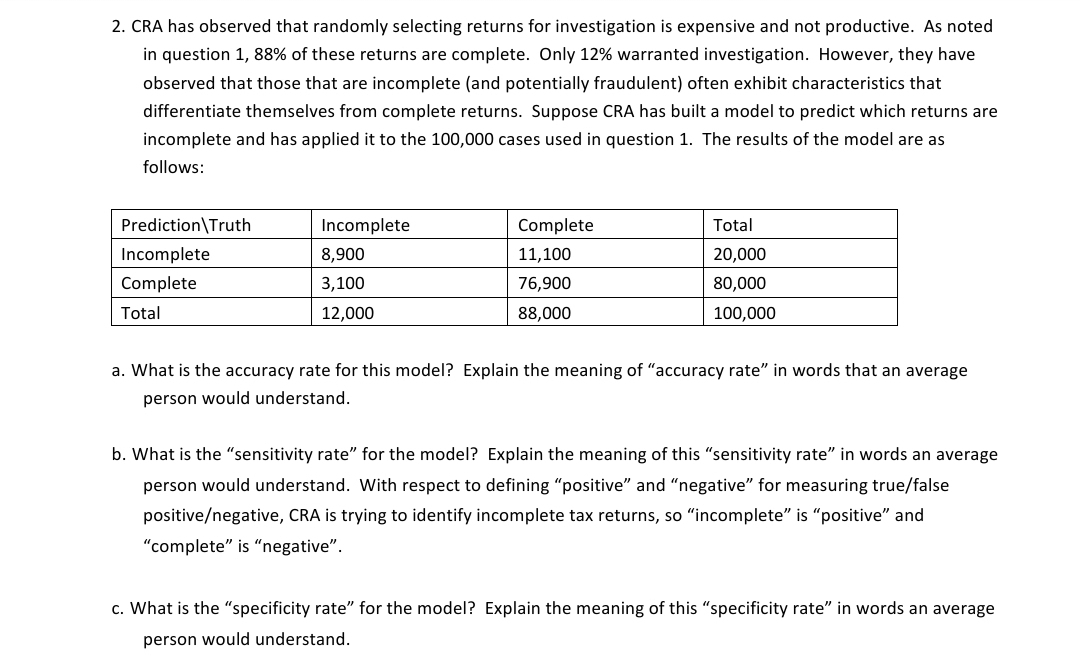
2. CRA has observed that randomly selecting returns for investigation is expensive and not productive. As noted in question 1, 88% of these returns are complete. Only 12% warranted investigation. However, they have observed that those that are incomplete {and potentially fraudulent} often exhibit characteristics that differentiate themselves from complete returns. Suppose CRA has built a model to predict which returns are incomplete and has applied it to the 100,000 cases used in question 1. The results of the model are as follows : Pred iction\\Truth Incomplete Complete Total Incomplete 8,900 11,100 20,000 Complete 3,100 75,900 80,000 Total 12,000 88,000 100,000 a. What is the accuracy rate for this model? Explain the meaning of "accuracy rate" in words that an average person would understand. b. What is the "sensitivity rate" for the model? Explain the meaning of this "sensitivity rate" in words an average person would understand. With respect to defining \"positive\" and "negative\" for measuring true/false positiveegative, CRA is trying to identify incomplete tax returns, so "incomplete" is "positive\" and \"complete\" is \"negative\". c. What is the "specicity rate" for the model? Explain the meaning of this \"specificity rate\" in words an average person would understand
Step by Step Solution
There are 3 Steps involved in it

Get step-by-step solutions from verified subject matter experts
 Study Help