



Question: Please show all the work you can! 3 standard 11 - Asymptotics 1 (Calculus 1 techniques) Problem 1. For each part, you will be given
Please show all the work you can!
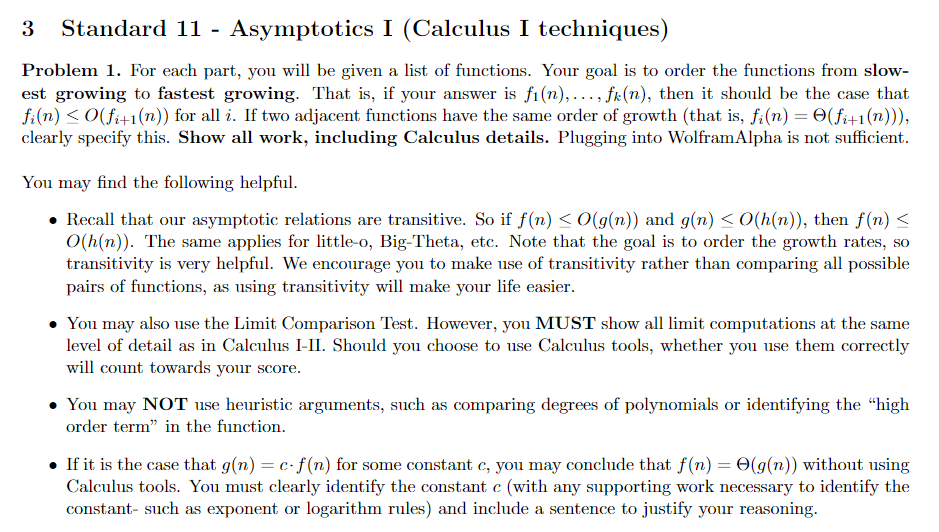
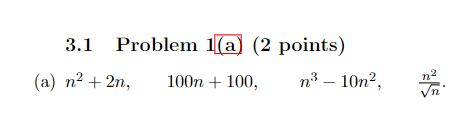
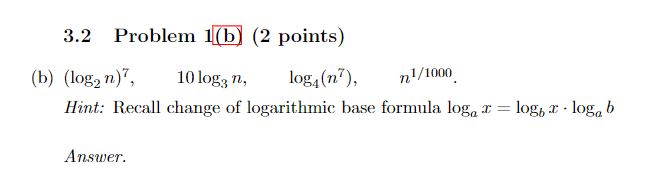
3 standard 11 - Asymptotics 1 (Calculus 1 techniques) Problem 1. For each part, you will be given a list of functions. Your goal is to order the functions from slowest growing to fastest growing. That is, if your answer is f1(n),,fk(n), then it should be the case that fi(n)O(fi+1(n)) for all i. If two adjacent functions have the same order of growth (that is, fi(n)=(fi+1(n))), clearly specify this. Show all work, including Calculus details. Plugging into WolframAlpha is not sufficient. You may find the following helpful. - Recall that our asymptotic relations are transitive. So if f(n)O(g(n)) and g(n)O(h(n)), then f(n) O(h(n)). The same applies for little-o, Big-Theta, etc. Note that the goal is to order the growth rates, so transitivity is very helpful. We encourage you to make use of transitivity rather than comparing all possible pairs of functions, as using transitivity will make your life easier. - You may also use the Limit Comparison Test. However, you MUST show all limit computations at the same level of detail as in Calculus I-II. Should you choose to use Calculus tools, whether you use them correctly will count towards your score. - You may NOT use heuristic arguments, such as comparing degrees of polynomials or identifying the "high order term" in the function. - If it is the case that g(n)=cf(n) for some constant c, you may conclude that f(n)=(g(n)) without using Calculus tools. You must clearly identify the constant c (with any supporting work necessary to identify the constant- such as exponent or logarithm rules) and include a sentence to justify your reasoning. 3.1 Problem 1(a) (2 points) (a) n2+2n,100n+100,n310n2,nn2. 3.2 Problem 1(b) (2 points) (b) (log2n)7,10log3n,log4(n7),n1/1000. Hint: Recall change of logarithmic base formula logax=logbxlogab
Step by Step Solution
There are 3 Steps involved in it

Get step-by-step solutions from verified subject matter experts