







Question: please show all work no excel just a-d 6-14, A high school graduate has to decide between working and going to college. If he works,
please show all work no excel just a-d
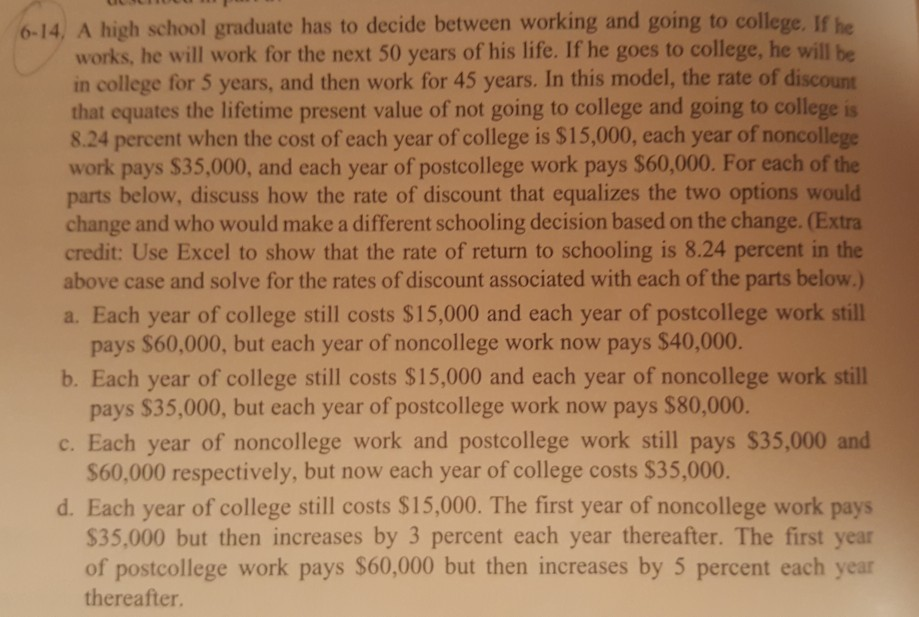
6-14, A high school graduate has to decide between working and going to college. If he works, he will work for the next 50 years of his life. If he goes to college, he will be in college for 5 years, and then work for 45 years. In this model, the rate of discount that equates the lifetime present value of not going to college and going to college is 8.24 percent when the cost of each year of college is $15,000, each year of noncollege work pays $35,000, and each year of postcollege work pays $60,000. For each of the parts below, discuss how the rate of discount that equalizes the two options would change and who would make a different schooling decision based on the change. (Extra credit: Use Excel to show that the rate of return to schooling is 8.24 percent in the above case and solve for the rates of discount associated with each of the parts below.) a. Each year of college still costs S15,000 and each year of postcollege work still b. Each year of college still costs $15,000 and each year of noncollege work still c. Each year of noncollege work and postcollege work still pays $35,000 and d. Each year of college still costs $15,000. The first year of noncollege work pays pays $60,000, but each year of noncollege work now pays $40,000. pays $35,000, but each year of postcollege work now pays $80,000. S60,000 respectively, but now each year of college costs $35,000. S35,000 but then increases by 3 percent each year thereafter. The first year of postcollege work pays $60,000 but then increases by 5 percent each year thereafter. 6-14, A high school graduate has to decide between working and going to college. If he works, he will work for the next 50 years of his life. If he goes to college, he will be in college for 5 years, and then work for 45 years. In this model, the rate of discount that equates the lifetime present value of not going to college and going to college is 8.24 percent when the cost of each year of college is $15,000, each year of noncollege work pays $35,000, and each year of postcollege work pays $60,000. For each of the parts below, discuss how the rate of discount that equalizes the two options would change and who would make a different schooling decision based on the change. (Extra credit: Use Excel to show that the rate of return to schooling is 8.24 percent in the above case and solve for the rates of discount associated with each of the parts below.) a. Each year of college still costs S15,000 and each year of postcollege work still b. Each year of college still costs $15,000 and each year of noncollege work still c. Each year of noncollege work and postcollege work still pays $35,000 and d. Each year of college still costs $15,000. The first year of noncollege work pays pays $60,000, but each year of noncollege work now pays $40,000. pays $35,000, but each year of postcollege work now pays $80,000. S60,000 respectively, but now each year of college costs $35,000. S35,000 but then increases by 3 percent each year thereafter. The first year of postcollege work pays $60,000 but then increases by 5 percent each year thereafter
Step by Step Solution
There are 3 Steps involved in it

Get step-by-step solutions from verified subject matter experts
 Study Help