







Question: please show an explain work for part a,b,c,d,e,f,g and h is consired all 1 problem pelase and thank you! Answer each of the following questions
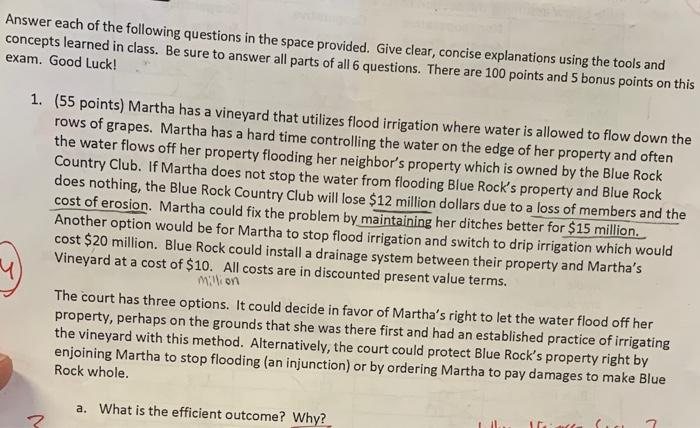
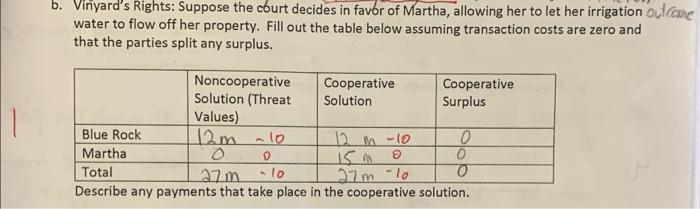
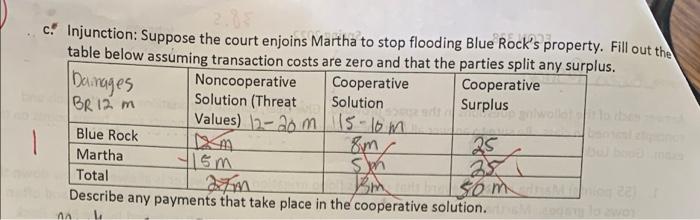
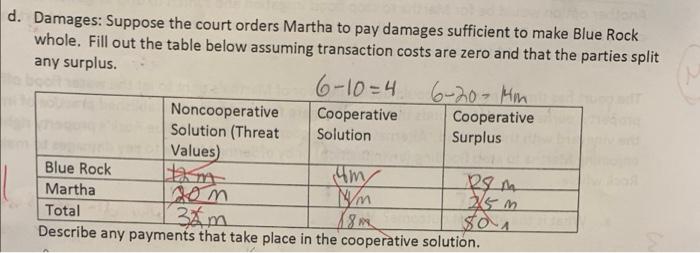




Answer each of the following questions in the space provided. Give clear, concise explanations using the tools and concepts learned in class. Be sure to answer all parts of all 6 questions. There are 100 points and 5 bonus points on this exam. Good Luck! 1. (55 points) Martha has a vineyard that utilizes flood irrigation where water is allowed to flow down the rows of grapes. Martha has a hard time controlling the water on the edge of her property and often the water flows off her property flooding her neighbor's property which is owned by the Blue Rock Country Club. If Martha does not stop the water from flooding Blue Rock's property and Blue Rock does nothing, the Blue Rock Country Club will lose $12 million dollars due to a loss of members and the cost of erosion. Martha could fix the problem by maintaining her ditches better for $15 million. Another option would be for Martha to stop flood irrigation and switch to drip irrigation which would cost $20 million. Blue Rock could install a drainage system between their property and Martha's Vineyard at a cost of $10. All costs are in discounted present value terms. million The court has three options. It could decide in favor of Martha's right to let the water flood off her property, perhaps on the grounds that she was there first and had an established practice of irrigating the vineyard with this method. Alternatively, the court could protect Blue Rock's property right by enjoining Martha to stop flooding (an injunction) or by ordering Martha to pay damages to make Blue Rock whole. a. What is the efficient outcome? Why? 2 il G 7. b. Vinyard's Rights: Suppose the court decides in favor of Martha, allowing her to let her irrigation of care water to flow off her property. Fill out the table below assuming transaction costs are zero and that the parties split any surplus. Noncooperative Cooperative Cooperative Solution (Threat Solution Surplus Values) Blue Rock 12m 10 12 m -10 0 Martha 0 15 m 0 Total am - 10 27m -10 0 Describe any payments that take place in the cooperative solution. a c Injunction: Suppose the court enjoins Martha to stop flooding Blue Rock's property. Fill out the table below assuming transaction costs are zero and that the parties split any surplus. Dainages Noncooperative Cooperative Cooperative Solution (Threat Solution Surplus BR 12 m Values) 12-20 m 15-16 m Blue Rock A 25 Martha 15 m som Total am BM 56 m Describe any payments that take place in the cooperative solution. 1 &m AA d. Damages: Suppose the court orders Martha to pay damages sufficient to make Blue Rock whole. Fill out the table below assuming transaction costs are zero and that the parties split any surplus. 6-10-4 6-20-4m Noncooperative Cooperative Cooperative Solution (Threat Solution Surplus Values) Blue Rock um Rom Martha om Nm 25 m Total 36 m Describe any payments that take place in the cooperative solution. tall drail e. Does this example illustrate the Coase Theorem? Explain. f. Under which remedy, damages or injunction, is the noncooperative solution most efficient? Is it generally true that this remedy makes the noncooperative solution most efficient? Explain. g. If the court decided to award damages, what would be the economic justification? Is this most consistent with the Normative Coase Theorem or the Normative Hobbes Theorem? Explain. Nunction h. If the court decided to award.dekages, what would be the economic justification? Is this most consistent with the Normative Coase Theorem or the Normative Hobbes Theorem? Explain. Answer each of the following questions in the space provided. Give clear, concise explanations using the tools and concepts learned in class. Be sure to answer all parts of all 6 questions. There are 100 points and 5 bonus points on this exam. Good Luck! 1. (55 points) Martha has a vineyard that utilizes flood irrigation where water is allowed to flow down the rows of grapes. Martha has a hard time controlling the water on the edge of her property and often the water flows off her property flooding her neighbor's property which is owned by the Blue Rock Country Club. If Martha does not stop the water from flooding Blue Rock's property and Blue Rock does nothing, the Blue Rock Country Club will lose $12 million dollars due to a loss of members and the cost of erosion. Martha could fix the problem by maintaining her ditches better for $15 million. Another option would be for Martha to stop flood irrigation and switch to drip irrigation which would cost $20 million. Blue Rock could install a drainage system between their property and Martha's Vineyard at a cost of $10. All costs are in discounted present value terms. million The court has three options. It could decide in favor of Martha's right to let the water flood off her property, perhaps on the grounds that she was there first and had an established practice of irrigating the vineyard with this method. Alternatively, the court could protect Blue Rock's property right by enjoining Martha to stop flooding (an injunction) or by ordering Martha to pay damages to make Blue Rock whole. a. What is the efficient outcome? Why? 2 il G 7. b. Vinyard's Rights: Suppose the court decides in favor of Martha, allowing her to let her irrigation of care water to flow off her property. Fill out the table below assuming transaction costs are zero and that the parties split any surplus. Noncooperative Cooperative Cooperative Solution (Threat Solution Surplus Values) Blue Rock 12m 10 12 m -10 0 Martha 0 15 m 0 Total am - 10 27m -10 0 Describe any payments that take place in the cooperative solution. a c Injunction: Suppose the court enjoins Martha to stop flooding Blue Rock's property. Fill out the table below assuming transaction costs are zero and that the parties split any surplus. Dainages Noncooperative Cooperative Cooperative Solution (Threat Solution Surplus BR 12 m Values) 12-20 m 15-16 m Blue Rock A 25 Martha 15 m som Total am BM 56 m Describe any payments that take place in the cooperative solution. 1 &m AA d. Damages: Suppose the court orders Martha to pay damages sufficient to make Blue Rock whole. Fill out the table below assuming transaction costs are zero and that the parties split any surplus. 6-10-4 6-20-4m Noncooperative Cooperative Cooperative Solution (Threat Solution Surplus Values) Blue Rock um Rom Martha om Nm 25 m Total 36 m Describe any payments that take place in the cooperative solution. tall drail e. Does this example illustrate the Coase Theorem? Explain. f. Under which remedy, damages or injunction, is the noncooperative solution most efficient? Is it generally true that this remedy makes the noncooperative solution most efficient? Explain. g. If the court decided to award damages, what would be the economic justification? Is this most consistent with the Normative Coase Theorem or the Normative Hobbes Theorem? Explain. Nunction h. If the court decided to award.dekages, what would be the economic justification? Is this most consistent with the Normative Coase Theorem or the Normative Hobbes Theorem? Explain
Step by Step Solution
There are 3 Steps involved in it

Get step-by-step solutions from verified subject matter experts
 Study Help