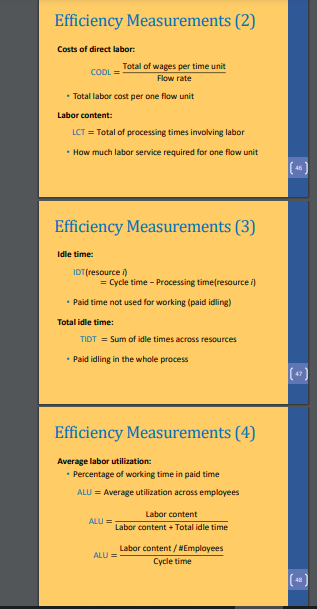
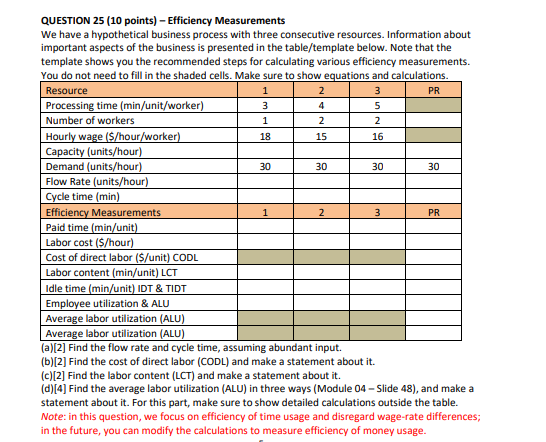
Question: please show calculations on chart by hand. Don't understand other examples. THIS IS ANOTHER EXAMPLE ON CHEGG. DONT UNDERSTAND IT. 4 1 3 1 18

please show calculations on chart by hand. Don't understand other examples.
please show calculations on chart by hand. Don't

please show calculations on chart by hand. Don't

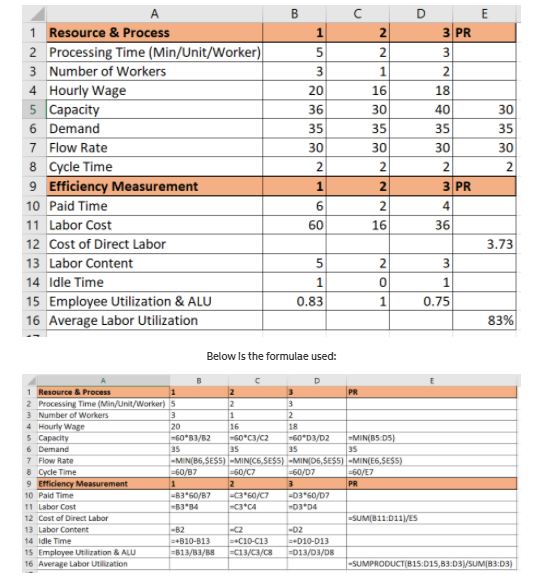
THIS IS ANOTHER EXAMPLE ON CHEGG. DONT UNDERSTAND IT.
please show calculations on chart by hand. Don't

4 1 3 1 18 3 5 2 16 15 30 30 30 30 1 QUESTION 25 (10 points) - Efficiency Measurements We have a hypothetical business process with three consecutive resources. Information about important aspects of the business is presented in the table/template below. Note that the template shows you the recommended steps for calculating various efficiency measurements. You do not need to fill in the shaded cells. Make sure to show equations and calculations. Resource 2 PR Processing time (min/unit/worker) Number of workers 2 Hourly wage (S/hour/worker) Capacity (units/hour) Demand (units/hour) Flow Rate (units/hour) Cycle time (min) Efficiency Measurements 2 3 PR Paid time (min/unit) Labor cost ($/hour) Cost of direct labor (S/unit) CODL Labor content (min/unit) LCT Idle time (min/unit) IDT & TIDT Employee utilization & ALU Average labor utilization (ALU) Average labor utilization (ALU) (a)[2] Find the flow rate and cycle time, assuming abundant input. (b)[2] Find the cost of direct labor (CODL) and make a statement about it. (c)[2] Find the labor content (LCT) and make a statement about it. (d)[4] Find the average labor utilization (ALU) in three ways (Module 04 - Slide 48), and make a statement about it. For this part, make sure to show detailed calculations outside the table. Note: in this question, we focus on efficiency of time usage and disregard wage-rate differences; in the future, you can modify the calculations to measure efficiency of money usage. Efficiency Measurements (2) COOL Costs of direct labor: Total of wages per time unit Flow rate - Total labor cost per one flow unit Labor content: LCT = Total of processing times involving labor How much labor service required for one flow unit Efficiency Measurements (3) Idle time: IDT(resource :) = Cycle time - Processing time[resource i) Paid time not used for working (paid idling) Total idle time: TIDT = Sum of idle times across resources Paid idling in the whole process Efficiency Measurements (4) Average labor utilization: Percentage of working time in paid time ALU = Average utilization across employees ALU = Labor content Labor content + Total idle time Labor content/ NEmployees ALU = Cycle time B c D E 3 PR 3 2 18 1 5 3 20 36 35 30 2 1 6 60 A 1 Resource & Process 2 Processing Time (Min/Unit/Worker) 3 Number of Workers 4 Hourly Wage 5 Capacity 6 Demand 7 Flow Rate 8 Cycle Time 9 Efficiency Measurement 10 Paid Time 11 Labor Cost 12 Cost of Direct Labor 13 Labor Content 14 Idle Time 15 Employee Utilization & ALU 16 Average Labor Utilization 2 2 1 16 30 35 30 2 40 35 30 30 35 30 2 wN 3 PR 6 4 36 3.73 un 3 5 1 0.83 2 0 1 0.75 1 83% Below is the formulae used: D 1 Resource & Process 2 PR 2 Processing Time (Min/Unit/Worker) 2 3 3 Number of Workers 3 1 2 4 Hourly Wage 20 16 18 5 Capacity -60*33/82 -60C3/02 -60 D3/D2 -MIN(B505) 6 Demand 35 35 35 35 7 Flow Rate -MIN(B6, SES5) -MINC.SE55) -MIND6, SE$5) -MIN(E6.SE$5) 8 Cycle Time =60/87 =60/C7 -60/07 =60/E7 9 Efficiency Measurement 1 2 PR 10 Paid Time -B360/87 -C360/C7 -03-50/D7 11 Labor Cost -334 -C3C -304 12 Cost of Direct Labor -SUM(B11:011/ES 13 Labor Content -B2 -02 14 Idle Time B10-B13 *C10-C13 D10-D13 15 Employee Utilization & ALU =513/B3/B8 =C13/C3/ =013/03/08 16 Average Labor Utilization -SUMPRODUCT(B15:015,33:03\/SUMB3:03) 4 1 3 1 18 3 5 2 16 15 30 30 30 30 1 QUESTION 25 (10 points) - Efficiency Measurements We have a hypothetical business process with three consecutive resources. Information about important aspects of the business is presented in the table/template below. Note that the template shows you the recommended steps for calculating various efficiency measurements. You do not need to fill in the shaded cells. Make sure to show equations and calculations. Resource 2 PR Processing time (min/unit/worker) Number of workers 2 Hourly wage (S/hour/worker) Capacity (units/hour) Demand (units/hour) Flow Rate (units/hour) Cycle time (min) Efficiency Measurements 2 3 PR Paid time (min/unit) Labor cost ($/hour) Cost of direct labor (S/unit) CODL Labor content (min/unit) LCT Idle time (min/unit) IDT & TIDT Employee utilization & ALU Average labor utilization (ALU) Average labor utilization (ALU) (a)[2] Find the flow rate and cycle time, assuming abundant input. (b)[2] Find the cost of direct labor (CODL) and make a statement about it. (c)[2] Find the labor content (LCT) and make a statement about it. (d)[4] Find the average labor utilization (ALU) in three ways (Module 04 - Slide 48), and make a statement about it. For this part, make sure to show detailed calculations outside the table. Note: in this question, we focus on efficiency of time usage and disregard wage-rate differences; in the future, you can modify the calculations to measure efficiency of money usage. Efficiency Measurements (2) COOL Costs of direct labor: Total of wages per time unit Flow rate - Total labor cost per one flow unit Labor content: LCT = Total of processing times involving labor How much labor service required for one flow unit Efficiency Measurements (3) Idle time: IDT(resource :) = Cycle time - Processing time[resource i) Paid time not used for working (paid idling) Total idle time: TIDT = Sum of idle times across resources Paid idling in the whole process Efficiency Measurements (4) Average labor utilization: Percentage of working time in paid time ALU = Average utilization across employees ALU = Labor content Labor content + Total idle time Labor content/ NEmployees ALU = Cycle time B c D E 3 PR 3 2 18 1 5 3 20 36 35 30 2 1 6 60 A 1 Resource & Process 2 Processing Time (Min/Unit/Worker) 3 Number of Workers 4 Hourly Wage 5 Capacity 6 Demand 7 Flow Rate 8 Cycle Time 9 Efficiency Measurement 10 Paid Time 11 Labor Cost 12 Cost of Direct Labor 13 Labor Content 14 Idle Time 15 Employee Utilization & ALU 16 Average Labor Utilization 2 2 1 16 30 35 30 2 40 35 30 30 35 30 2 wN 3 PR 6 4 36 3.73 un 3 5 1 0.83 2 0 1 0.75 1 83% Below is the formulae used: D 1 Resource & Process 2 PR 2 Processing Time (Min/Unit/Worker) 2 3 3 Number of Workers 3 1 2 4 Hourly Wage 20 16 18 5 Capacity -60*33/82 -60C3/02 -60 D3/D2 -MIN(B505) 6 Demand 35 35 35 35 7 Flow Rate -MIN(B6, SES5) -MINC.SE55) -MIND6, SE$5) -MIN(E6.SE$5) 8 Cycle Time =60/87 =60/C7 -60/07 =60/E7 9 Efficiency Measurement 1 2 PR 10 Paid Time -B360/87 -C360/C7 -03-50/D7 11 Labor Cost -334 -C3C -304 12 Cost of Direct Labor -SUM(B11:011/ES 13 Labor Content -B2 -02 14 Idle Time B10-B13 *C10-C13 D10-D13 15 Employee Utilization & ALU =513/B3/B8 =C13/C3/ =013/03/08 16 Average Labor Utilization -SUMPRODUCT(B15:015,33:03\/SUMB3:03)

Step by Step Solution

There are 3 Steps involved in it

1 Expert Approved Answer
Step: 1 Unlock blur-text-image

Question Has Been Solved by an Expert!

Get step-by-step solutions from verified subject matter experts

Step: 2 Unlock
Step: 3 Unlock

Students Have Also Explored These Related General Management Questions!