



Question: Please show part B and C, all the explanation and work Thank you A device has been proposed that will serve as a blood oxygenator
Please show part B and C, all the explanation and work
Thank you
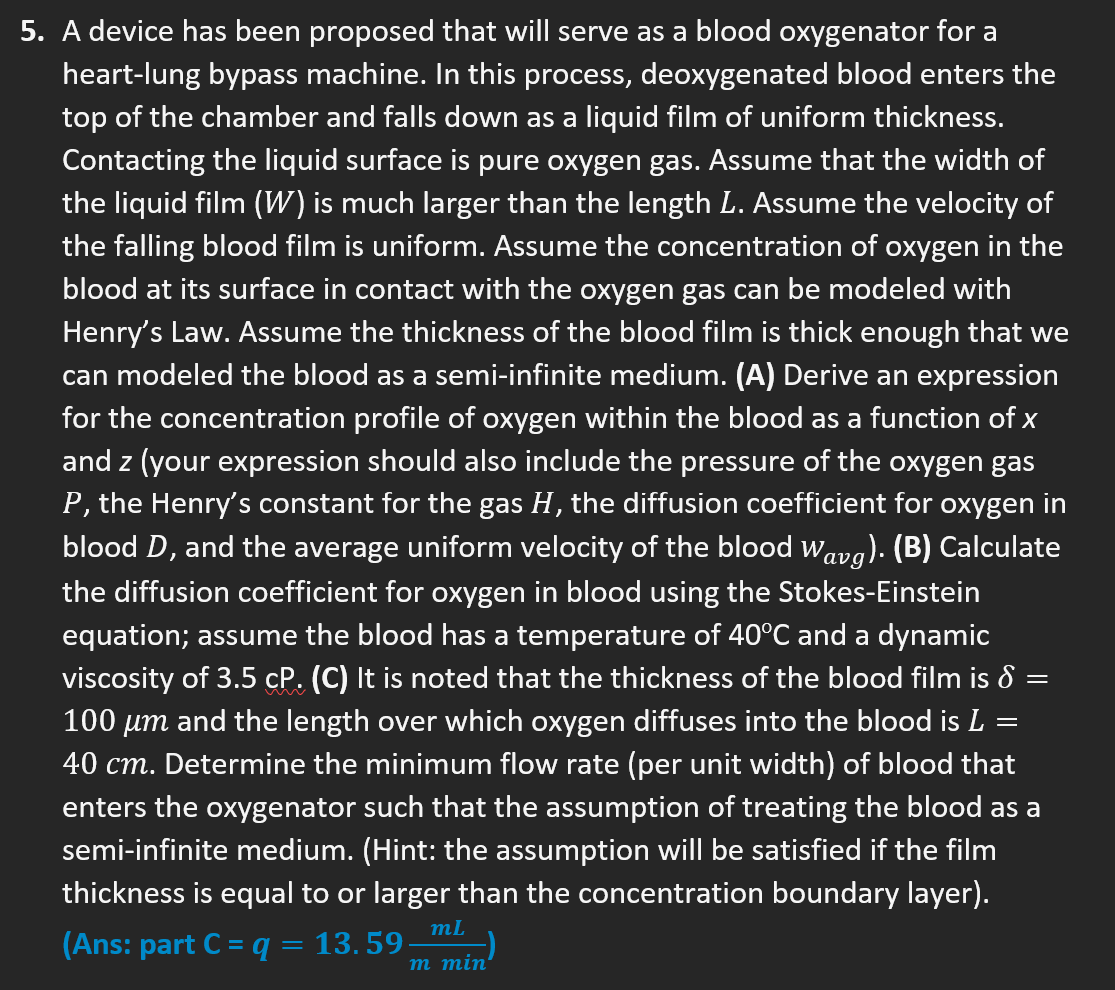
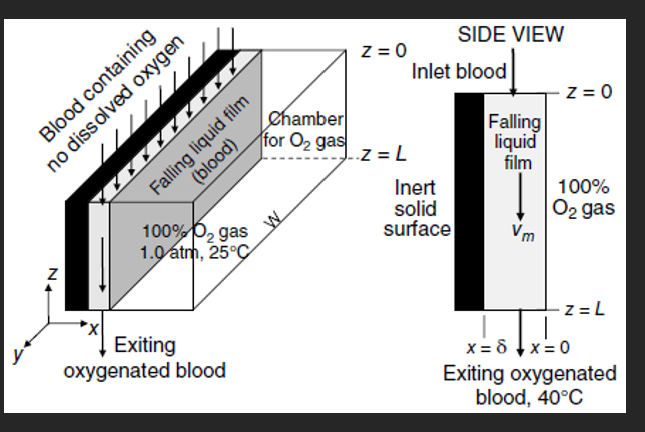
A device has been proposed that will serve as a blood oxygenator for a heart-lung bypass machine. In this process, deoxygenated blood enters the top of the chamber and falls down as a liquid film of uniform thickness. Contacting the liquid surface is pure oxygen gas. Assume that the width of the liquid film (W) is much larger than the length L. Assume the velocity of the falling blood film is uniform. Assume the concentration of oxygen in the blood at its surface in contact with the oxygen gas can be modeled with Henry's Law. Assume the thickness of the blood film is thick enough that we can modeled the blood as a semi-infinite medium. (A) Derive an expression for the concentration profile of oxygen within the blood as a function of x and z (your expression should also include the pressure of the oxygen gas P, the Henry's constant for the gas H, the diffusion coefficient for oxygen in blood D, and the average uniform velocity of the blood wavg ). (B) Calculate the diffusion coefficient for oxygen in blood using the Stokes-Einstein equation; assume the blood has a temperature of 40C and a dynamic viscosity of 3.5cP. (C) It is noted that the thickness of the blood film is = 100m and the length over which oxygen diffuses into the blood is L= 40cm. Determine the minimum flow rate (per unit width) of blood that enters the oxygenator such that the assumption of treating the blood as a semi-infinite medium. (Hint: the assumption will be satisfied if the film thickness is equal to or larger than the concentration boundary layer). (Ans: part C=q=13.59mminmL ) oxygenated blood Exiting oxygenated blood, 40C
Step by Step Solution
There are 3 Steps involved in it

Get step-by-step solutions from verified subject matter experts