







Question: please show solution work with calculate question. the another question is clear b) The auxiliary electrode uses in voltammetry cell to i. Produce the potential
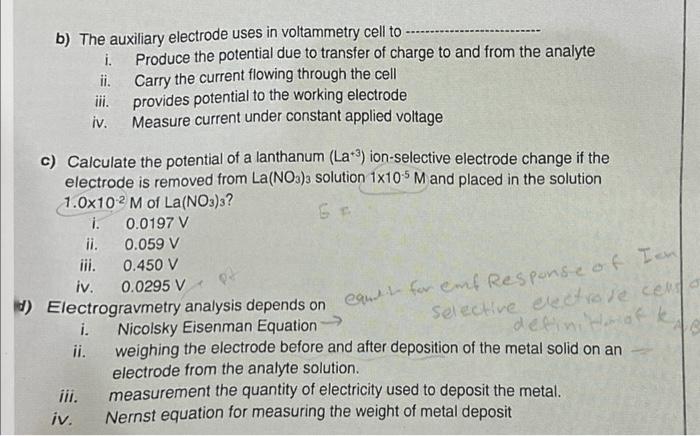
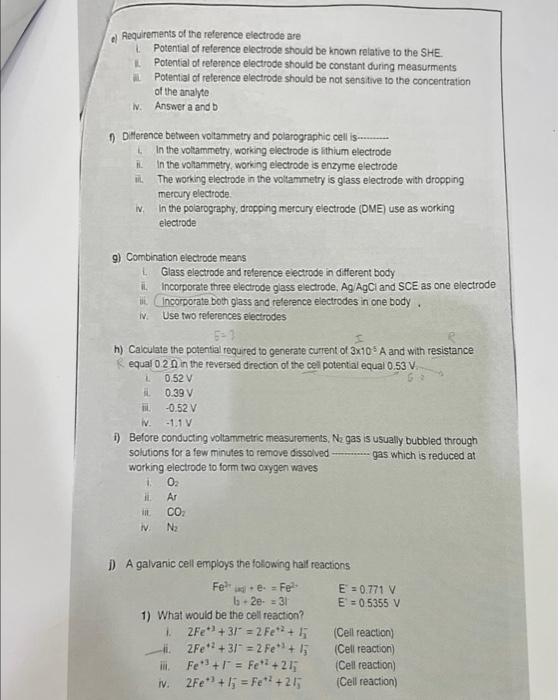
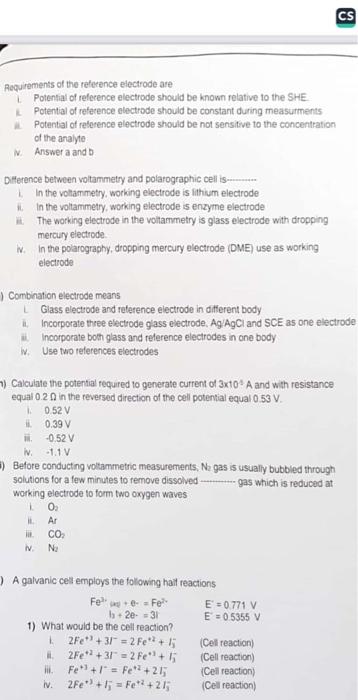
b) The auxiliary electrode uses in voltammetry cell to i. Produce the potential due to transfer of charge to and from the analyte ii. Carry the current flowing through the cell iii. provides potential to the working electrode iv. Measure current under constant applied voltage c) Calculate the potential of a lanthanum (La+3) ion-selective electrode change if the electrode is removed from La(NO3)3 solution 1105M and placed in the solution 1.0102M of La(NO3)3 ? i. 0.0197V ii. 0.059V iv. 0.0295V d) Electrogravmetry analysis depends on equ. i. Nicolsky Eisenman Equation ii. Weighing the electrode before and after deposition of the metal solid on an electrode from the analyte solution. iii. measurement the quantity of electricity used to deposit the metal. iv. Nernst equation for measuring the weight of metal deposit a) Requirements of the reference electrode are 1. Potential of reference electrode should be known relative to the SHE. 1. Potential of reference clectrode should be constant during measurments ii. Potential of relerence electrode should be not senstive to the concentration of the analve. iv. Answer a and b 7) DMlerence between votammetry and polarographic cell is. L. In the volammety, working electrode is athium electrode ii. In the voliammety, working electrode is enzyme electiode ii. The vorking electrode in the volammetry is glass electrode with dropping mercury electrode. N. In the polarography, dropping mercury electrode (DME) use as working electrode 9) Combination electrode means L. Glass electrode and reference eiectrode in ditterent body ii. Incorporate three electrode glass electrode, Ag/AgCl and SCE as one electrode ii. Incorporate both glass and relerence electrodes in one body. iv. Use two references electrodes h) Calculate the potential requred to generate curent of 3105A and with resistance equal 0.2n in the reversed drection of the cel potental equal 0.53V. i. 0.52V a. 0.39V iii. 0.52V iv. 1.1V i) Before conducting vollammetre measurements, N gas is usually bubbled through solutions for a few minutes to remove dissolved working electrode to form two oxygen waves gas which is reduced at i. O2 ii. Ar iit. CO2 iv. N2 j) A galvanic cell employs the folowing half reactions FeF2+4+e=Fe2E=0.771Vb+20=31E=0.5355V 1) What would be the cell reaction? 1. 2Fe+3+3I=2Fe+2+h1 (Cell reaction) ii. 2Fe+2+3I=2Fe+3+I3 (Cell reaction) iii. Fe+3+I=Fe+2+2I(Cell reaction) iv. 2Fe+3+I3=Fe+2+2F3 (Cell reaction) Requirements of the reference electrode are 1. Potenfial of reference electrode should be known relative to the SHE 1. Potential of reference electrode should be constant during measurments ii. Potential of relerence electrode should be not sensitive to the concentration of the anglyte v. Answer a and b Diference belween voltammetry and polarographic cell is. 1. In the vollammetry, working electrode is lithium electrode ii. In the voltammetry, working electrode is entyme electrode it. The working electrode in the voitammetry is glass electrodo with dropping mercufy electrode V. In the polarography, dropping mercury electrode (DME) use as working electrode Combination electrode means L Glass electode and reterence electrode in ditferent body i.. Incorporate three electrode glass olectrode, Ag/AgCl and SCE as one electrode ii. Incorporate both glass and reference electrodes in one body W. Use tuo references electrodes 1) Calcuitate the potertial requred 10 generate cufrent of 3x+0A and with resistance equal 0.2 in the reversed direction of the cell potential equal 0.53V. i. 0.52V ii. 0.39V in. 0.52V N. of.1 V Before conducting voltammetric measurements, N2 gas is usually bubbied through solutions for a few minutes to remove dissolved 9as which is reducod atworking electrode to form two oxygen waves i. O2. ii. Ar iii. CO7 iv. N2 A galvanic cel employs the following hail reactions Fe3ix+e=Fe2+ly+2e=31E=0.771VE=0.5355V 1) What would be the cell reaction? 1. 2Fe+3+31=2Fe+2+y (Cell reaction) ii. 2Fe+2+3t=2Fe+1+I3 (Cell reaction) iii. Fe+1+I=Fe+2+2l3 (Cell reaction) N. 2Fe+3+t3=Fe+2+2I3 (Cell reaction)
Step by Step Solution
There are 3 Steps involved in it

Get step-by-step solutions from verified subject matter experts
 Study Help