







Question: please show steps wheb solving. thw box is my main focus. please help solve ut and show steps of how to solve it. thank you
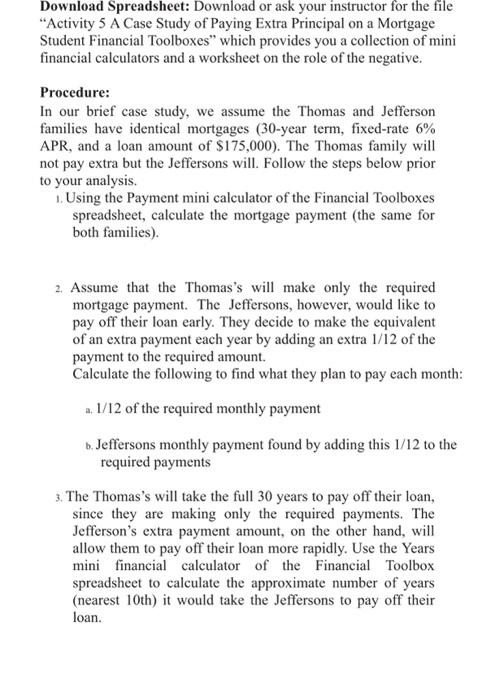
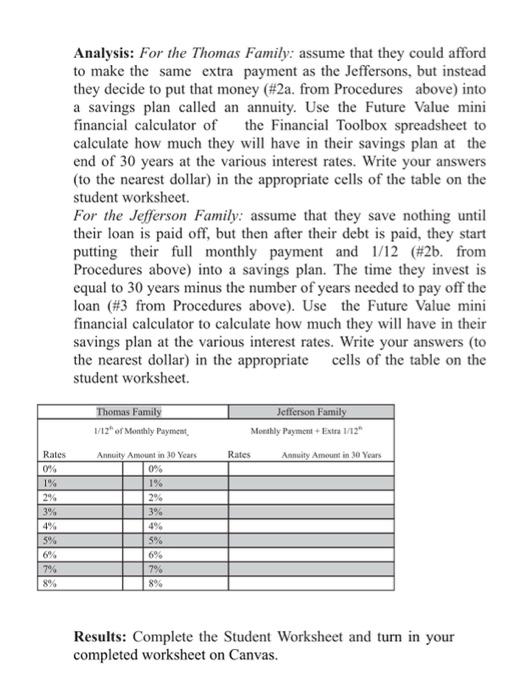
Download Spreadsheet: Download or ask your instructor for the file "Activity 5 A Case Study of Paying Extra Principal on a Mortgage Student Financial Toolboxes which provides you a collection of mini financial calculators and a worksheet on the role of the negative. Procedure: In our brief case study, we assume the Thomas and Jefferson families have identical mortgages (30-year term, fixed-rate 6% APR, and a loan amount of $175,000). The Thomas family will not pay extra but the Jeffersons will. Follow the steps below prior to your analysis. 1. Using the Payment mini calculator of the Financial Toolboxes spreadsheet, calculate the mortgage payment (the same for both families). 2. Assume that the Thomas's will make only the required mortgage payment. The Jeffersons, however, would like to pay off their loan early. They decide to make the equivalent of an extra payment each year by adding an extra 1/12 of the payment to the required amount. Calculate the following to find what they plan to pay each month: ..1/12 of the required monthly payment b. Jeffersons monthly payment found by adding this 1/12 to the required payments 3. The Thomas's will take the full 30 years to pay off their loan, since they are making only the required payments. The Jefferson's extra payment amount, on the other hand, will allow them to pay off their loan more rapidly. Use the Years mini financial calculator of the Financial Toolbox spreadsheet to calculate the approximate number of years (nearest 10th) it would take the Jeffersons to pay off their loan. Analysis: For the Thomas Family: assume that they could afford to make the same extra payment as the Jeffersons, but instead they decide to put that money (#2a. from Procedures above) into a savings plan called an annuity. Use the Future Value mini financial calculator of the Financial Toolbox spreadsheet to calculate how much they will have in their savings plan at the end of 30 years at the various interest rates. Write your answers (to the nearest dollar) in the appropriate cells of the table on the student worksheet. For the Jefferson Family: assume that they save nothing until their loan is paid off, but then after their debt is paid, they start putting their full monthly payment and 1/12 (#2b. from Procedures above) into a savings plan. The time they invest is equal to 30 years minus the number of years needed to pay off the loan (#3 from Procedures above). Use the Future Value mini financial calculator to calculate how much they will have in their savings plan at the various interest rates. Write your answers to the nearest dollar) in the appropriate cells of the table on the student worksheet. Thomas Family 1712+ or Monthly Payment Jefferson Family Monthly Payment + Extra 1/12 Rates Annuity Amount in 30 Years Rates 0% 1% 2% 3% 4% 5% 6% 7% 8% Annuity Amount in 30 Years 0% 1% 2% 3% 4% 5% 6% 7% 8% Results: Complete the Student Worksheet and turn in your completed worksheet on Canvas. Download Spreadsheet: Download or ask your instructor for the file "Activity 5 A Case Study of Paying Extra Principal on a Mortgage Student Financial Toolboxes which provides you a collection of mini financial calculators and a worksheet on the role of the negative. Procedure: In our brief case study, we assume the Thomas and Jefferson families have identical mortgages (30-year term, fixed-rate 6% APR, and a loan amount of $175,000). The Thomas family will not pay extra but the Jeffersons will. Follow the steps below prior to your analysis. 1. Using the Payment mini calculator of the Financial Toolboxes spreadsheet, calculate the mortgage payment (the same for both families). 2. Assume that the Thomas's will make only the required mortgage payment. The Jeffersons, however, would like to pay off their loan early. They decide to make the equivalent of an extra payment each year by adding an extra 1/12 of the payment to the required amount. Calculate the following to find what they plan to pay each month: ..1/12 of the required monthly payment b. Jeffersons monthly payment found by adding this 1/12 to the required payments 3. The Thomas's will take the full 30 years to pay off their loan, since they are making only the required payments. The Jefferson's extra payment amount, on the other hand, will allow them to pay off their loan more rapidly. Use the Years mini financial calculator of the Financial Toolbox spreadsheet to calculate the approximate number of years (nearest 10th) it would take the Jeffersons to pay off their loan. Analysis: For the Thomas Family: assume that they could afford to make the same extra payment as the Jeffersons, but instead they decide to put that money (#2a. from Procedures above) into a savings plan called an annuity. Use the Future Value mini financial calculator of the Financial Toolbox spreadsheet to calculate how much they will have in their savings plan at the end of 30 years at the various interest rates. Write your answers (to the nearest dollar) in the appropriate cells of the table on the student worksheet. For the Jefferson Family: assume that they save nothing until their loan is paid off, but then after their debt is paid, they start putting their full monthly payment and 1/12 (#2b. from Procedures above) into a savings plan. The time they invest is equal to 30 years minus the number of years needed to pay off the loan (#3 from Procedures above). Use the Future Value mini financial calculator to calculate how much they will have in their savings plan at the various interest rates. Write your answers to the nearest dollar) in the appropriate cells of the table on the student worksheet. Thomas Family 1712+ or Monthly Payment Jefferson Family Monthly Payment + Extra 1/12 Rates Annuity Amount in 30 Years Rates 0% 1% 2% 3% 4% 5% 6% 7% 8% Annuity Amount in 30 Years 0% 1% 2% 3% 4% 5% 6% 7% 8% Results: Complete the Student Worksheet and turn in your completed worksheet on Canvas
Step by Step Solution
There are 3 Steps involved in it

Get step-by-step solutions from verified subject matter experts
 Study Help