Question: Please Show the work thank you ! 3. Consider the data points (xo, fo), (21, f1), ..., (In, fn), where the points To, X1, .

Please Show the work thank you !
Please Show the work thank you ! 3. Consider thePlease Show the work thank you ! 3. Consider the
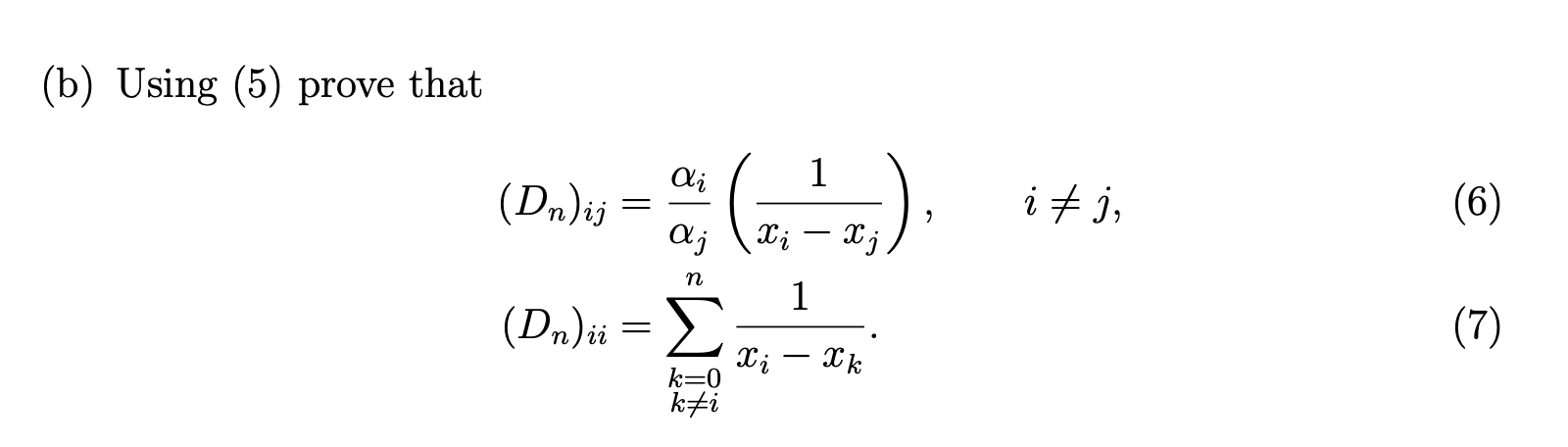
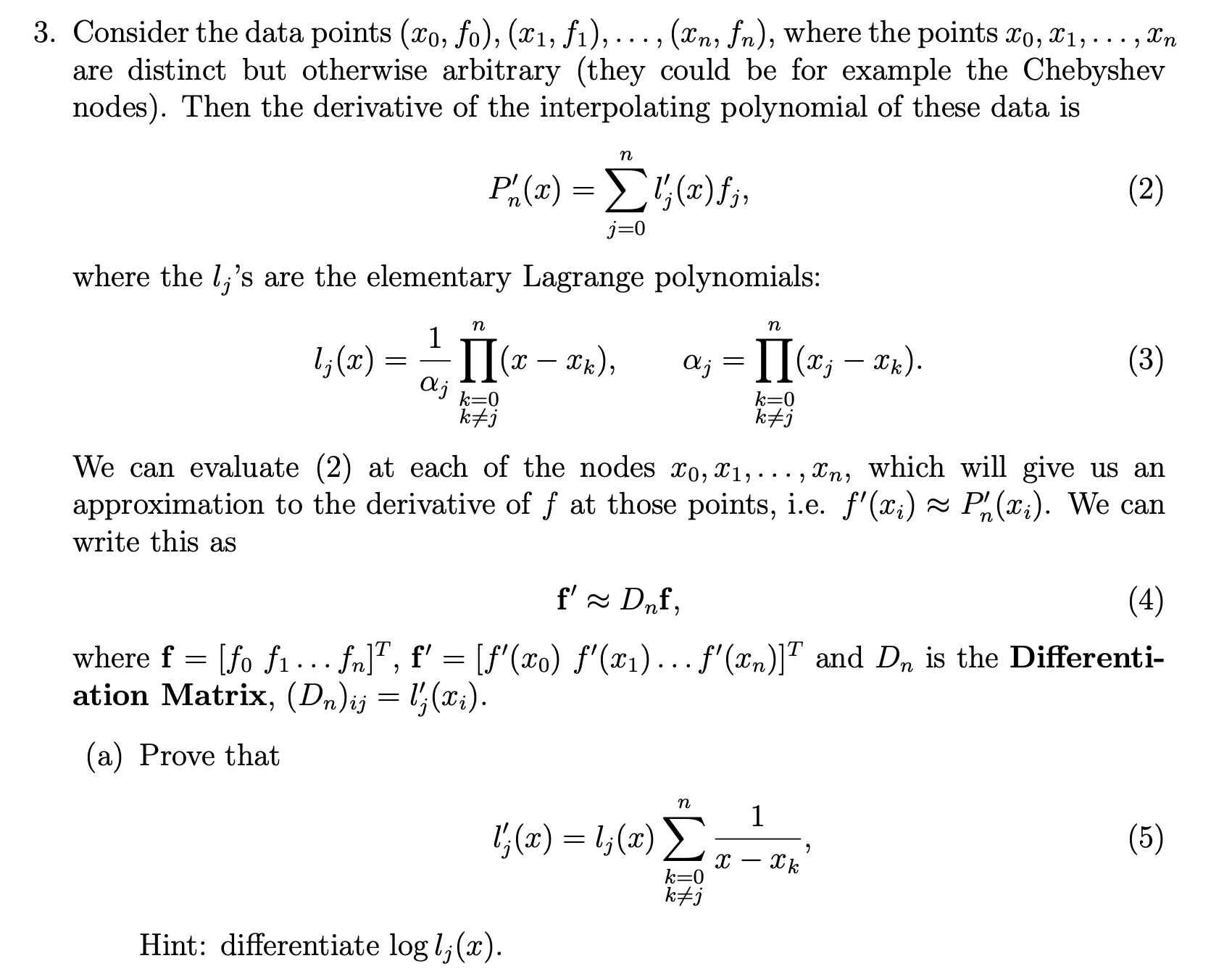
3. Consider the data points (xo, fo), (21, f1), ..., (In, fn), where the points To, X1, . .., In are distinct but otherwise arbitrary (they could be for example the Chebyshev nodes). Then the derivative of the interpolating polynomial of these data is Ph ( z.) = _", ( x ) fi , (2) j=0 where the ;'s are the elementary Lagrange polynomials: 1 n n li (20 ) = II(x - 2k), a; = [1(2;-2k). (3) a j K=0 *=0 k/j We can evaluate (2) at each of the nodes Co, X1, . .., In, which will give us an approximation to the derivative of f at those points, i.e. f'(xi) ~ Pr(xi). We can write this as f' ~ Dnf, (4) where f = [fo f1 . . . fn]T, f' = [f'(xo) f'(x1) . .. f'(n)]] and Dn is the Differenti- ation Matrix, (Dn)ij = l'(xi). (a) Prove that n 1'; (20) = 1, (20) > (5) X - C K K=0 kfj Hint: differentiate log li (x).(b) Using (5) prove that ai (Dn)ij = if j, (6) a ; i - C j n 1 (Dn)ii = (7) i - k k=0 kfi

Step by Step Solution

There are 3 Steps involved in it

1 Expert Approved Answer
Step: 1 Unlock blur-text-image

Question Has Been Solved by an Expert!

Get step-by-step solutions from verified subject matter experts

Step: 2 Unlock
Step: 3 Unlock

Students Have Also Explored These Related Mathematics Questions!