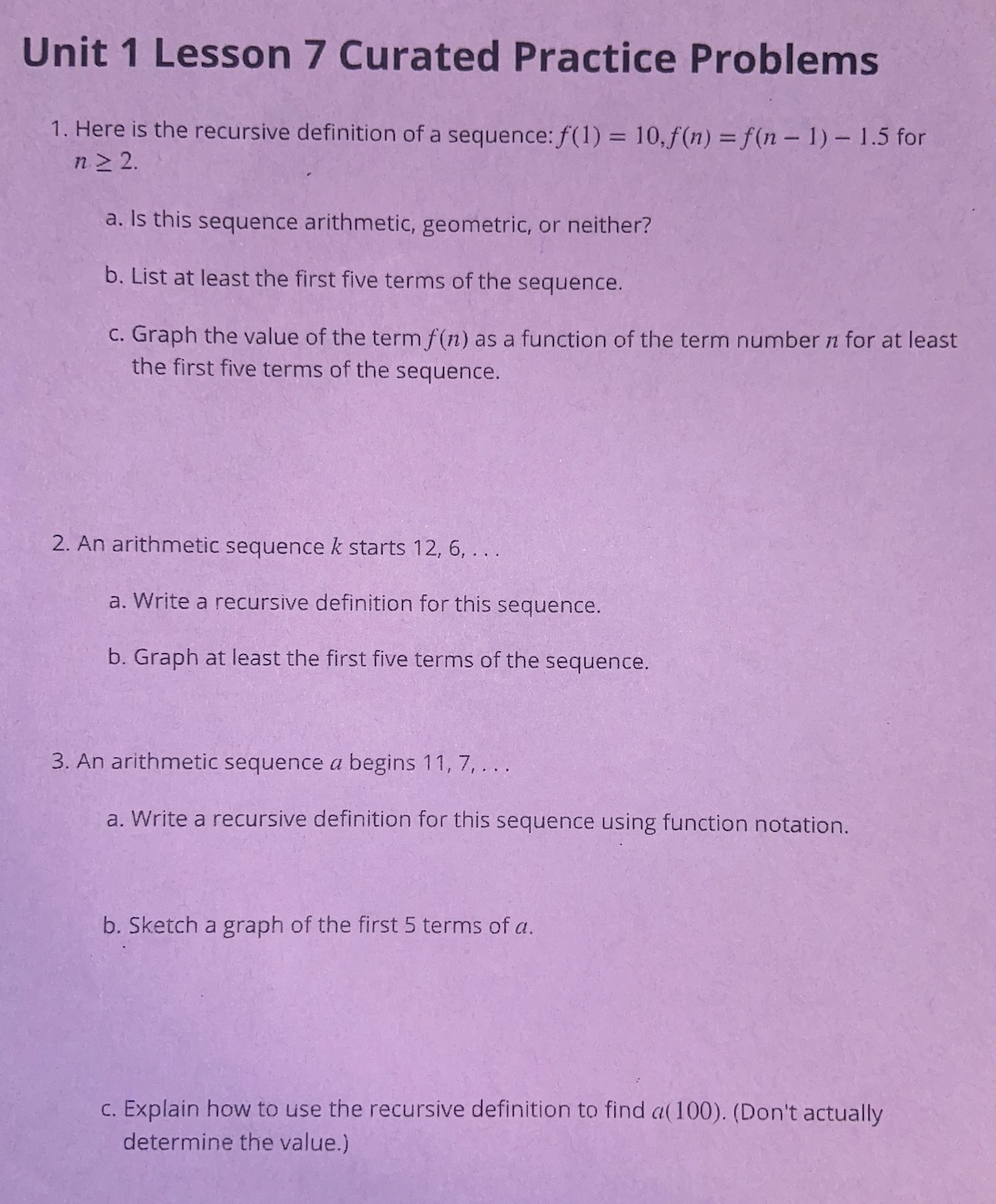
Question: Please show work, Thank you ! Unit 1 Lesson 7 Curated Practice Problems 1. Here is the recursive definition of a sequence: f(1) = 10,f(n)
Please show work, Thank you !
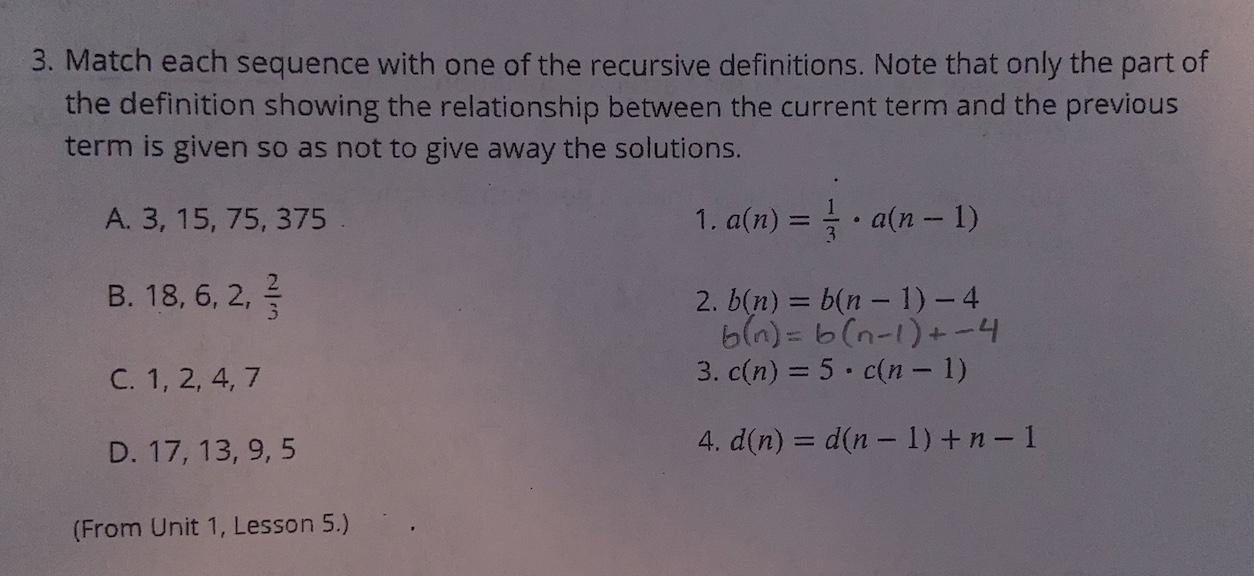
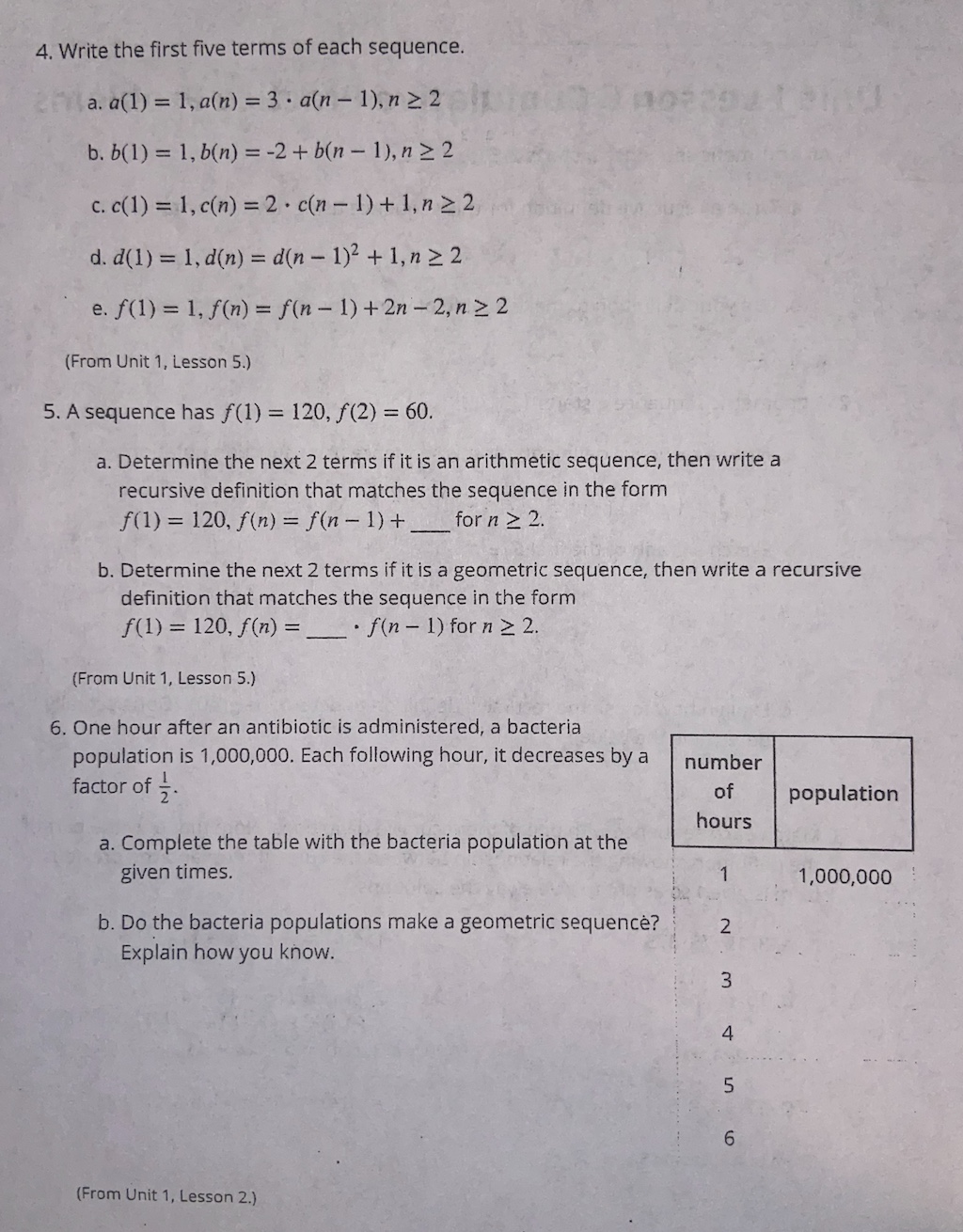
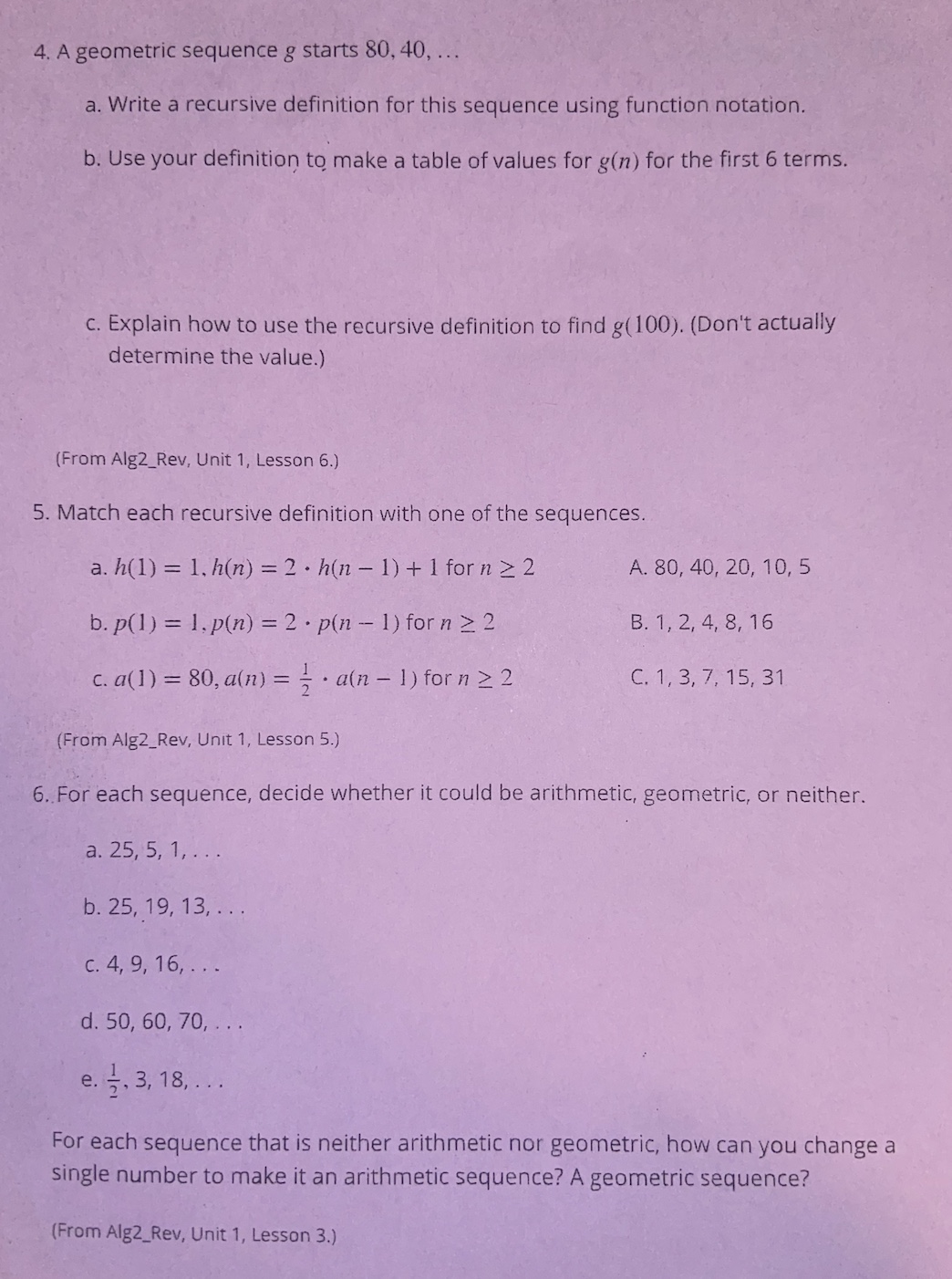
Unit 1 Lesson 7 Curated Practice Problems 1. Here is the recursive definition of a sequence: f(1) = 10,f(n) =f(n - 1) - 1.5 for n 2 2. a. Is this sequence arithmetic, geometric, or neither? b. List at least the first five terms of the sequence. c. Graph the value of the term f(n) as a function of the term number n for at least the first five terms of the sequence. 2. An arithmetic sequence k starts 12, 6, . . . a. Write a recursive definition for this sequence. b. Graph at least the first five terms of the sequence. 3. An arithmetic sequence a begins 11, 7, . .. a. Write a recursive definition for this sequence using function notation. b. Sketch a graph of the first 5 terms of a. c. Explain how to use the recursive definition to find a(100). (Don't actually determine the value.)3. Match each sequence with one of the recursive definitions. Note that only the part of the definition showing the relationship between the current term and the previous term is given so as not to give away the solutions. A. 3, 15, 75, 375 1. a (n) = . a(n - 1) B. 18, 6, 2, W/ N 2. b(n) = b(n - 1) -4 6 (n) = 6 (n-1) +-4 C. 1, 2, 4, 7 3. c(n) = 5 . c(n - 1) D. 17, 13, 9, 5 4. d(n) = d(n - 1) +n-1 (From Unit 1, Lesson 5.)4. Write the first five terms of each sequence. emila. a(1) = 1, a(n) = 3 . a(n - 1), n 2 2 b. b(1) = 1, b(n) = -2 + b(n - 1), n >2 c. c(1) = 1, c(n) = 2 . c(n - 1) + 1, n 2 2 d. d(1) = 1, d(n) = d(n - 1)2 + 1, n > 2 e. f(1) = 1, f(n) = f(n - 1) + 2n -2, n > 2 (From Unit 1, Lesson 5.) 5. A sequence has f(1) = 120, f(2) = 60. a. Determine the next 2 terms if it is an arithmetic sequence, then write a recursive definition that matches the sequence in the form f(1) = 120, f(n) = f(n - 1) +_forn 2 2. b. Determine the next 2 terms if it is a geometric sequence, then write a recursive definition that matches the sequence in the form f(1) = 120, f(n) = _. f(n - 1) forn 2 2. (From Unit 1, Lesson 5.) 6. One hour after an antibiotic is administered, a bacteria population is 1,000,000. Each following hour, it decreases by a number factor of -. of population hours a. Complete the table with the bacteria population at the given times. 1,000,000 b. Do the bacteria populations make a geometric sequence? 2 Explain how you know. 3 4 UT 6 (From Unit 1, Lesson 2.)4. A geometric sequence g starts 80, 40, ... a. Write a recursive definition for this sequence using function notation. b. Use your definition to make a table of values for g(n) for the first 6 terms. c. Explain how to use the recursive definition to find g(100). (Don't actually determine the value.) (From Alg2_Rev, Unit 1, Lesson 6.) 5. Match each recursive definition with one of the sequences. a. h(1) = 1. h(n) = 2 . h(n - 1) + 1 for n 2 2 A. 80, 40, 20, 10, 5 b. p(1) = 1. p(n) = 2 . p(n - 1) for n 2 2 B. 1, 2, 4, 8, 16 c. a(]) = 80, a(n) = = . a(n - 1) for n 2 2 C. 1, 3, 7, 15, 31 (From Alg2_Rev, Unit 1, Lesson 5.) 6. For each sequence, decide whether it could be arithmetic, geometric, or neither. a. 25, 5, 1 , ... b. 25, 19, 13, . .. C. 4, 9, 16, . . . d. 50, 60, 70, .. . e . - , 3 , 18 , ... For each sequence that is neither arithmetic nor geometric, how can you change a single number to make it an arithmetic sequence? A geometric sequence? (From Alg2_Rev, Unit 1, Lesson 3.)
Step by Step Solution
There are 3 Steps involved in it
1 Expert Approved Answer
Step: 1 Unlock
Question Has Been Solved by an Expert!
Get step-by-step solutions from verified subject matter experts
Step: 2 Unlock
Step: 3 Unlock
Students Have Also Explored These Related Mathematics Questions!









 Study Help