







Question: Please skip b and c if you are not going to answer the entire question. Emphasis on a, d, e and f but if you
 Please skip b and c if you are not going to answer the entire question. Emphasis on a, d, e and f but if you could answer the full question it would be most appreciated.
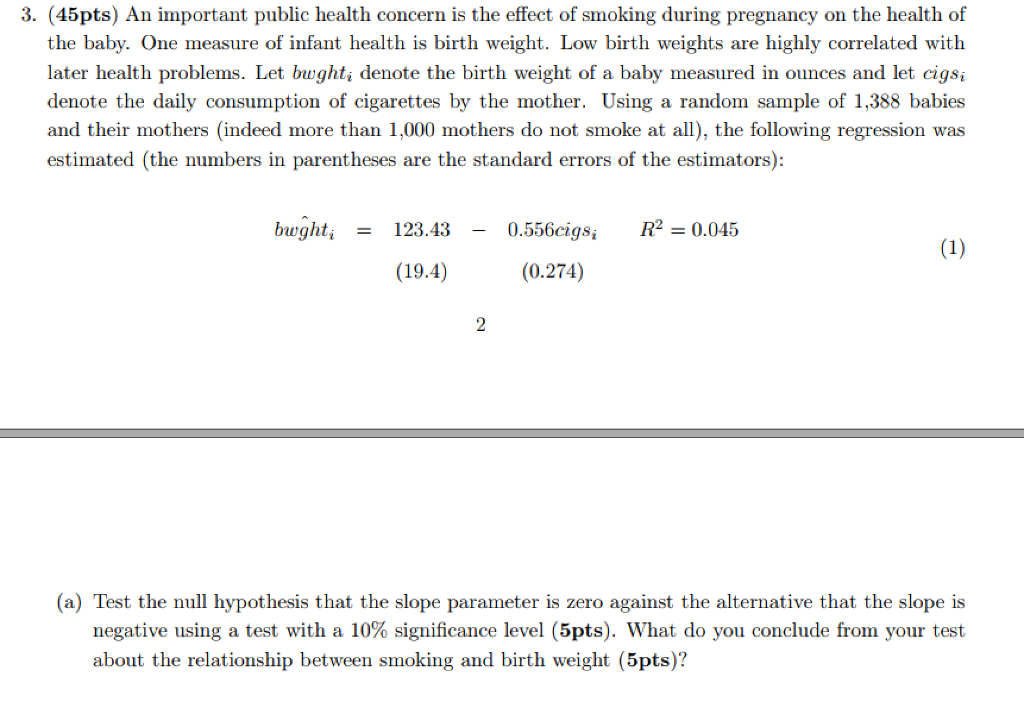
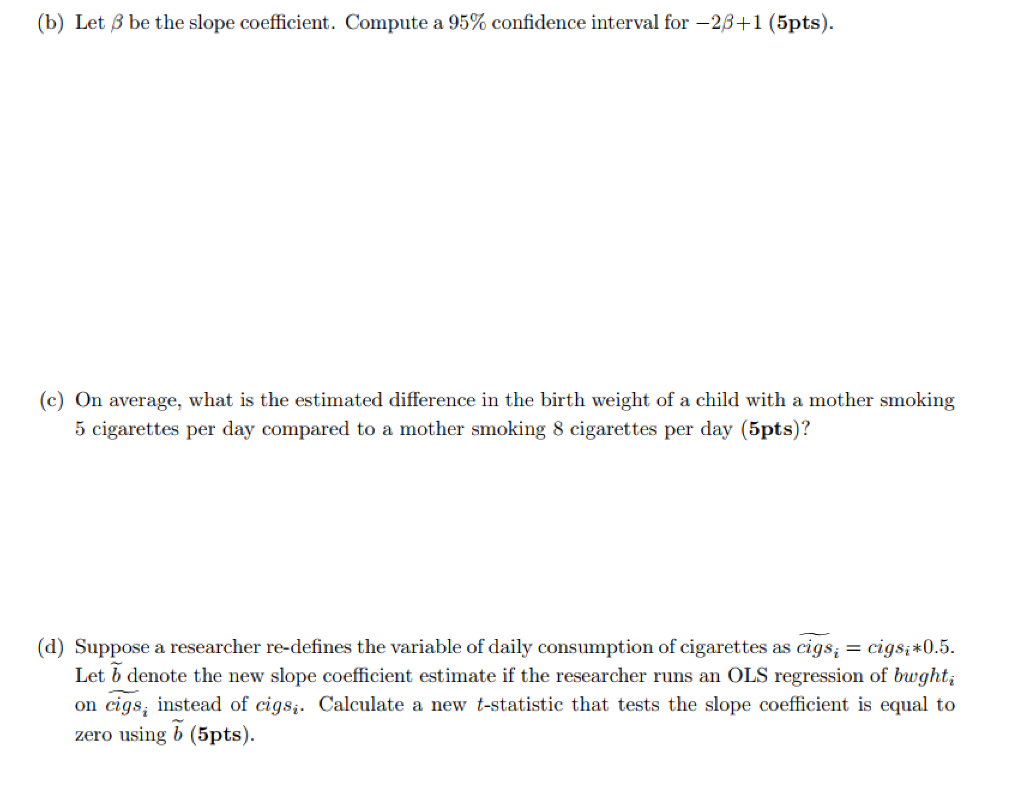
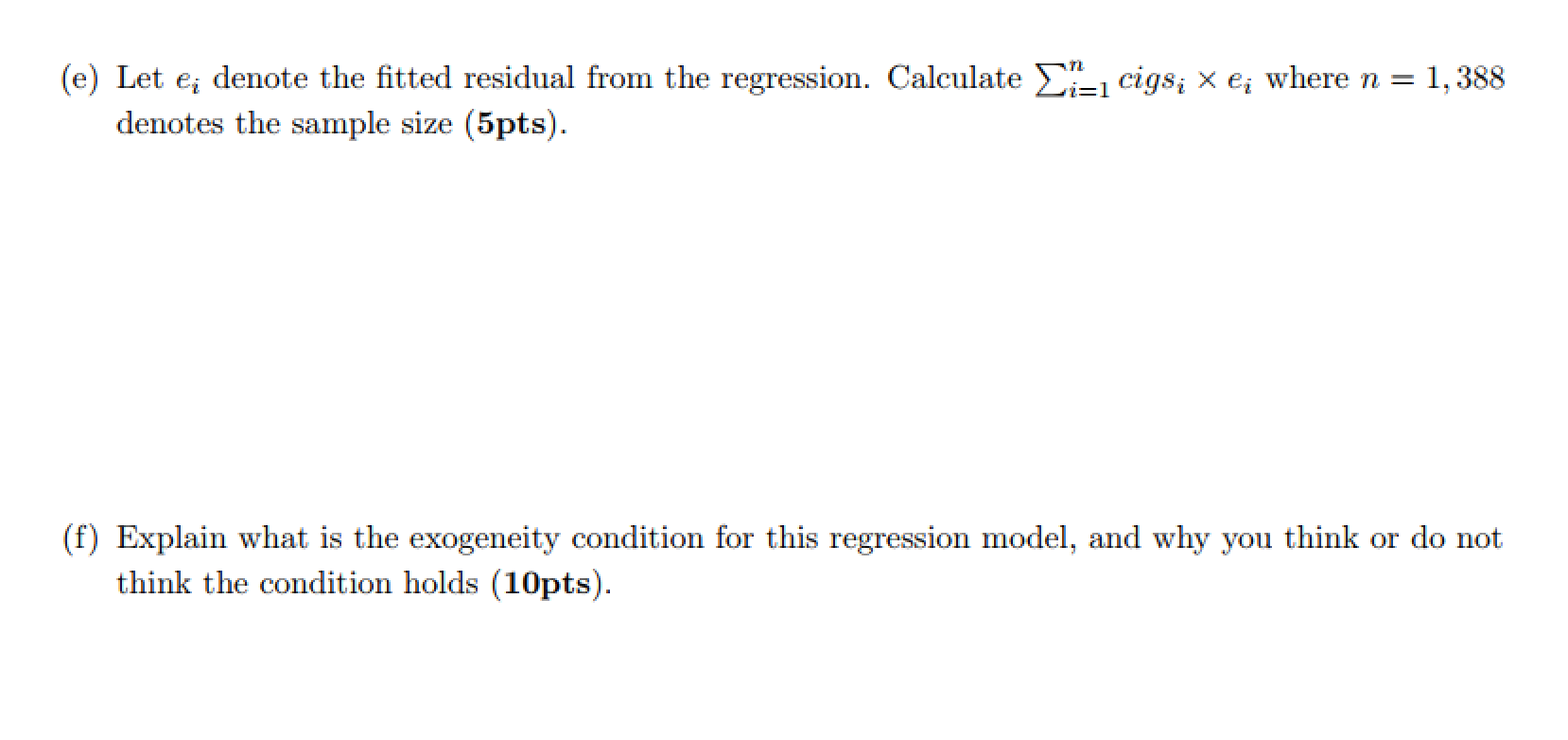
3. (45pts) An important public health concern is the effect of smoking during pregnancy on the health of the baby. One measure of infant health is birth weight. Low birth weights are highly correlated with later health problems. Let bwght denote the birth weight of a baby measured in ounces and let cigsi denote the daily consumption of cigarettes by the mother. Using a random sample of 1,388 babies and their mothers (indeed more than 1,000 mothers do not smoke at all), the following regression was estimated (the numbers in parentheses are the standard errors of the estimators): bwght; 123.43 0.556cigs, R2 = 0.045 (1) (19.4) (0.274) 2 (a) Test the null hypothesis that the slope parameter is zero against the alternative that the slope is negative using a test with a 10% significance level (5pts). What do you conclude from your test about the relationship between smoking and birth weight (5pts)? (b) Let B be the slope coefficient. Compute a 95% confidence interval for -26+1 (5pts). (c) On average, what is the estimated difference in the birth weight of a child with a mother smoking 5 cigarettes per day compared to a mother smoking 8 cigarettes per day (5pts)? (d) Suppose a researcher re-defines the variable of daily consumption of cigarettes as cigs; = cigs;*0.5. Let b denote the new slope coefficient estimate if the researcher runs an OLS regression of bwght; on cigs; instead of cigsi. Calculate a new t-statistic that tests the slope coefficient is equal to zero using b (5pts). (e) Let ei denote the fitted residual from the regression. Calculate 1-1 cigs; x ei where n = 1,388 denotes the sample size (5pts). (f) Explain what is the exogeneity condition for this regression model, and why you think or do not think the condition holds (10pts). 3. (45pts) An important public health concern is the effect of smoking during pregnancy on the health of the baby. One measure of infant health is birth weight. Low birth weights are highly correlated with later health problems. Let bwght denote the birth weight of a baby measured in ounces and let cigsi denote the daily consumption of cigarettes by the mother. Using a random sample of 1,388 babies and their mothers (indeed more than 1,000 mothers do not smoke at all), the following regression was estimated (the numbers in parentheses are the standard errors of the estimators): bwght; 123.43 0.556cigs, R2 = 0.045 (1) (19.4) (0.274) 2 (a) Test the null hypothesis that the slope parameter is zero against the alternative that the slope is negative using a test with a 10% significance level (5pts). What do you conclude from your test about the relationship between smoking and birth weight (5pts)? (b) Let B be the slope coefficient. Compute a 95% confidence interval for -26+1 (5pts). (c) On average, what is the estimated difference in the birth weight of a child with a mother smoking 5 cigarettes per day compared to a mother smoking 8 cigarettes per day (5pts)? (d) Suppose a researcher re-defines the variable of daily consumption of cigarettes as cigs; = cigs;*0.5. Let b denote the new slope coefficient estimate if the researcher runs an OLS regression of bwght; on cigs; instead of cigsi. Calculate a new t-statistic that tests the slope coefficient is equal to zero using b (5pts). (e) Let ei denote the fitted residual from the regression. Calculate 1-1 cigs; x ei where n = 1,388 denotes the sample size (5pts). (f) Explain what is the exogeneity condition for this regression model, and why you think or do not think the condition holds (10pts)
Step by Step Solution
There are 3 Steps involved in it

Get step-by-step solutions from verified subject matter experts
 Study Help