







Question: please slove step by step all five 68 A student wants to use an Arrhenius plot to determine the activation energy for a reaction which
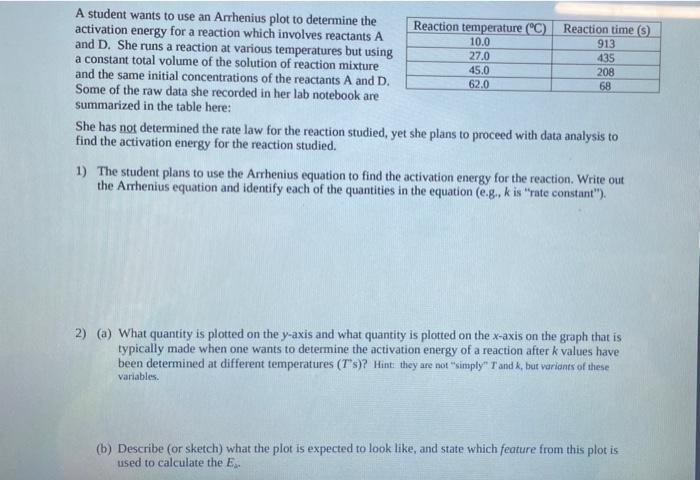
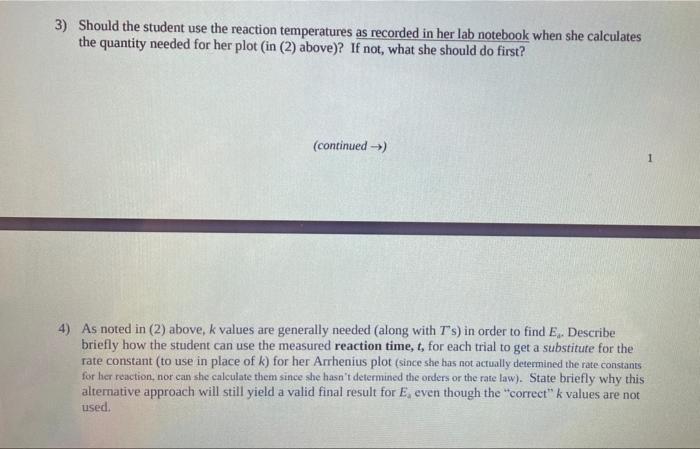
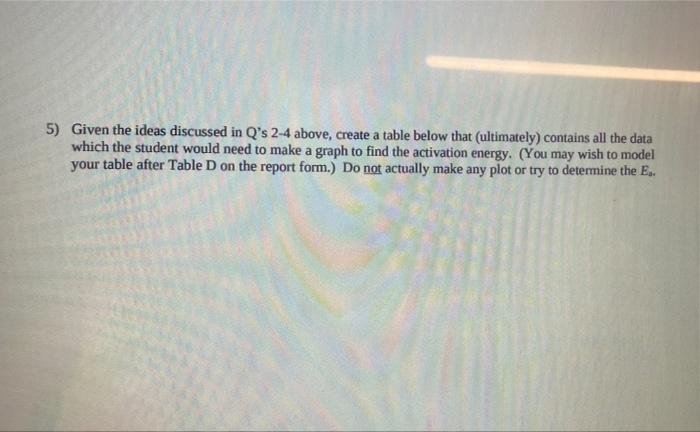
68 A student wants to use an Arrhenius plot to determine the activation energy for a reaction which involves reactants A Reaction temperature (C) Reaction time (5) 10.0 913 and D. She runs a reaction at various temperatures but using 27.0 435 a constant total volume of the solution of reaction mixture 45.0 208 and the same initial concentrations of the reactants A and D. 62.0 Some of the raw data she recorded in her lab notebook are summarized in the table here: She has not determined the rate law for the reaction studied, yet she plans to proceed with data analysis to find the activation energy for the reaction studied. 1) The student plans to use the Arrhenius equation to find the activation energy for the reaction. Write out the Arrhenius equation and identify each of the quantities in the equation (e.g., kis "rate constant"). 2) (a) What quantity is plotted on the y-axis and what quantity is plotted on the x-axis on the graph that is typically made when one wants to determine the activation energy of a reaction after k values have been determined at different temperatures (T's)? Hint they are not simply" Tandk, but variants of these variables. (b) Describe (or sketch) what the plot is expected to look like and state which feature from this plot is used to calculate the E. 3) Should the student use the reaction temperatures as recorded in her lab notebook when she calculates the quantity needed for her plot (in (2) above)? If not, what she should do first? (continued 1 4) As noted in (2) above, k values are generally needed (along with T's) in order to find E Describe briefly how the student can use the measured reaction time, t, for each trial to get a substitute for the rate constant (to use in place of k) for her Arrhenius plot (since she has not actually determined the rate constants for her reaction, nor can she calculate them since she hasn't determined the orders or the rate law). State briefly why this alternative approach will still yield a valid final result for E, even though the correct" k values are not used 5) Given the ideas discussed in Q's 2-4 above, create a table below that (ultimately) contains all the data which the student would need to make a graph to find the activation energy. (You may wish to model your table after Table D on the report form.) Do not actually make any plot or try to determine the E
Step by Step Solution
There are 3 Steps involved in it

Get step-by-step solutions from verified subject matter experts
 Study Help