







Question: please so important Instructions: Read carefully the case study below and answer the questions that follow Us Versus Them: Generational Conflict in the Workplace The
please so
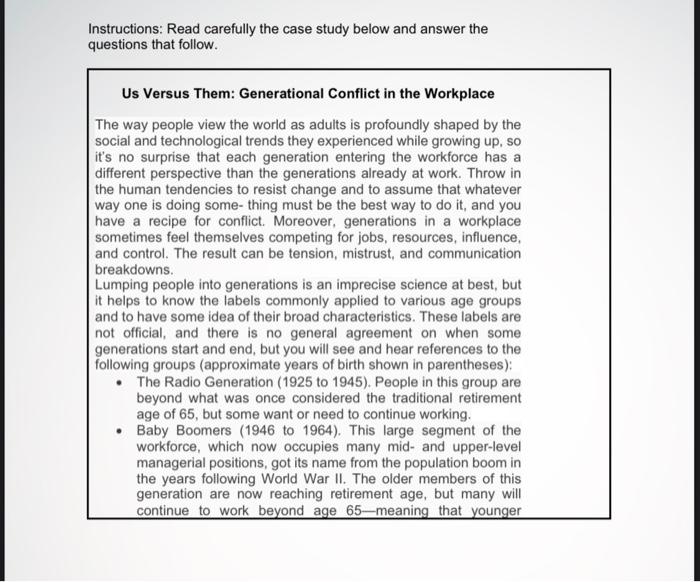
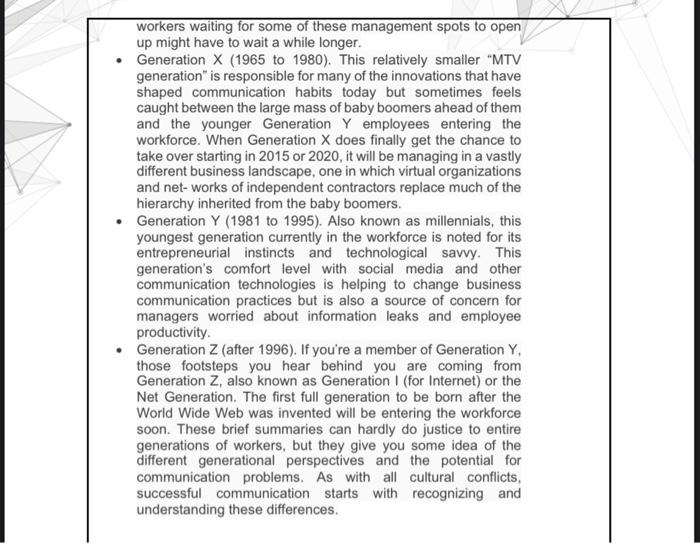
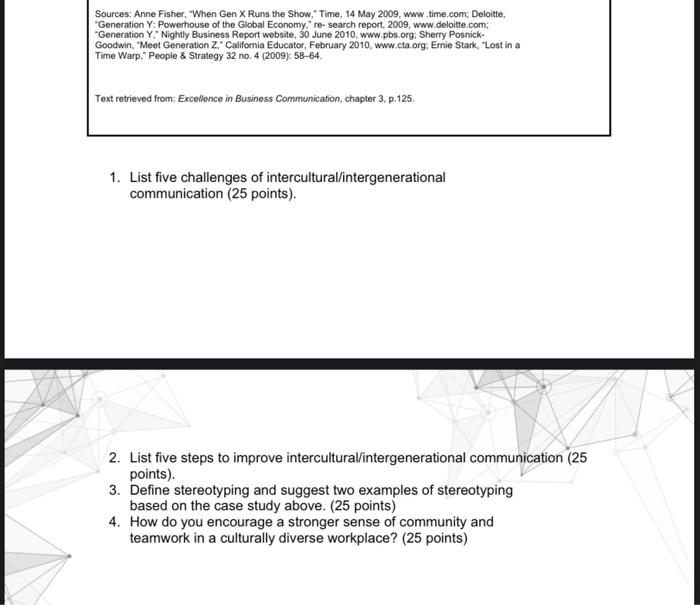
Instructions: Read carefully the case study below and answer the questions that follow Us Versus Them: Generational Conflict in the Workplace The way people view the world as adults is profoundly shaped by the social and technological trends they experienced while growing up, so it's no surprise that each generation entering the workforce has a different perspective than the generations already at work. Throw in the human tendencies to resist change and to assume that whatever way one is doing something must be the best way to do it, and you have a recipe for conflict. Moreover, generations in a workplace sometimes feel themselves competing for jobs, resources, influence, and control. The result can be tension, mistrust, and communication breakdowns. Lumping people into generations is an imprecise science at best, but it helps to know the labels commonly applied to various age groups and to have some idea of their broad characteristics. These labels are not official, and there is no general agreement on when some generations start and end, but you will see and hear references to the following groups (approximate years of birth shown in parentheses): The Radio Generation (1925 to 1945). People in this group are beyond what was once considered the traditional retirement age of 65, but some want or need to continue working. Baby Boomers (1946 to 1964). This large segment of the workforce, which now occupies many mid- and upper-level managerial positions, got its name from the population boom in the years following World War II. The older members of this generation are now reaching retirement age, but many will continue to work beyond age 65-meaning that younger workers waiting for some of these management spots to open up might have to wait a while longer. Generation X (1965 to 1980). This relatively smaller "MTV generation" is responsible for many of the innovations that have shaped communication habits today but sometimes feels caught between the large mass of baby boomers ahead of them and the younger Generation Y employees entering the workforce. When Generation X does finally get the chance to take over starting in 2015 or 2020, it will be managing in a vastly different business landscape, one in which virtual organizations and net- works of independent contractors replace much of the hierarchy inherited from the baby boomers. Generation Y (1981 to 1995). Also known as millennials, this youngest generation currently in the workforce is noted for its entrepreneurial instincts and technological savvy. This generation's comfort level with social media and other communication technologies is helping to change business communication practices but is also a source of concern for managers worried about information leaks and employee productivity Generation Z (after 1996). If you're a member of Generation Y, those footsteps you hear behind you are coming from Generation Z, also known as Generation 1 (for Internet) or the Net Generation. The first full generation to be born after the World Wide Web was invented will be entering the workforce soon. These brief summaries can hardly do justice to entire generations of workers, but they give you some idea of the different generational perspectives and the potential for communication problems. As with all cultural conflicts, successful communication starts with recognizing and understanding these differences. Sources: Anne Fisher, "When Gen X Runs the Show, Time, 14 May 2009, www.time.com, Deloitte, "Generation Y: Powerhouse of the Global Economy," re- search report, 2009, www.deloitte.com "Generation Y." Nightly Business Report website, 30 June 2010, www.pbs.org: Sherry Posnick- Goodwin, "Meet Generation Z." California Educator, February 2010, www.cta.org: Ernie Stark, "Lost in a Time Warp." People & Strategy 32 no. 4 (2009): 58-64 Text retrieved from: Excellence in Business Communication, chapter 3. p.125. 1. List five challenges of intercultural/intergenerational communication (25 points). 2. List five steps to improve intercultural/intergenerational communication (25 points). 3. Define stereotyping and suggest two examples of stereotyping based on the case study above. (25 points) 4. How do you encourage a stronger sense of community and teamwork in a culturally diverse workplace? (25 points) important
Step by Step Solution
There are 3 Steps involved in it
1 Expert Approved Answer
Step: 1 Unlock

Question Has Been Solved by an Expert!
Get step-by-step solutions from verified subject matter experts
Step: 2 Unlock
Step: 3 Unlock
 Study Help