







Question: Please solve by LINGO or Excel Solver and provide a screen capture and a short written version of your answer A) B Full answer will
Please solve by LINGO or Excel Solver and provide a screen capture and a short written version of your answer 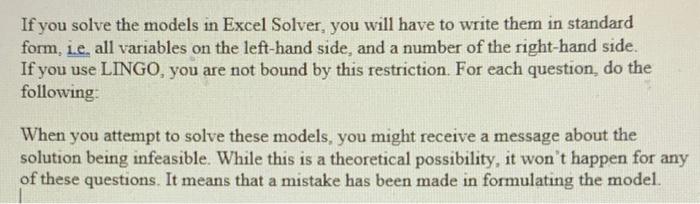
A)
B
Full answer will receive a like!
Dont copy old answers
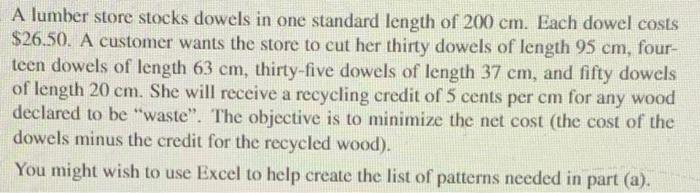
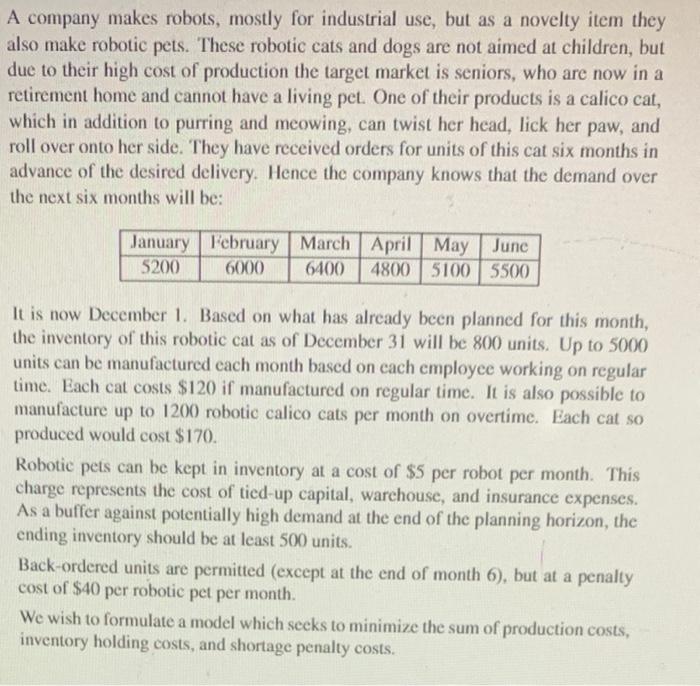
If you solve the models in Excel Solver, you will have to write them in standard form, ie, all variables on the left-hand side, and a number of the right-hand side. If you use LINGO, you are not bound by this restriction. For each question, do the following When you attempt to solve these models, you might receive a message about the solution being infeasible. While this is a theoretical possibility, it won't happen for any of these questions. It means that a mistake has been made in formulating the model. a A lumber store stocks dowels in one standard length of 200 cm. Each dowel costs $26.50. A customer wants the store to cut her thirty dowels of length 95 cm, four- teen dowels of length 63 cm, thirty-five dowels of length 37 cm, and fifty dowels of length 20 cm. She will receive a recycling credit of 5 cents per cm for any wood declared to be "waste". The objective is to minimize the net cost (the cost of the dowels minus the credit for the recycled wood). You might wish to use Excel to help create the list of patterns needed in part (a). A company makes robots, mostly for industrial use, but as a novelty item they also make robotic pets. These robotic cats and dogs are not aimed at children, but due to their high cost of production the target market is seniors, who are now in a retirement home and cannot have a living pet. One of their products is a calico cat, which in addition to purring and meowing, can twist her head, lick her paw, and roll over onto her side. They have received orders for units of this cat six months in advance of the desired delivery. Hence the company knows that the demand over the next six months will be: January February March April May June 5200 6000 6400 4800 5100 5500 It is now December 1. Based on what has already been planned for this month, the inventory of this robotic cat as of December 31 will be 800 units. Up to 5000 units can be manufactured each month based on each employee working on regular time. Each cat costs $120 if manufactured on regular time. It is also possible to manufacture up to 1200 robotic calico cats per month on overtime. Each cat so produced would cost $170. Robotic pets can be kept in inventory at a cost of $5 per robot per month. This charge represents the cost of tied-up capital, warehouse, and insurance expenses. As a buffer against potentially high demand at the end of the planning horizon, the ending inventory should be at least 500 units. Back-ordered units are permitted (except at the end of month 6), but at a penalty cost of $40 per robotic pet per month We wish to formulate a model which seeks to minimize the sum of production costs, inventory holding costs, and shortage penalty costs Step by Step Solution
There are 3 Steps involved in it
1 Expert Approved Answer
Step: 1 Unlock

Question Has Been Solved by an Expert!
Get step-by-step solutions from verified subject matter experts
Step: 2 Unlock
Step: 3 Unlock
 Study Help