







Question: Please solve for me C, = 4C2= C3 = CA= A. In general, how does the number of combinations compare to the number of permutations?
Please solve for me
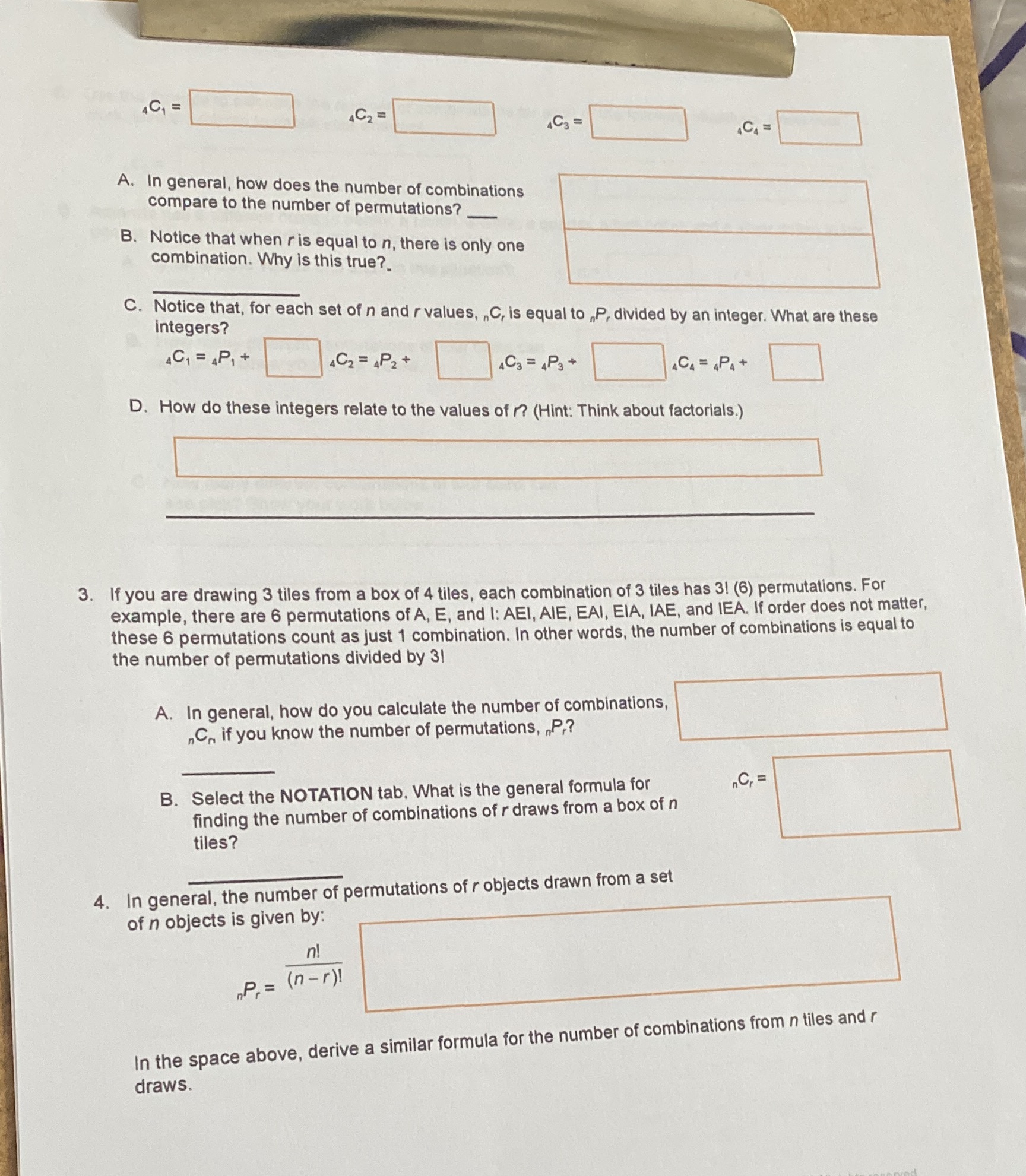
C, = 4C2= C3 = CA= A. In general, how does the number of combinations compare to the number of permutations? B. Notice that when r is equal to n, there is only one combination. Why is this true?_ integers? C. Notice that, for each set of n and r values, ,C, is equal to ,P, divided by an integer. What are these AC1 = P, + A C 2 = 4 P 2 + A C 3 = 1 P 3 + A C. = P . + D. How do these integers relate to the values of r? (Hint: Think about factorials.) 3. If you are drawing 3 tiles from a box of 4 tiles, each combination of 3 tiles has 3! (6) permutations. For example, there are 6 permutations of A, E, and I: AEI, AIE, EAI, EIA, IAE, and IEA. If order does not matter, these 6 permutations count as just 1 combination. In other words, the number of combinations is equal to the number of permutations divided by 3! A. In general, how do you calculate the number of combinations, Cn if you know the number of permutations, ,P.? B. Select the NOTATION tab. What is the general formula for C, = finding the number of combinations of r draws from a box of n tiles? 4. In general, the number of permutations of r objects drawn from a set of n objects is given by: n! P. = ( n - r ) ! In the space above, derive a similar formula for the number of combinations from n tiles and r draws
Step by Step Solution
There are 3 Steps involved in it

Get step-by-step solutions from verified subject matter experts
 Study Help