







Question: 1. What is the truth value of the statement p p if the truth value of p is True (1) 2. When will be
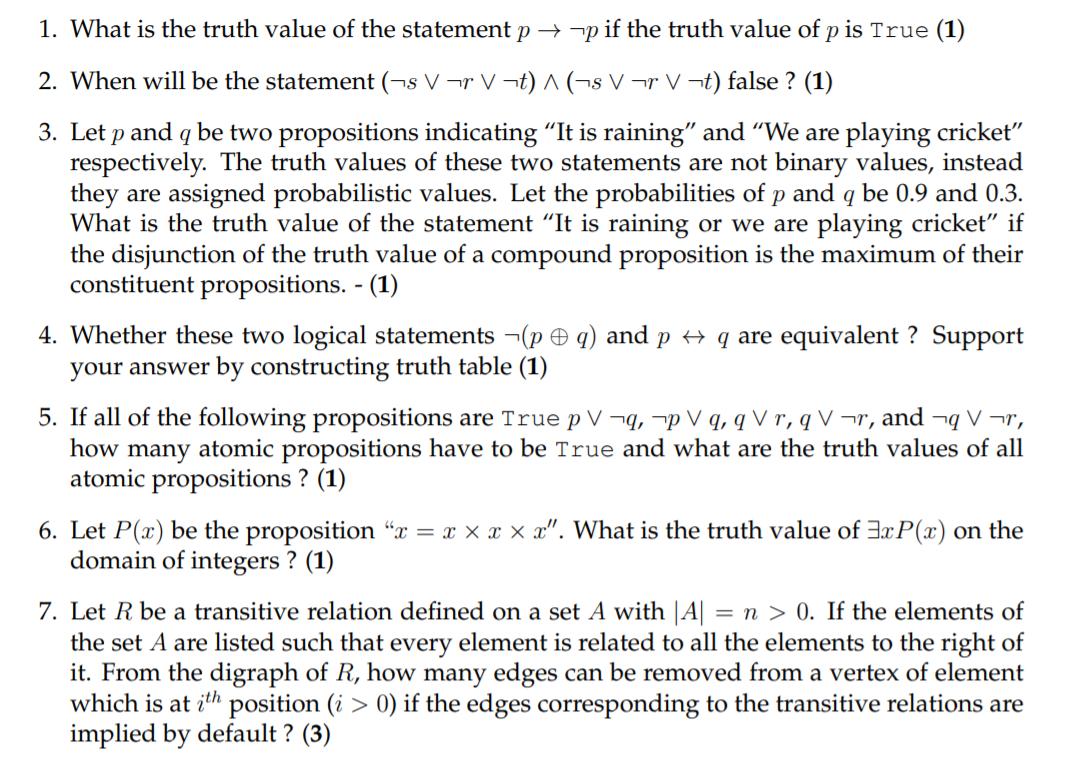
1. What is the truth value of the statement p p if the truth value of p is True (1) 2. When will be the statement (s VrVt) A (s VrVt) false? (1) 3. Let p and q be two propositions indicating "It is raining" and "We are playing cricket" respectively. The truth values of these two statements are not binary values, instead they are assigned probabilistic values. Let the probabilities of p and q be 0.9 and 0.3. What is the truth value of the statement "It is raining or we are playing cricket" if the disjunction of the truth value of a compound proposition is the maximum of their constituent propositions. - (1) 4. Whether these two logical statements (p q) and p q are equivalent ? Support your answer by constructing truth table (1) 5. If all of the following propositions are True pVq, pVq, qr, qr, and q Vr, how many atomic propositions have to be True and what are the truth values of all atomic propositions ? (1) 6. Let P(x) be the proposition "x = x x x x x". What is the truth value of xP(x) on the domain of integers ? (1) 7. Let R be a transitive relation defined on a set A with |A| = n > 0. If the elements of the set A are listed such that every element is related to all the elements to the right of it. From the digraph of R, how many edges can be removed from a vertex of element which is at ith position (i > 0) if the edges corresponding to the transitive relations are implied by default? (3)
Step by Step Solution
3.43 Rating (153 Votes )
There are 3 Steps involved in it
1 The truth value of the statement pp if the truth value of p is True is True This is because the double implication operator implies that if the statement is true then the statement must be true no m... View full answer

Get step-by-step solutions from verified subject matter experts
 Study Help