







Question: please solve it completely I will thumb you up 3. Assessment objective: This question assesses your understanding of the reasons for the occurrence of short-
please solve it completely I will thumb you up
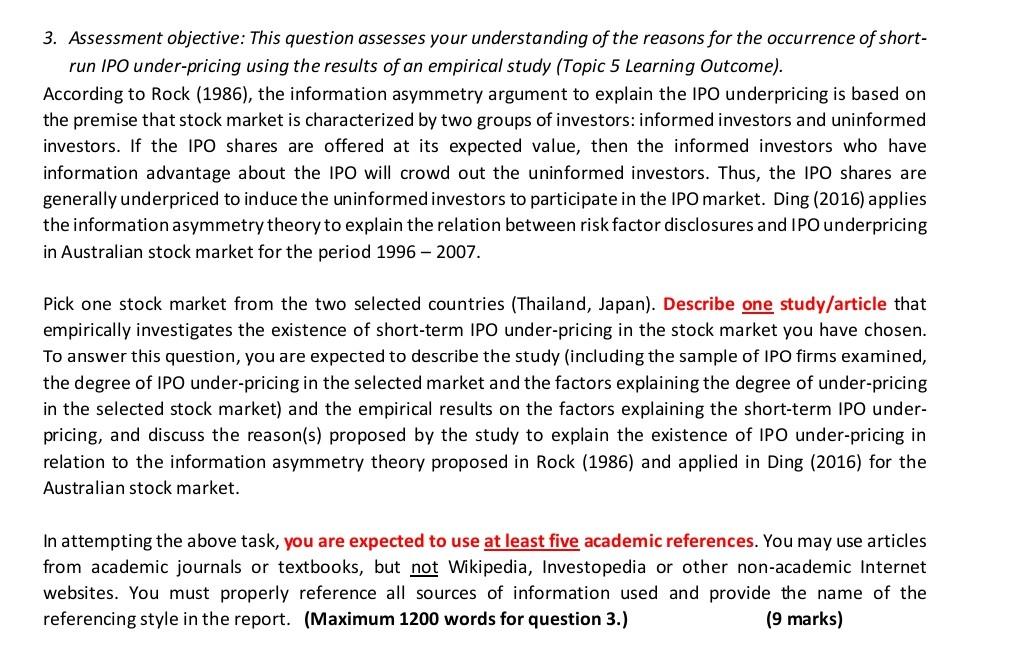
3. Assessment objective: This question assesses your understanding of the reasons for the occurrence of short- run IPO under-pricing using the results of an empirical study (Topic 5 Learning Outcome). According to Rock (1986), the information asymmetry argument to explain the IPO underpricing is based on the premise that stock market is characterized by two groups of investors: informed investors and uninformed investors. If the IPO shares are offered at its expected value, then the informed investors who have information advantage about the IPO will crowd out the uninformed investors. Thus, the IPO shares are generally underpriced to induce the uninformed investors to participate in the IPO market. Ding (2016) applies the information asymmetry theory to explain the relation between risk factor disclosures and IPO underpricing in Australian stock market for the period 1996 - 2007. Pick one stock market from the two selected countries (Thailand, Japan). Describe one study/article that empirically investigates the existence of short-term IPO under-pricing in the stock market you have chosen. To answer this question, you are expected to describe the study (including the sample of IPO firms examined, the degree of IPO under-pricing in the selected market and the factors explaining the degree of under-pricing in the selected stock market) and the empirical results on the factors explaining the short-term IPO under- pricing, and discuss the reason(s) proposed by the study to explain the existence of IPO under-pricing in relation to the information asymmetry theory proposed in Rock (1986) and applied Ding (2016) for the Australian stock market. In attempting the above task, you are expected to use at least five academic references. You may use articles from academic journals or textbooks, but not Wikipedia, Investopedia or other non-academic Internet websites. You must properly reference all sources of information used and provide the name of the referencing style in the report. (Maximum 1200 words for question 3.) (9 marks) 3. Assessment objective: This question assesses your understanding of the reasons for the occurrence of short- run IPO under-pricing using the results of an empirical study (Topic 5 Learning Outcome). According to Rock (1986), the information asymmetry argument to explain the IPO underpricing is based on the premise that stock market is characterized by two groups of investors: informed investors and uninformed investors. If the IPO shares are offered at its expected value, then the informed investors who have information advantage about the IPO will crowd out the uninformed investors. Thus, the IPO shares are generally underpriced to induce the uninformed investors to participate in the IPO market. Ding (2016) applies the information asymmetry theory to explain the relation between risk factor disclosures and IPO underpricing in Australian stock market for the period 1996 - 2007. Pick one stock market from the two selected countries (Thailand, Japan). Describe one study/article that empirically investigates the existence of short-term IPO under-pricing in the stock market you have chosen. To answer this question, you are expected to describe the study (including the sample of IPO firms examined, the degree of IPO under-pricing in the selected market and the factors explaining the degree of under-pricing in the selected stock market) and the empirical results on the factors explaining the short-term IPO under- pricing, and discuss the reason(s) proposed by the study to explain the existence of IPO under-pricing in relation to the information asymmetry theory proposed in Rock (1986) and applied Ding (2016) for the Australian stock market. In attempting the above task, you are expected to use at least five academic references. You may use articles from academic journals or textbooks, but not Wikipedia, Investopedia or other non-academic Internet websites. You must properly reference all sources of information used and provide the name of the referencing style in the report. (Maximum 1200 words for question 3.) (9 marks)
Step by Step Solution
There are 3 Steps involved in it

Get step-by-step solutions from verified subject matter experts
 Study Help