







Question: CASE 4.3 ASSIGNING STUDENTS TO SCHOOLS The Springfield school board has made the decision to close one of its middle schools (sixth, seventh, and
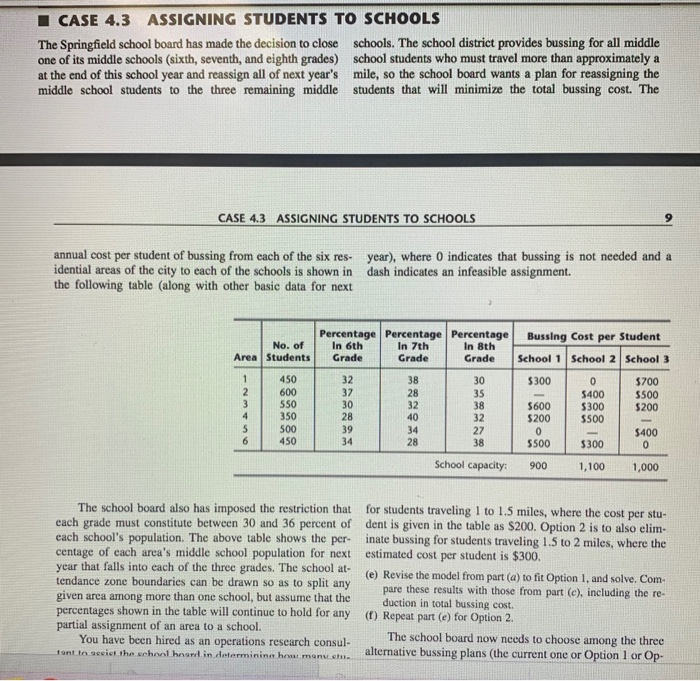
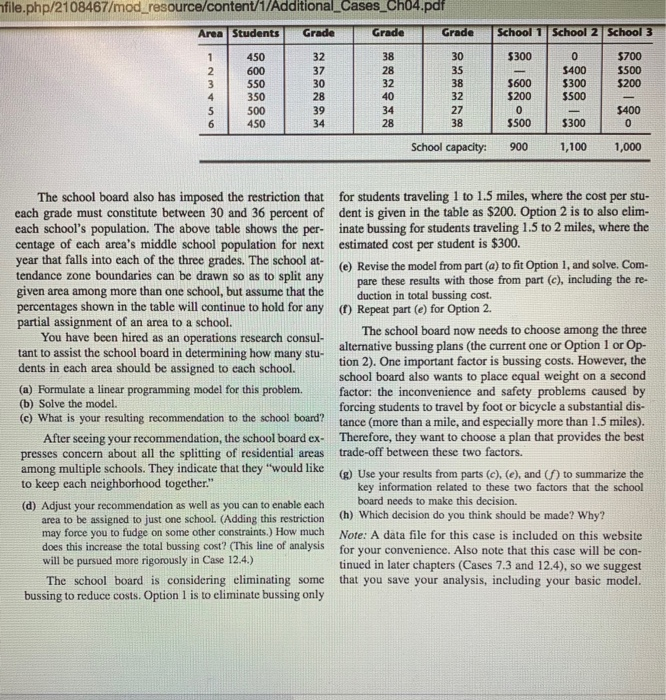
CASE 4.3 ASSIGNING STUDENTS TO SCHOOLS The Springfield school board has made the decision to close one of its middle schools (sixth, seventh, and eighth grades) at the end of this school year and reassign all of next year's middle school students to the three remaining middle schools. The school district provides bussing for all middle school students who must travel more than approximately a mile, so the school board wants a plan for reassigning the students that will minimize the total bussing cost. The CASE 4.3 ASSIGNING STUDENTS TO SCHOOLS annual cost per student of bussing from each of the six res- idential areas of the city to each of the schools is shown in the following table (along with other basic data for next year), where 0 indicates that bussing is not needed and a dash indicates an infeasible assignment. Percentage Percentage Percentage Bussing Cost per Student No. of Area Students In 6th Grade In 7th Grade In 8th Grade School 1 School 2 School 3 1 450 32 2 600 37 3 550 30 4 350 28 5 500 39 6 450 34 22232 38 30 $300 0 $700 28 35 $400 $500 38 $600 $300 $200 40 32 $200 $500 34 27 0 $400 28 38 $500 $300 0 School capacity: 900 1,100 1,000 The school board also has imposed the restriction that each grade must constitute between 30 and 36 percent of each school's population. The above table shows the per- centage of each area's middle school population for next year that falls into each of the three grades. The school at- tendance zone boundaries can be drawn so as to split any given area among more than one school, but assume that the percentages shown in the table will continue to hold for any partial assignment of an area to a school. You have been hired as an operations research consul- tant to assist the school hoard in determining how many chi for students traveling 1 to 1.5 miles, where the cost per stu- dent is given in the table as $200. Option 2 is to also elim- inate bussing for students traveling 1.5 to 2 miles, where the estimated cost per student is $300. (e) Revise the model from part (a) to fit Option 1, and solve. Com- pare these results with those from part (c), including the re- duction in total bussing cost. (f) Repeat part (e) for Option 2. The school board now needs to choose among the three alternative bussing plans (the current one or Option 1 or Op- file.php/2108467/mod_resource/content/1/Additional_Cases_Ch04.pdf Area Students Grade Grade Grade School 1 School 2 School 3 123 450 600 3 550 30 4 350 as. 500 6 450 233227 28 39 34 22242 38 30 $300 0 $700 28 35 $400 $500 32 38 $600 $300 $200 40 32 $200 $500 34 27 0 $400 28 38 $500 $300 0 School capacity: 900 1,100 1,000 The school board also has imposed the restriction that each grade must constitute between 30 and 36 percent of each school's population. The above table shows the per- centage of each area's middle school population for next year that falls into each of the three grades. The school at- tendance zone boundaries can be drawn so as to split any given area among more than one school, but assume that the percentages shown in the table will continue to hold for any partial assignment of an area to a school. You have been hired as an operations research consul- tant to assist the school board in determining how many stu- dents in each area should be assigned to each school. (a) Formulate a linear programming model for this problem. (b) Solve the model. (c) What is your resulting recommendation to the school board? After seeing your recommendation, the school board ex- presses concern about all the splitting of residential areas among multiple schools. They indicate that they "would like to keep each neighborhood together." (d) Adjust your recommendation as well as you can to enable each area to be assigned to just one school. (Adding this restriction may force you to fudge on some other constraints.) How much does this increase the total bussing cost? (This line of analysis will be pursued more rigorously in Case 12.4.) The school board is considering eliminating some bussing to reduce costs. Option 1 is to eliminate bussing only for students traveling 1 to 1.5 miles, where the cost per stu- dent is given in the table as $200. Option 2 is to also elim- inate bussing for students traveling 1.5 to 2 miles, where the estimated cost per student is $300. (e) Revise the model from part (a) to fit Option 1, and solve. Com- pare these results with those from part (c), including the re- duction in total bussing cost. (f) Repeat part (e) for Option 2. The school board now needs to choose among the three alternative bussing plans (the current one or Option 1 or Op- tion 2). One important factor is bussing costs. However, the school board also wants to place equal weight on a second factor: the inconvenience and safety problems caused by forcing students to travel by foot or bicycle a substantial dis- tance (more than a mile, and especially more than 1.5 miles). Therefore, they want to choose a plan that provides the best trade-off between these two factors. (g) Use your results from parts (c), (e), and (f) to summarize the key information related to these two factors that the school board needs to make this decision. (h) Which decision do you think should be made? Why? Note: A data file for this case is included on this website for your convenience. Also note that this case will be con- tinued in later chapters (Cases 7.3 and 12.4), so we suggest that you save your analysis, including your basic model.
Step by Step Solution
There are 3 Steps involved in it
Lets break down and answer the parts of the question based on the case study a Formulate a Linear Programming Model for this Problem We are tasked with assigning students from different areas to one o... View full answer

Get step-by-step solutions from verified subject matter experts
 Study Help