







Question: please solve it the same way this question solved: Consider the following integer-linear program which is used to decide which warehouses to open from a
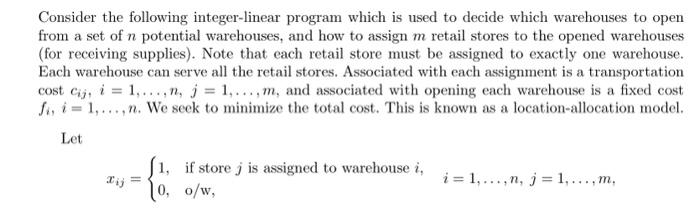
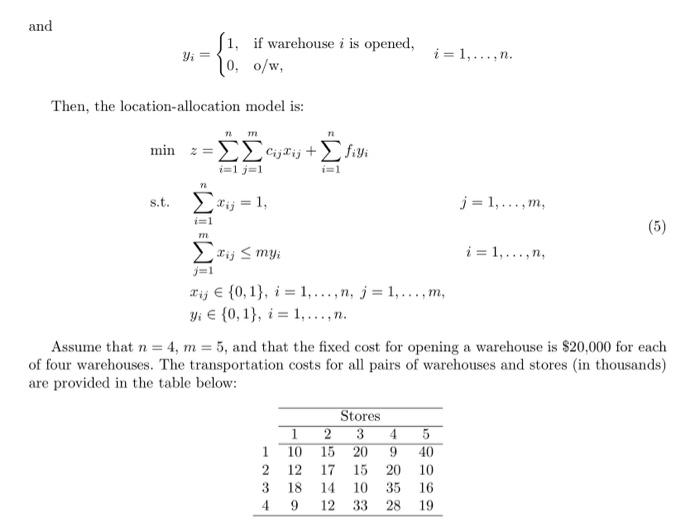
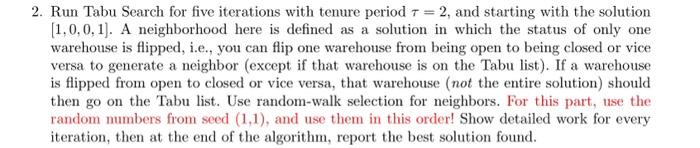
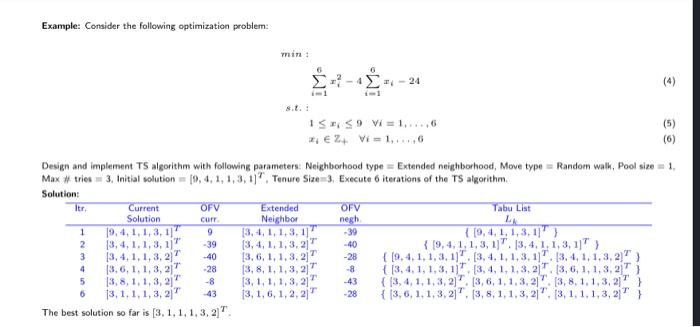
Consider the following integer-linear program which is used to decide which warehouses to open from a set of n potential warehouses, and how to assign m retail stores to the opened warehouses (for receiving supplies). Note that each retail store must be assigned to exactly one warehouse. Each warehouse can serve all the retail stores. Associated with each assignment is a transportation costcij,i=1,,n,j=1,,m, and associated with opening each warehouse is a fixed cost fi,i=1,,n. We seck to minimize the total cost. This is known as a location-allocation model. Let xij={1,0,ifstorejisassignedtowarehousei,o/w, and yi={1,0,ifwarehouseiisopened,o/w Then, the location-allocation model is: mins.t.z=i=1nj=1mcijxij+i=1nfiyii=1nxij=1,j=1mxijmyixij{0,1},i=1,,n,j=1,,m,n,yi{0,1},i=1,,n.j=1,,m, Assume that n=4,m=5, and that the fixed cost for opening a warehouse is $20,000 for each of four warehouses. The transportation costs for all pairs of warehouses and stores (in thousands) are provided in the table below: 2. Run Tabu Search for five iterations with tenure period =2, and starting with the solution [1,0,0,1]. A neighborhood here is defined as a solution in which the status of only one warehouse is flipped, i.e., you can flip one warehouse from being open to being closed or vice versa to generate a neighbor (except if that warehouse is on the Tabu list). If a warehouse is flipped from open to closed or vice versa, that warehouse (not the entire solution) should then go on the Tabu list. Use random-walk selection for neighbors. For this part, use the random numbers from seed (1,1), and use them in this order! Show detailed work for every iteration, then at the end of the algorithm, report the best solution found. Example: Consider the following optimization problem: min:i=16xi24i=16xi24s.t.:1xi9i=1,,6xiZ+i=1,,6 Design and implement TS algorithm with following parameters: Neighborhood type = Extended neighborhood, Move type = Random walk, Pool size = Max # tries =3. Initial solution =[9,4,1,1,3,1]T, Tenure Size =3. Execute 6 iterations of the TS algorithm. Solution
Step by Step Solution
There are 3 Steps involved in it

Get step-by-step solutions from verified subject matter experts
 Study Help