







Question: Please solve it using any programming code. For problem 13 you can just do one of the four exercises Please help f (2-c) +-+ 3.3
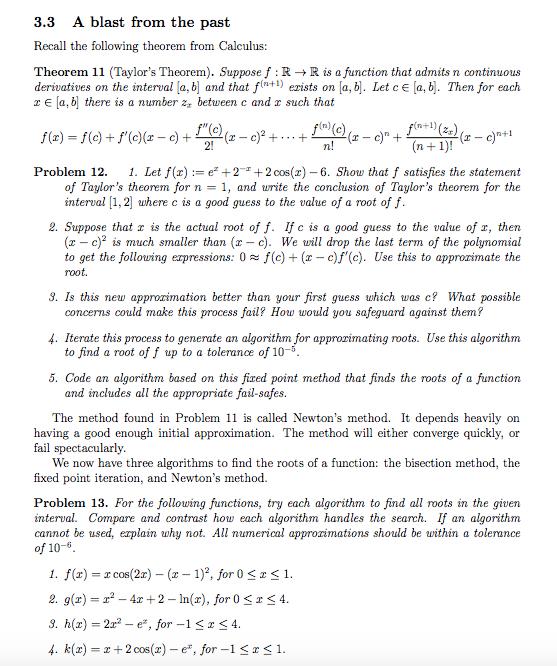
Please solve it using any programming code.
For problem 13 you can just do one of the four exercises
Please help
f" (2-c) +-+ 3.3 A blast from the past Recall the following theorem from Calculus: Theorem 11 (Taylor's Theorem). Suppose f : R+R is a function that admits n continuous derivatives on the interval (a, b) and that f(n+1) exists on [a, b]. Let cela, b]. Then for each re(a,b) there is a number 2, between c and r such that f(1) = f(c) + f'(C)(-C) + 2 2! n! (n + 1)! Problem 12. 1. Let f(r) :=e* +2+ + 2 cos(z) - 6. Show that f satisfies the statement of Taylor's theorem for n = 1, and write the conclusion of Taylor's theorem for the interval [1, 2] where c is a good guess to the value of a root of f. 2. Suppose that r is the actual root of f. If c is a good guess to the value of 1, then (3 - c) is much smaller than (r -c). We will drop the last term of the polynomial to get the following expressions: 0 = f(c) + (x - c)f'(c). Use this to approximate the root. 3. Is this new approximation better than your first guess which was c? What possible concerns could make this process fail? How would you safeguard against them? 4. Iterate this process to generate an algorithm for approximating roots. Use this algorithm to find a root of f up to a tolerance of 10-5 5. Code an algorithm based on this fired point method that finds the roots of a function and includes all the appropriate fail-safes. The method found in Problem 11 is called Newton's method. It depends heavily on having a good enough initial approximation. The method will either converge quickly, or fail spectacularly. We now have three algorithms to find the roots of a function: the bisection method, the fixed point iteration, and Newton's method. Problem 13. For the following functions, try each algorithm to find all roots in the given interval. Compare and contrast how each algorithm handles the search. If an algorithm cannot be used, explain why not. All numerical approximations should be within a tolerance of 10-8 1. f(x) = 2 COS(2) - (2-1), for 0
Step by Step Solution
There are 3 Steps involved in it

Get step-by-step solutions from verified subject matter experts
 Study Help