







Question: Please solve only if you know, do not copy past the answer that's already posted on chegg. I'll make sure I like you ans. 3.
Please solve only if you know, do not copy past the answer that's already posted on chegg. I'll make sure I like you ans.
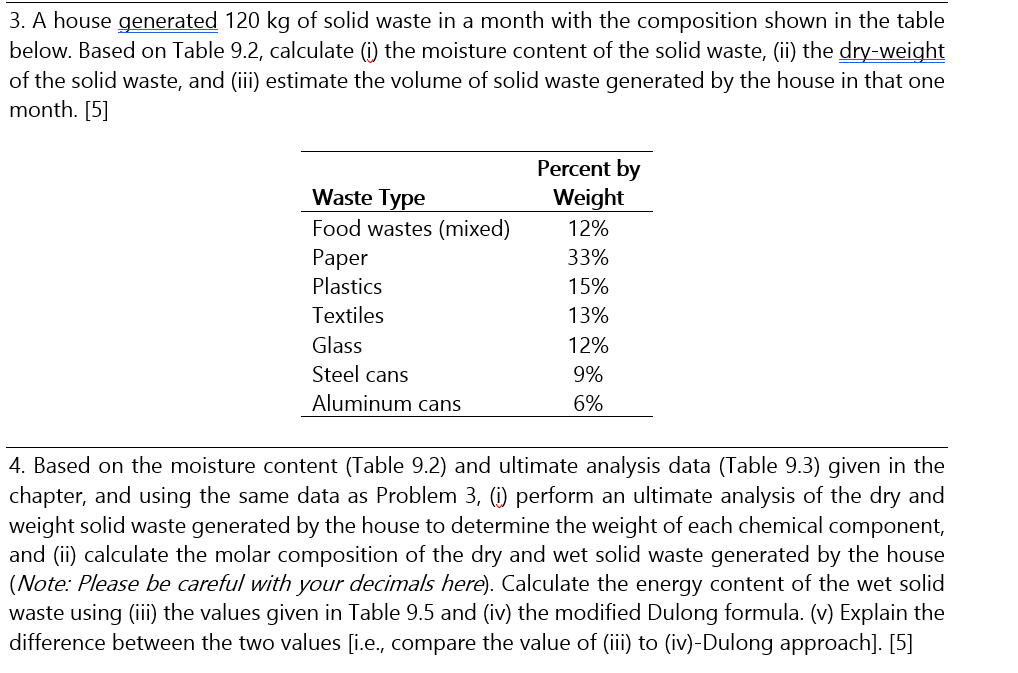
3. A house generated 120kg of solid waste in a month with the composition shown in the table below. Based on Table 9.2, calculate (i) the moisture content of the solid waste, (ii) the dry-weight of the solid waste, and (iii) estimate the volume of solid waste generated by the house in that one month. [5] 4. Based on the moisture content (Table 9.2) and ultimate analysis data (Table 9.3) given in the chapter, and using the same data as Problem 3, (i) perform an ultimate analysis of the dry and weight solid waste generated by the house to determine the weight of each chemical component, and (ii) calculate the molar composition of the dry and wet solid waste generated by the house (Note: Please be careful with your decimals here). Calculate the energy content of the wet solid waste using (iii) the values given in Table 9.5 and (iv) the modified Dulong formula. (v) Explain the difference between the two values [i.e., compare the value of (iii) to (iv)-Dulong approach]. [5] 3. A house generated 120kg of solid waste in a month with the composition shown in the table below. Based on Table 9.2, calculate (i) the moisture content of the solid waste, (ii) the dry-weight of the solid waste, and (iii) estimate the volume of solid waste generated by the house in that one month. [5] 4. Based on the moisture content (Table 9.2) and ultimate analysis data (Table 9.3) given in the chapter, and using the same data as Problem 3, (i) perform an ultimate analysis of the dry and weight solid waste generated by the house to determine the weight of each chemical component, and (ii) calculate the molar composition of the dry and wet solid waste generated by the house (Note: Please be careful with your decimals here). Calculate the energy content of the wet solid waste using (iii) the values given in Table 9.5 and (iv) the modified Dulong formula. (v) Explain the difference between the two values [i.e., compare the value of (iii) to (iv)-Dulong approach]. [5]
Step by Step Solution
There are 3 Steps involved in it

Get step-by-step solutions from verified subject matter experts
 Study Help