



Question: Please solve part c. I have already solved parts a and b. 3.2. Viscous heating in laminar tube flow (asymptotic solutions). (a) Show that for
Please solve part c. I have already solved parts a and b.
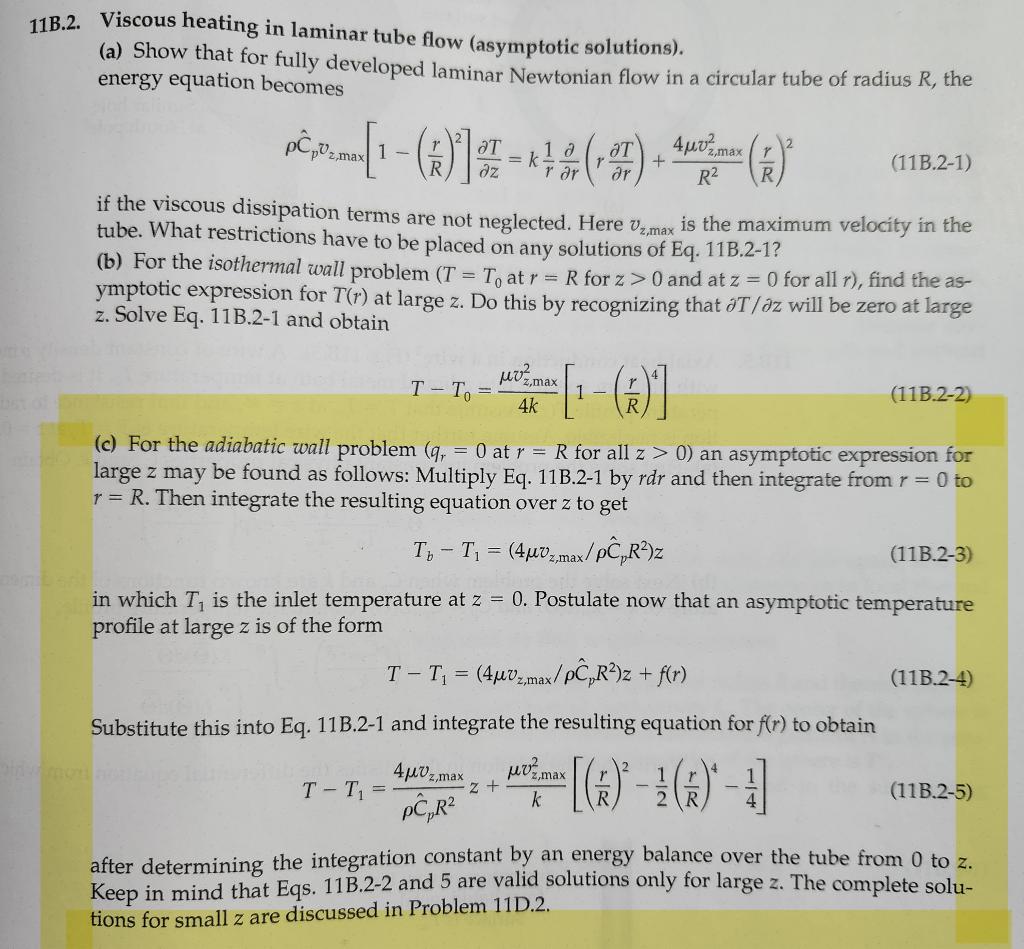
3.2. Viscous heating in laminar tube flow (asymptotic solutions). (a) Show that for fully developed laminar Newtonian flow in a circular tube of radius R, the energy equation becomes C^pvz,max[1(Rr)2]zT=kr1r(rrT)+R24vz,max2(Rr)2 if the viscous dissipation terms are not neglected. Here vz,max is the maximum velocity in the tube. What restrictions have to be placed on any solutions of Eq. 11B.2-1? (b) For the isothermal wall problem ( T=T0 at r=R for z>0 and at z=0 for all r ), find the asymptotic expression for T(r) at large z. Do this by recognizing that T/z will be zero at large z. Solve Eq. 11B.2-1 and obtain TT0=4kvz,max2[1(Rr)4] (c) For the adiabatic wall problem (qr=0 at r=R for all z>0) an asymptotic expression for large z may be found as follows: Multiply Eq. 11B.2-1 by rdr and then integrate from r=0 to r=R. Then integrate the resulting equation over z to get TbT1=(4vz,max/C^pR2)z in which T1 is the inlet temperature at z=0. Postulate now that an asymptotic temperature profile at large z is of the form TT1=(4vz,max/C^pR2)z+f(r) Substitute this into Eq. 11B.2-1 and integrate the resulting equation for f(r) to obtain TT1=C^pR24vz,maxz+kvz,max2[(Rr)221(Rr)441] after determining the integration constant by an energy balance over the tube from 0 to z. Keep in mind that Eqs. 11B.2-2 and 5 are valid solutions only for large z. The complete solutions for small z are discussed in Problem 11D.2
Step by Step Solution
There are 3 Steps involved in it

Get step-by-step solutions from verified subject matter experts