







Question: Please solve Problem #10.9 Only 10-9. When HOCl is added to water, it can enter into a 10-7. The pharmaceutical diclofenac can be oxidized number
Please solve Problem #10.9 Only
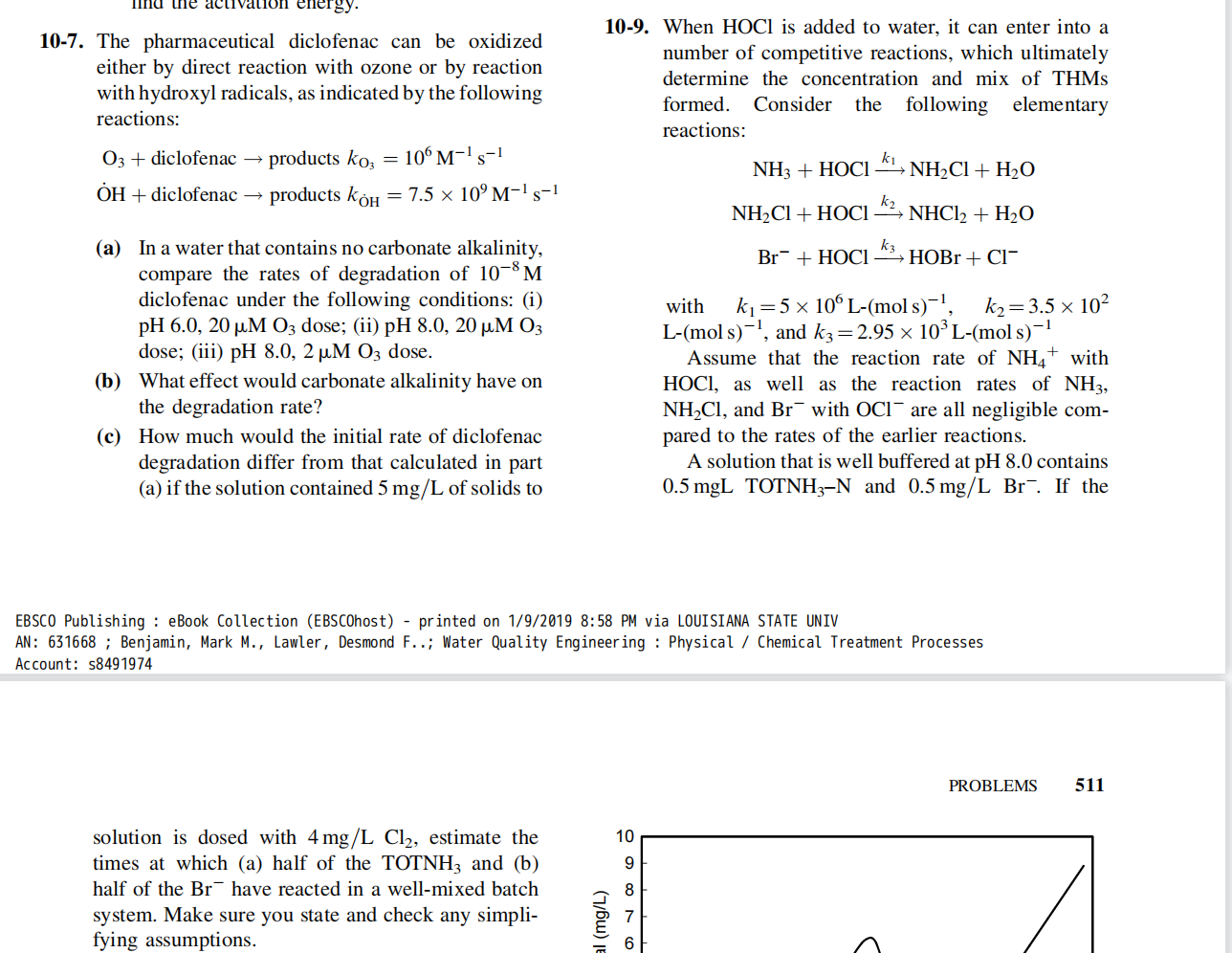
10-9. When HOCl is added to water, it can enter into a 10-7. The pharmaceutical diclofenac can be oxidized number of competitive reactions, which ultimately either by direct reaction with ozone or by reaction with hydroxyl radicals, as indicated by the following determine the concentration and mix of THMs formed. Consider the following elementary reactions: reactions: O3+diclofenacOH+diclofenacproductskO3=106M1s1productskOH=7.5109M1s1 (a) In a water that contains no carbonate alkalinity, compare the rates of degradation of 108M diclofenac under the following conditions: (i) with k1=5106L(mols)1,k2=3.5102 pH6.0,20MO3 dose; (ii) pH8.0,20MO3 L(mols)1, and k3=2.95103L(mols)1 dose; (iii) pH8.0,2MO3 dose. Assume that the reaction rate of NH4+with (b) What effect would carbonate alkalinity have on HOCl, as well as the reaction rates of NH3, the degradation rate? (c) How much would the initial rate of diclofenac pared to the rates of the earlier reactions. degradation differ from that calculated in part A solution that is well buffered at pH8.0 contains (a) if the solution contained 5mg/L of solids to EBSCO Publishing : eBook Collection (EBSCOhost) - printed on 1/9/2019 8:58 PM via LOUISIANA STATE UNIV AN: 631668 ; Benjamin, Mark M., Lawler, Desmond F..; Water Quality Engineering : Physical / Chemical Treatment Processes Account: s8491974 PROBLEMS 511 solution is dosed with 4mg/LCl2, estimate the times at which (a) half of the TOTNH3 and (b) half of the Brhave reacted in a well-mixed batch system. Make sure you state and check any simplifying assumptions. 10-9. When HOCl is added to water, it can enter into a 10-7. The pharmaceutical diclofenac can be oxidized number of competitive reactions, which ultimately either by direct reaction with ozone or by reaction with hydroxyl radicals, as indicated by the following determine the concentration and mix of THMs formed. Consider the following elementary reactions: reactions: O3+diclofenacOH+diclofenacproductskO3=106M1s1productskOH=7.5109M1s1 (a) In a water that contains no carbonate alkalinity, compare the rates of degradation of 108M diclofenac under the following conditions: (i) with k1=5106L(mols)1,k2=3.5102 pH6.0,20MO3 dose; (ii) pH8.0,20MO3 L(mols)1, and k3=2.95103L(mols)1 dose; (iii) pH8.0,2MO3 dose. Assume that the reaction rate of NH4+with (b) What effect would carbonate alkalinity have on HOCl, as well as the reaction rates of NH3, the degradation rate? (c) How much would the initial rate of diclofenac pared to the rates of the earlier reactions. degradation differ from that calculated in part A solution that is well buffered at pH8.0 contains (a) if the solution contained 5mg/L of solids to EBSCO Publishing : eBook Collection (EBSCOhost) - printed on 1/9/2019 8:58 PM via LOUISIANA STATE UNIV AN: 631668 ; Benjamin, Mark M., Lawler, Desmond F..; Water Quality Engineering : Physical / Chemical Treatment Processes Account: s8491974 PROBLEMS 511 solution is dosed with 4mg/LCl2, estimate the times at which (a) half of the TOTNH3 and (b) half of the Brhave reacted in a well-mixed batch system. Make sure you state and check any simplifying assumptions
Step by Step Solution
There are 3 Steps involved in it

Get step-by-step solutions from verified subject matter experts
 Study Help