







Question: Please solve problems 4.2-4.5 UL 14.15). Note VU Wsponding matrix A is nonsymmetric as, for instance, the elements aiz and aji corresponding to the points
Please solve 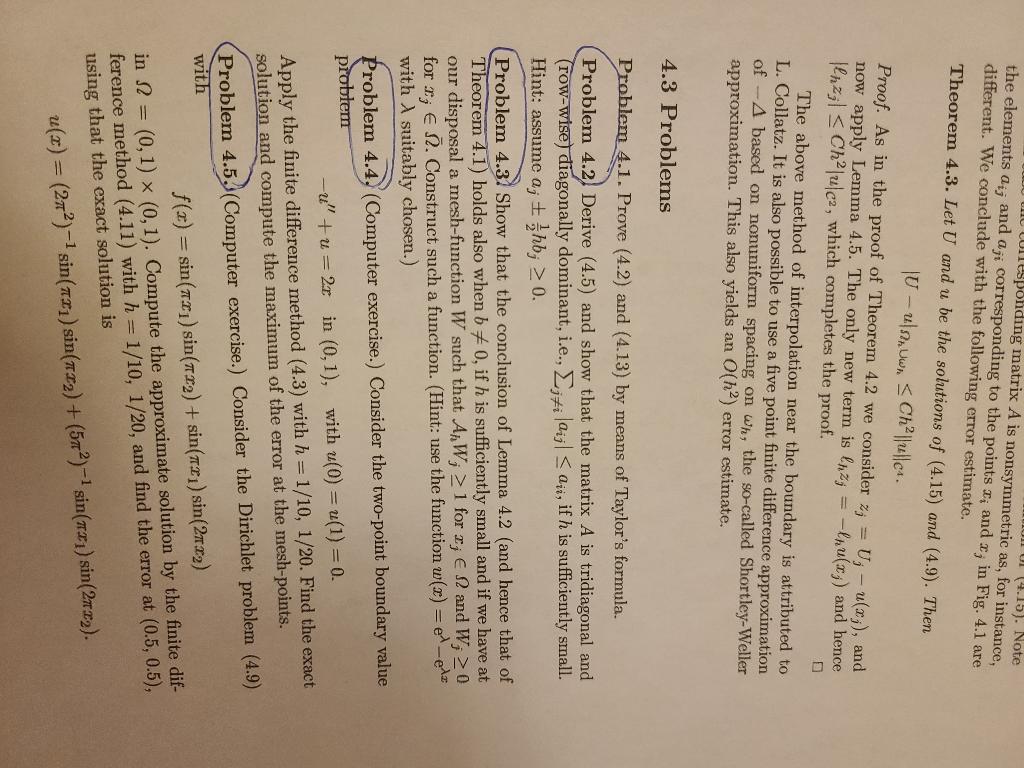 problems 4.2-4.5
UL 14.15). Note VU Wsponding matrix A is nonsymmetric as, for instance, the elements aiz and aji corresponding to the points Ti anda; in Fig. 4.1 are different. We conclude with the following error estimate. Theorem 4.3. Let U and u be the solutions of (4.15) and (4.9). Then \U uwwn 1 for 2; EN and W, > 0 for I; E 2. Construct such a function. (Hint: use the function w(x) = el-elz with suitably chosen.) Problem 4.4, (Computer exercise. Consider the two-point boundary value problem -u" +u=2 in (0,1), with u(0) = u(1) = 0. Apply the finite difference method (4.3) with h=1/10, 1/20. Find the exact solution and compute the maximum of the error at the mesh-points. Problem 4.5. (Computer exercise. Consider the Dirichlet problem (4.9) with f(x) = sin(721) sin(112) + sin(721) sin(2x2) in 2 = (0,1) (0,1). Compute the approximate solution by the finite dif- ference method (4.11) with h=1/10, 1/20, and find the error at (0.5, 0.5), using that the exact solution is u(x) = (2x)+sin(737) sin(122) + (572) sin(727) sin(2722). UL 14.15). Note VU Wsponding matrix A is nonsymmetric as, for instance, the elements aiz and aji corresponding to the points Ti anda; in Fig. 4.1 are different. We conclude with the following error estimate. Theorem 4.3. Let U and u be the solutions of (4.15) and (4.9). Then \U uwwn 1 for 2; EN and W, > 0 for I; E 2. Construct such a function. (Hint: use the function w(x) = el-elz with suitably chosen.) Problem 4.4, (Computer exercise. Consider the two-point boundary value problem -u" +u=2 in (0,1), with u(0) = u(1) = 0. Apply the finite difference method (4.3) with h=1/10, 1/20. Find the exact solution and compute the maximum of the error at the mesh-points. Problem 4.5. (Computer exercise. Consider the Dirichlet problem (4.9) with f(x) = sin(721) sin(112) + sin(721) sin(2x2) in 2 = (0,1) (0,1). Compute the approximate solution by the finite dif- ference method (4.11) with h=1/10, 1/20, and find the error at (0.5, 0.5), using that the exact solution is u(x) = (2x)+sin(737) sin(122) + (572) sin(727) sin(2722)
Step by Step Solution
There are 3 Steps involved in it

Get step-by-step solutions from verified subject matter experts
 Study Help