







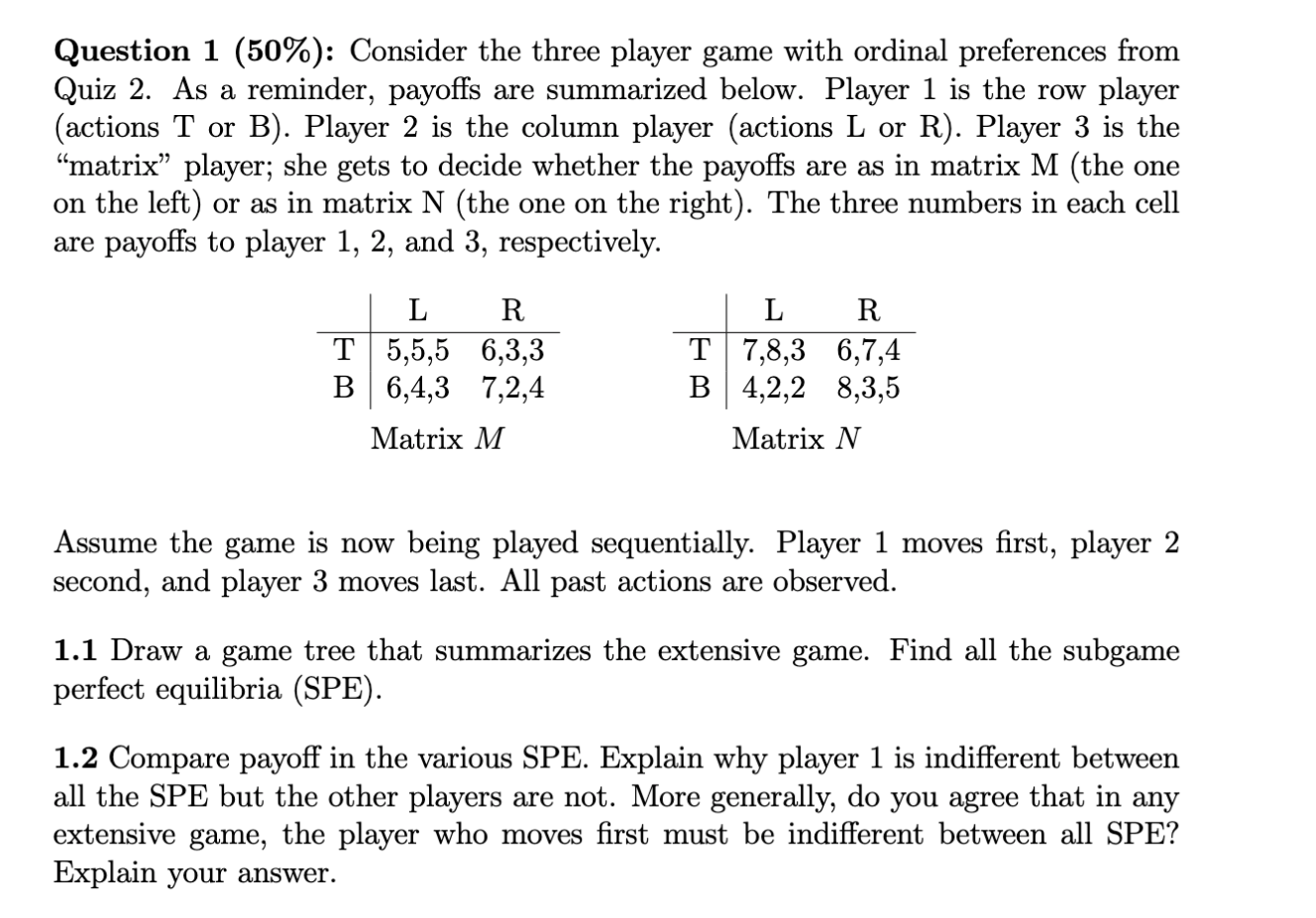
Question: please solve Question 1 (50%): Consider the three player game with ordinal preferences from Quiz 2. As a reminder, payoffs are summarized below. Player 1
please solve
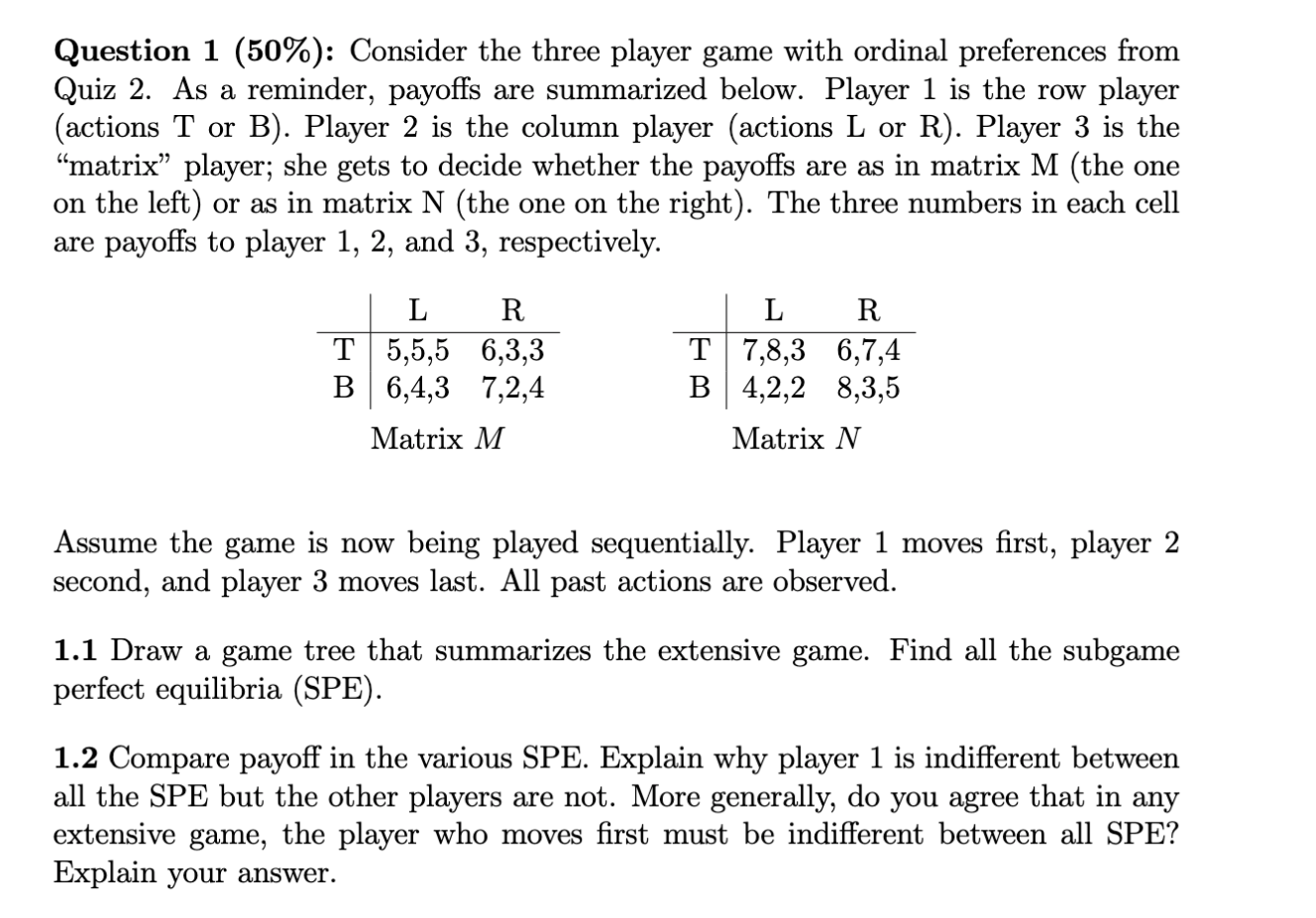
Question 1 (50%): Consider the three player game with ordinal preferences from Quiz 2. As a reminder, payoffs are summarized below. Player 1 is the row player (actions T or B). Player 2 is the column player (actions L or R). Player 3 is the \"matrix\" player; she gets to decide whether the payoffs are as in matrix M (the one on the left) or as in matrix N (the one on the right). The three numbers in each cell are payoffs to player 1, 2, and 3, respectively. T 5,5,5 6,3,3 T 7,8,3 6,7,4 B 6,4,3 7,2,4 B 4,2,2 8,3,5 Matrix M Matrix N Assume the game is now being played sequentially. Player 1 moves rst, player 2 second, and player 3 moves last. All past actions are observed. 1.1 Draw a game tree that summarizes the extensive game. Find all the subgame perfect equilibria (SPE). 1.2 Compare payoff in the various SPE. Explain why player 1 is indifferent between all the SPE but the other players are not. More generally, do you agree that in any extensive game, the player who moves rst must be indifferent between all SPE? Explain your
Step by Step Solution
There are 3 Steps involved in it

Get step-by-step solutions from verified subject matter experts
 Study Help