







Question: PLEASE SOLVE QUESTION 2 Alibaba Group: Rivals at the Gate? Jack Ma founded Alibaba in 1999 making it one of the most successful companies of
PLEASE SOLVE QUESTION 2
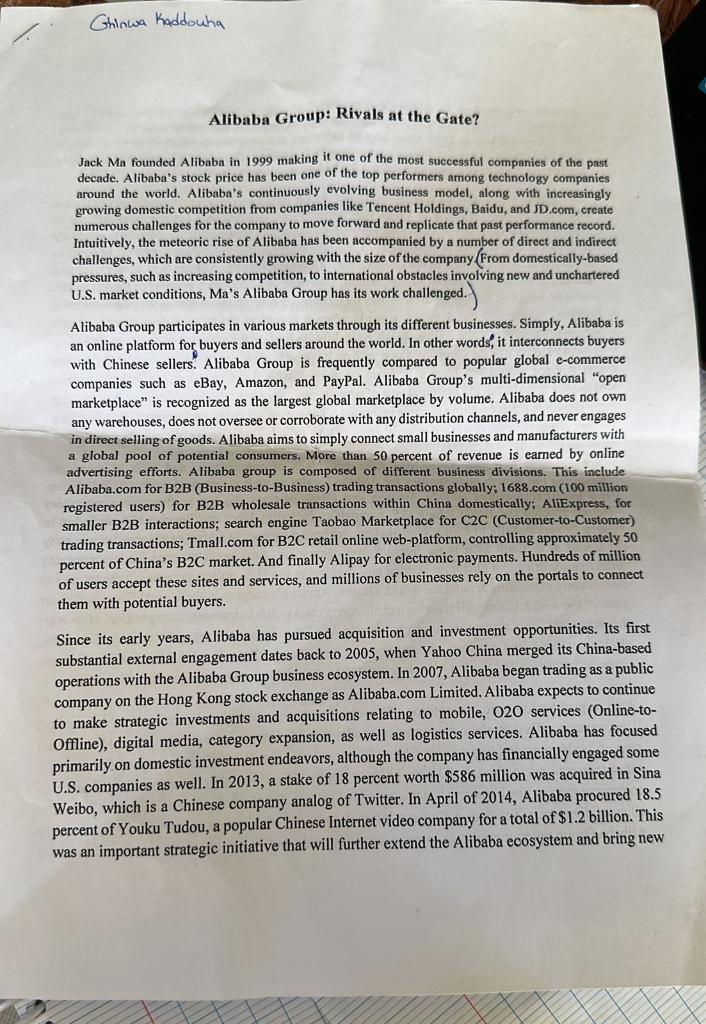
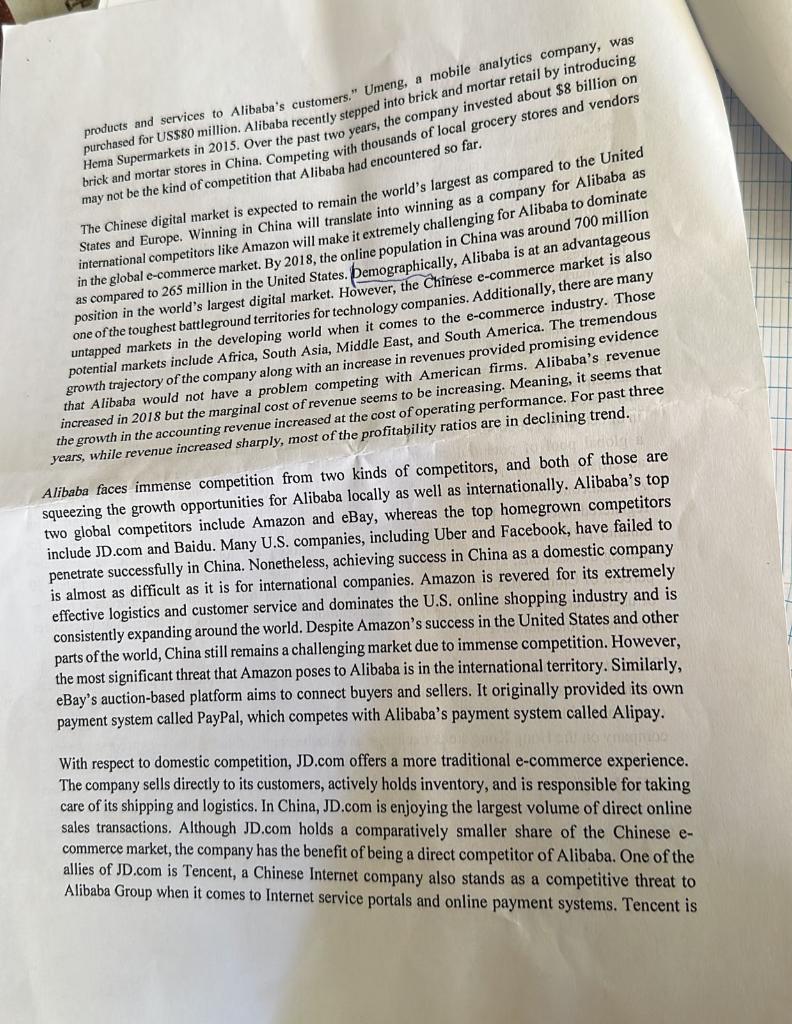
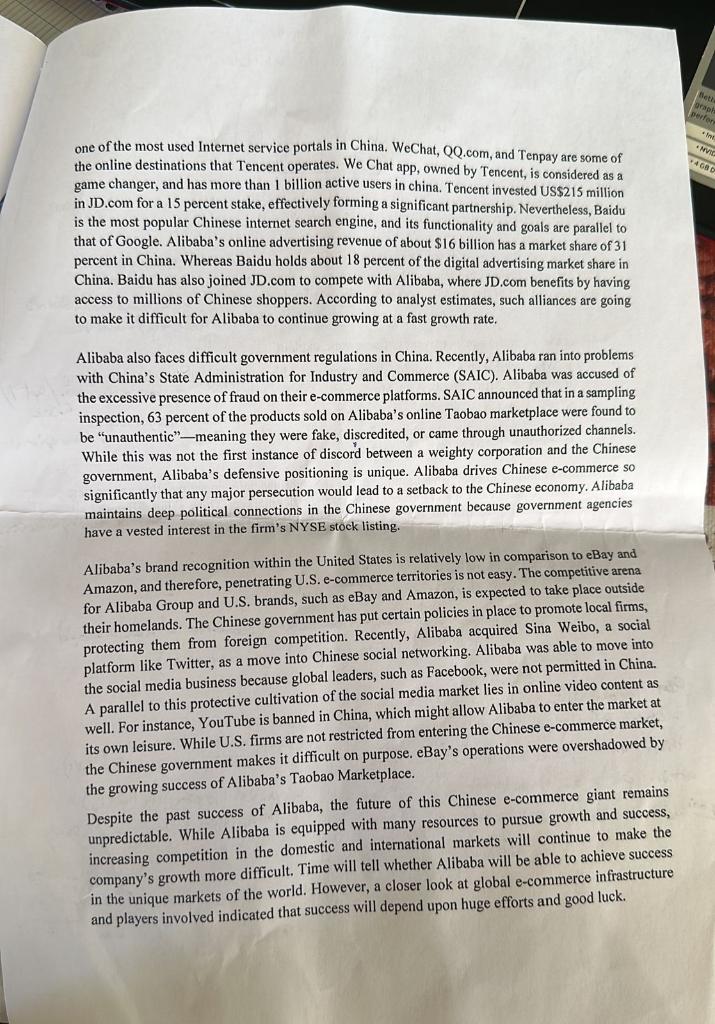
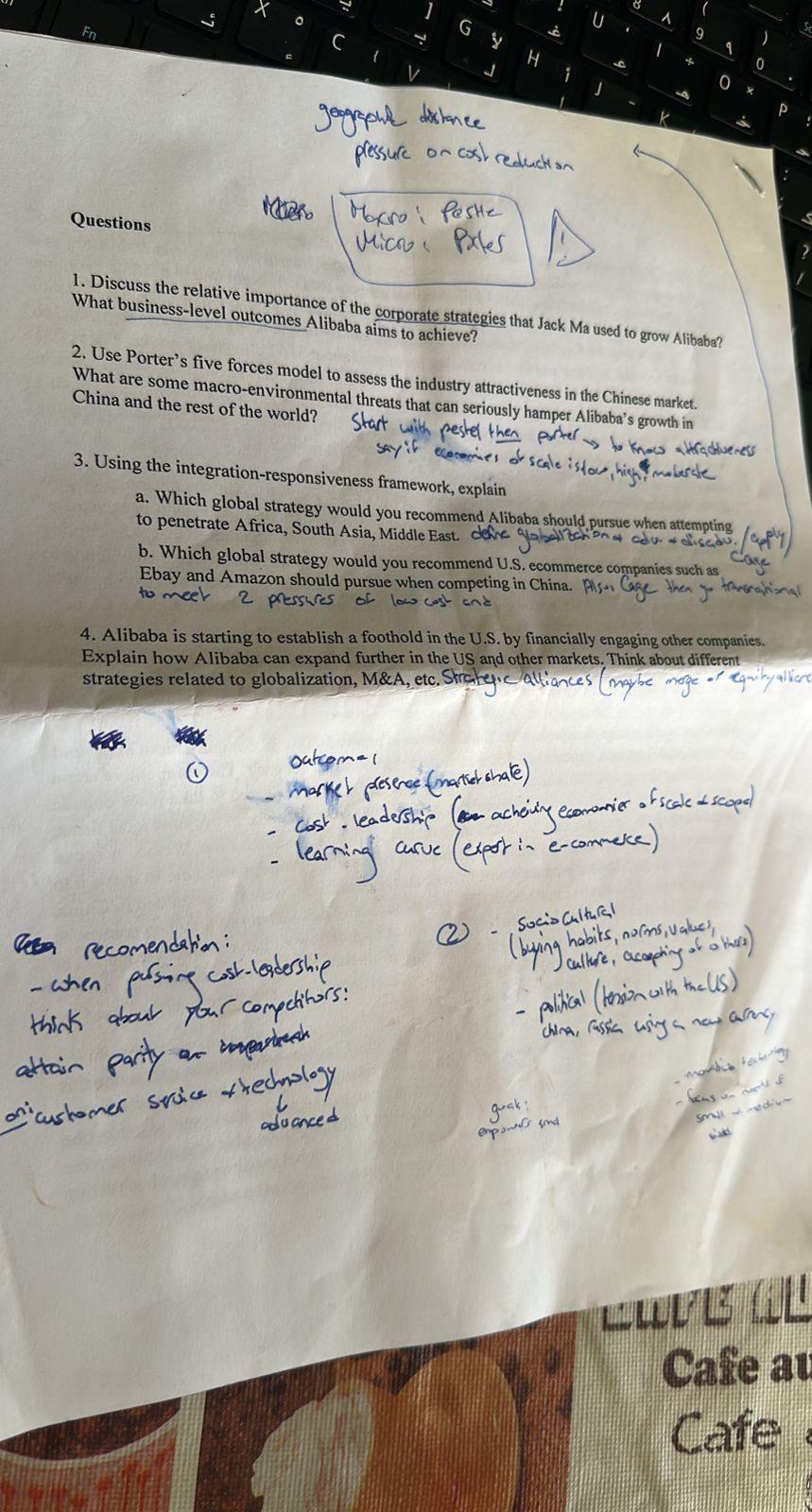
Alibaba Group: Rivals at the Gate? Jack Ma founded Alibaba in 1999 making it one of the most successful companies of the past decade. Alibaba's stock price has been one of the top performers among technology companies around the world. Alibaba's continuously evolving business model, along with increasingly growing domestic competition from companies like Tencent Holdings, Baidu, and JD.com, create numerous challenges for the company to move forward and replicate that past performance record. Intuitively, the meteoric rise of Alibaba has been accompanied by a number of direct and indirect challenges, which are consistently growing with the size of the company/From domestically-based pressures, such as increasing competition, to international obstacles involving new and unchartered U.S. market conditions, Ma's Alibaba Group has its work challenged. Alibaba Group participates in various markets through its different businesses. Simply, Alibaba is an online platform for buyers and sellers around the world. In other words, it interconnects buyers with Chinese sellers. Alibaba Group is frequently compared to popular global e-commerce companies such as eBay, Amazon, and PayPal. Alibaba Group's multi-dimensional "open marketplace" is recognized as the largest global marketplace by volume. Alibaba does not own any warehouses, does not oversee or corroborate with any distribution channels, and never engages in direct selling of goods. Alibaba aims to simply connect small businesses and manufacturers with a global pool of potential consumers. More than 50 percent of revenue is earned by online advertising efforts. Alibaba group is composed of different business divisions. This include Alibaba.com for B2B (Business-to-Business) trading transactions globally; 1688.com (100 million registered users) for B2B wholesale transactions within China domestically; AliExpress, for smaller B2B interactions; search engine Taobao Marketplace for C2C (Customer-to-Customer) trading transactions; Tmall.com for B2C retail online web-platform, controlling approximately 50 percent of China's B2C market. And finally Alipay for electronic payments. Hundreds of million of users accept these sites and services, and millions of businesses rely on the portals to connect them with potential buyers. Since its early years, Alibaba has pursued acquisition and investment opportunities. Its first substantial external engagement dates back to 2005 , when Yahoo China merged its China-based operations with the Alibaba Group business ecosystem. In 2007, Alibaba began trading as a public company on the Hong Kong stock exchange as Alibaba.com Limited. Alibaba expects to continue to make strategic investments and acquisitions relating to mobile, O2O services (Online-to Offline), digital media, category expansion, as well as logistics services. Alibaba has focuse primarily on domestic investment endeavors, although the company has financially engaged som U.S. companies as well. In 2013 , a stake of 18 percent worth $586 million was acquired in Sin Weibo, which is a Chinese company analog of Twitter. In April of 2014, Alibaba procured 18. percent of Youku Tudou, a popular Chinese Internet video company for a total of $1.2 billion. Th was an important strategic initiative that will further extend the Alibaba ecosystem and bring ne products and services to Alibaba's customers." Umeng, a mobile analytics company, was purchased for US $80 million. Alibaba recently stepped Hema Supermarkets in 2015. Over the past two years, ars, the company invested about $8 billion on international competitors like Amazon will make it extremely challenging hor Alion in China was around 700 million in the global e-commerce market. By 2018 , the online population in Chically, Alibaba is at an advanket is also as compared to 265 million in the United States. Demogre the Chinese e-commerce mark there are many position in the world's largest digital market. Howerer, companies. Additionally, there industry. Those one of the toughest battleground territories for techen it comes to the e-commerce industry-mend untapped markets in the developing world when it comes East, and South America. The treming evidence potential markets include Africa, South Asia, Midde growth trajectory of the company along with an incring with American firms. Alibaba's seems that that Alibaba would not have a problem compe seems to be increasing. Meaning, For past three increased in 2018 but the marginal cost of revent the cost of operating performand increased an trening trend. the growth in the accounting revenue increased at the cost of operatitability ratios are in declining the profit. - and both of those are Alibaba faces immense competition from two kinds of competitors, and both of thaba's top squeezing the growth opportunities for Alibaba locally as well as inters homegrown competitors two global competitors include Amazon and eBay, whereas the top hber and Facebook, have failed to include JD.com and Baidu. Many U.S. companies, including Uber and in China as a domestic company penetrate successfully in China. Nonetheless, achieving success in Chan is revered for its extremely is almost as difficult as it is for international companies. Amates the U.S. online shopping industry and is effective logistics and customer service and dominates the U.S. onliner consistently expanding around the world. Despite Amazon's success in the United States and other parts of the world, China still remains a challenging market due to immense competition. However, the most significant threat that Amazon poses to Alibaba is in the international territory. Similarly, eBay's auction-based platform aims to connect buyers and sellers. It originally provided its own payment system called PayPal, which competes with Alibaba's payment system called Alipay. With respect to domestic competition, JD.com offers a more traditional e-commerce experience. The company sells directly to its customers, actively holds inventory, and is responsible for taking care of its shipping and logistics. In China, JD.com is enjoying the largest volume of direct online sales transactions. Although JD.com holds a comparatively smaller share of the Chinese ecommerce market, the company has the benefit of being a direct competitor of Alibaba. One of the allies of JD.com is Tencent, a Chinese Internet company also stands as a competitive threat to Alibaba Group when it comes to Internet service portals and online payment systems. Tencent is one of the most used Internet service portals in China. WeChat, QQ.com, and Tenpay are some of the online destinations that Tencent operates. We Chat app, owned by Tencent, is considered as a game changer, and has more than 1 billion active users in china. Tencent invested US 215 million in JD.com for a 15 percent stake, effectively forming a significant partnership. Nevertheless, Baidu is the most popular Chinese internet search engine, and its functionality and goals are parallel to that of Google. Alibaba's online advertising revenue of about $16 billion has a market share of 31 percent in China. Whereas Baidu holds about 18 percent of the digital advertising market share in China. Baidu has also joined JD.com to compete with Alibaba, where JD.com benefits by having access to millions of Chinese shoppers. According to analyst estimates, such alliances are going to make it difficult for Alibaba to continue growing at a fast growth rate. Alibaba also faces difficult government regulations in China. Recently, Alibaba ran into problems with China's State Administration for Industry and Commerce (SAIC). Alibaba was accused of the excessive presence of fraud on their e-commerce platforms. SAIC announced that in a sampling inspection, 63 percent of the products sold on Alibaba's online Taobao marketplace were found to be "unauthentic"-meaning they were fake, discredited, or came through unauthorized channels. While this was not the first instance of discord between a weighty corporation and the Chinese government, Alibaba's defensive positioning is unique. Alibaba drives Chinese e-commerce so significantly that any major persecution would lead to a setback to the Chinese economy. Alibaba maintains deep political connections in the Chinese government because government agencies have a vested interest in the firm's NYSE stock listing. Alibaba's brand recognition within the United States is relatively low in comparison to eBay and Amazon, and therefore, penetrating U.S. e-commerce territories is not easy. The competitive arena for Alibaba Group and U.S. brands, such as eBay and Amazon, is expected to take place outside their homelands. The Chinese government has put certain policies in place to promote local firms, protecting them from foreign competition. Recently, Alibaba acquired Sina Weibo, a social platform like Twitter, as a move into Chinese social networking. Alibaba was able to move into the social media business because global leaders, such as Facebook, were not permitted in China. A parallel to this protective cultivation of the social media market lies in online video content as well. For instance, YouTube is banned in China, which might allow Alibaba to enter the market at its own leisure. While U.S. firms are not restricted from entering the Chinese e-commerce market, the Chinese government makes it difficult on purpose. eBay's operations were overshadowed by the growing success of Alibaba's Taobao Marketplace. Despite the past success of Alibaba, the future of this Chinese e-commerce giant remains unpredictable. While Alibaba is equipped with many resources to pursue growth and success, increasing competition in the domestic and international markets will continue to make the company's growth more difficult. Time will tell whether Alibaba will be able to achieve success in the unique markets of the world. However, a closer look at global e-commerce infrastructure and players involved indicated that success will depend upon huge efforts and good luck. 2. Use Porter's five forces model to assess the industry attractiveness in the Chinese market. What are some macro-environmental threats that can seriously hamper Alibaba's growth in China and the rest of the world? Start with pested then parter to know athedlueness say it eceacies of scale istoe, hight maberste 3. Using the integration-responsiveness framework, explain a. Which global strategy would you recommend Alibaba should pursue when attempting to penetrate Africa, South Asia, Middle East. dehre Gobholl zah pursue when attempting (adu discedu. (aply) b. Which global strategy would you recommend U.S. ecommerce companies such as Ebay and Amazon should pursue when competing in China. Also lage then 5 therrakional to meet 2 plessures of low cost ine 4. Alibaba is starting to establish a foothold in the U.S. by financially engaging other companies. Explain how Alibaba can expand further in the US and other markets. Think about different strategies related to globalization, M\&A, etc. Stratefic alfiances (maybe moge or eg-ithy alic (1) outeomal - market preseree. (marter ohate) - cost. leadership acheing ecomanier of scale + scopal - learning curve (export in e-commere) Recomendation: - when pursine cost-egdership think about pour competitors: atrain parity ar wepaddeck onicustromer sroice thechology aduanced (2) - socis cuttrial (buying habits, noems, values, -cullue, acopbing ob o twis) - Palital (tensisn uith the US) china, cassia wiry a nem airry
Step by Step Solution
There are 3 Steps involved in it

Get step-by-step solutions from verified subject matter experts
 Study Help