







Question: Please solve question 48 and 49. Do not use Laplace form 392 7. COMPARTMENTAL MODELING FIGURE 7.15 A general two-compartment model. Compartment 1 has volume
Please solve question 48 and 49. Do not use Laplace form
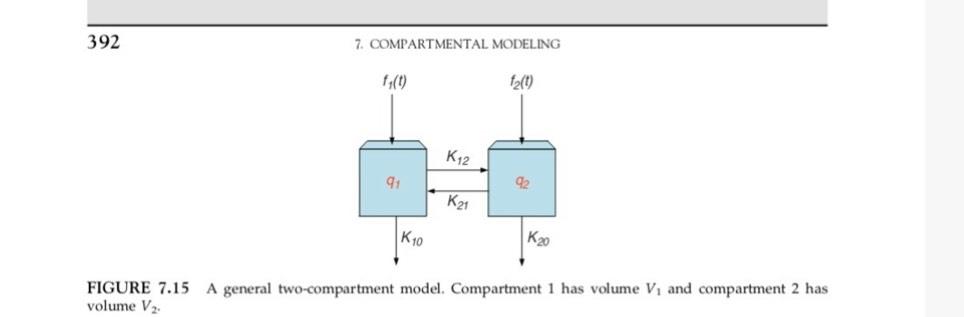
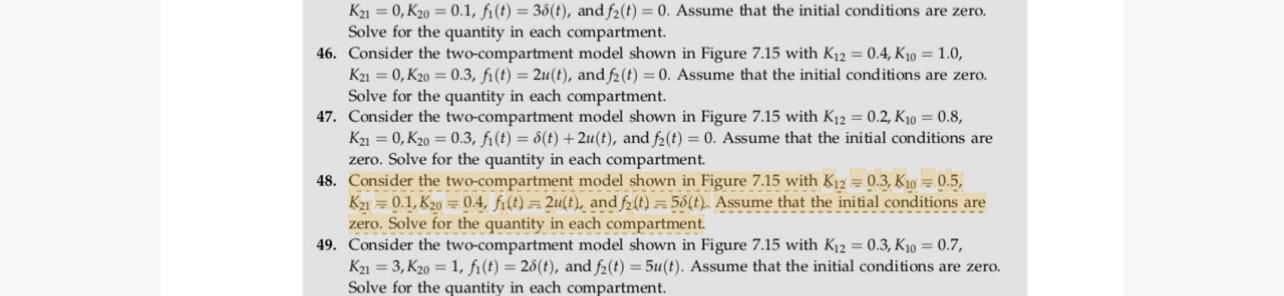
392 7. COMPARTMENTAL MODELING FIGURE 7.15 A general two-compartment model. Compartment 1 has volume V1 and compartment 2 has volume V2. K21=0,K20=0.1,f1(t)=3(t), and f2(t)=0. Assume that the initial conditions are zero. Solve for the quantity in each compartment. 46. Consider the two-compartment model shown in Figure 7.15 with K12=0.4,K10=1.0, K21=0,K20=0.3,f1(t)=2u(t), and f2(t)=0. Assume that the initial conditions are zero. Solve for the quantity in each compartment. 47. Consider the two-compartment model shown in Figure 7.15 with K12=0.2,K10=0.8, K21=0,K20=0.3,f1(t)=(t)+2u(t), and f2(t)=0. Assume that the initial conditions are zero. Solve for the quantity in each compartment. 48. Consider the two-compartment model shown in Figure 7.15 with K12=0.3,K10=0.5, K21=0.1,K20=0.4,f1(t)=2u(t) and f2(t)=5(t). Assume that the initial conditions are zero. Solve for the quantity in each compartment. 49. Consider the two-compartment model shown in Figure 7.15 with K12=0.3,K10=0.7, K21=3,K20=1,f1(t)=2(t), and f2(t)=5u(t). Assume that the initial conditions are zero. Solve for the quantity in each compartment. 392 7. COMPARTMENTAL MODELING FIGURE 7.15 A general two-compartment model. Compartment 1 has volume V1 and compartment 2 has volume V2. K21=0,K20=0.1,f1(t)=3(t), and f2(t)=0. Assume that the initial conditions are zero. Solve for the quantity in each compartment. 46. Consider the two-compartment model shown in Figure 7.15 with K12=0.4,K10=1.0, K21=0,K20=0.3,f1(t)=2u(t), and f2(t)=0. Assume that the initial conditions are zero. Solve for the quantity in each compartment. 47. Consider the two-compartment model shown in Figure 7.15 with K12=0.2,K10=0.8, K21=0,K20=0.3,f1(t)=(t)+2u(t), and f2(t)=0. Assume that the initial conditions are zero. Solve for the quantity in each compartment. 48. Consider the two-compartment model shown in Figure 7.15 with K12=0.3,K10=0.5, K21=0.1,K20=0.4,f1(t)=2u(t) and f2(t)=5(t). Assume that the initial conditions are zero. Solve for the quantity in each compartment. 49. Consider the two-compartment model shown in Figure 7.15 with K12=0.3,K10=0.7, K21=3,K20=1,f1(t)=2(t), and f2(t)=5u(t). Assume that the initial conditions are zero. Solve for the quantity in each compartment
Step by Step Solution
There are 3 Steps involved in it

Get step-by-step solutions from verified subject matter experts
 Study Help